Ibuprofen overdose: symptoms, daily limits and is 600 mg too much?
600 mg of ibuprofen is a standard prescription dose, but over-the-counter limits are lower. See overdose symptoms, what to do, risky combinations and limits in five countries.
Yes, you can overdose on ibuprofen (Advil, Motrin, Nurofen), but a single 600 mg dose is a standard prescription dose for adults when a prescriber directs it. Without a prescription, the US label limit is 1,200 mg in 24 hours. Most overdoses cause mild stomach symptoms, but large ones can cause seizures and kidney harm, so call Poison Help at 1-800-222-1222 if you are unsure.
At a glance
- The US Advil label says adults and children 12 and over should not take more than 6 tablets (1,200 mg) in 24 hours unless a doctor directs.
- Prescription ibuprofen labels list 400, 600 and 800 mg tablets and say not to exceed 3,200 mg a day, for use only as prescribed.
- StatPearls says most people have no or mild symptoms after an ibuprofen overdose, and that it is rarely fatal, although deaths have been reported.
- Our count found 1,483 listings containing ibuprofen in the FDA’s National Drug Code Directory (data updated October 2, 2026), and every finished 400, 600 and 800 mg listing is prescription-only.
- About 1 in 7 finished ibuprofen listings (193 of 1,337) also contain another active ingredient, most often acetaminophen or the sleep aid diphenhydramine.
- In Canada, ibuprofen up to 400 mg per tablet can be sold without a prescription, with a label limit of 1,200 mg a day.
Can you overdose on ibuprofen 600 mg?
A single 600 mg dose is not an overdose when a prescriber has told you to take it. The US prescription ibuprofen label lists 400 mg, 600 mg or 800 mg three or four times a day for arthritis, and says “Do not exceed 3200 mg total daily dose.” It also tells prescribers to use “the lowest effective dose for the shortest duration.”
Over-the-counter ibuprofen is different. The US Advil Drug Facts label says to take 1 tablet (200 mg) every 4 to 6 hours while symptoms persist, and “do not exceed 6 tablets in 24 hours, unless directed by a doctor.” That is a 1,200 mg daily limit. So taking 600 mg (three 200 mg tablets) at once on your own is more than the over-the-counter label directs.
Two common mistakes push people over the limit:
- Adding store-bought ibuprofen to a prescription. If you already take 600 or 800 mg tablets, don’t add Advil or Motrin on top unless your prescriber says so.
- Taking two products that both contain ibuprofen, such as a pain reliever plus a nighttime or cold and flu product.
If you have taken more than the label allows and are worried, call Poison Help. A specialist will tell you whether you need to be seen.
What are the symptoms of an ibuprofen overdose?
StatPearls says “most patients report no or mild symptoms following ibuprofen overdose.” Stomach upset is the most common problem. In one study, about 30% of people had drowsiness or other signs of a slowed nervous system, though these were generally mild.
MedlinePlus lists these possible symptoms:
- nausea, vomiting, heartburn, diarrhea and stomach pain (possible bleeding in the stomach and intestines)
- ringing in the ears, blurred vision, severe headache, unsteadiness or confusion
- rash, sweating, chills, and little or no urine
- low blood pressure, slow or difficult breathing, seizures or coma in severe cases
StatPearls says a build-up of acid in the blood (metabolic acidosis) is the most common abnormal test result after a large overdose, and that seizures and pauses in breathing have been reported in children.
What should you do if someone took too much ibuprofen?
- Call 911 (or your local emergency number) if the person has a seizure, is hard to wake, or is struggling to breathe.
- Otherwise, call Poison Help at 1-800-222-1222. MedlinePlus says it is free, confidential and open 24 hours a day, and the call “does NOT need to be an emergency.”
- Have the facts ready if you can: the person’s age, weight and condition, the product name and strength, the time it was swallowed, how much was taken, and whether it was prescribed for them. Don’t delay the call to find them.
- Check for acetaminophen. If the product was a combination such as Advil Dual Action or Combiflam, the acetaminophen (paracetamol) in it can harm the liver without early symptoms. Get help even if the person seems fine. Our guide to acetaminophen overdose explains why.
- If the person is unconscious but breathing, lay them on their side in the recovery position while you wait for help.
Don’t try to make the person vomit; home remedies don’t treat an overdose. If you’re not sure what the pills are, our pill imprint search can identify them from the letters and numbers stamped on each one. Our guide to the signs of an overdose covers what to watch for with any medicine.
What happens at the hospital?
StatPearls says treatment is “primarily supportive,” meaning doctors watch the person closely and treat each problem as it appears. According to MedlinePlus, care may include checking heart rate, breathing and blood pressure, activated charcoal, help with breathing, fluids through a vein, a heart tracing (ECG) and, in rare serious cases, kidney dialysis. StatPearls says charcoal is used after a significant overdose within the past 2 hours.
The outlook is usually good. MedlinePlus says “recovery is likely with prompt medical treatment, except in very large overdoses,” and that some people may develop lasting liver or kidney injury. StatPearls adds that kidney problems are typically reversible with supportive care and fluids.
Is taking too much ibuprofen over time dangerous?
Yes. Taking more than directed, or for longer, raises the chance of stomach bleeding, and the US Advil label also warns about heart and kidney risks.
Stomach bleeding
The label says ibuprofen “may cause severe stomach bleeding,” and the chance is higher if you:
- are 60 or older;
- have had stomach ulcers or bleeding problems;
- take a blood thinner or a steroid;
- take other NSAIDs, such as aspirin or naproxen;
- have 3 or more alcoholic drinks every day while using it;
- take more or for a longer time than directed.
The FDA lists the signs of stomach bleeding as feeling faint, vomiting blood, or bloody or black stools. Get medical help right away if they appear.
Heart attack and stroke
The label states: “NSAIDs, except aspirin, increase the risk of heart attack, heart failure, and stroke. These can be fatal.” Prescription ibuprofen labels carry a boxed warning about the same risk.
Kidney problems
Ibuprofen can reduce blood flow to the kidneys, especially in people who are dehydrated or have kidney disease, StatPearls explains. The Advil label tells people with kidney disease, or who take a diuretic (water pill), to ask a doctor first.
Doubling up: other NSAIDs and combination products
Ibuprofen belongs to a group of medicines called NSAIDs, along with aspirin and naproxen. The Advil label says taking it with other NSAIDs raises the chance of severe stomach bleeding. Our guide to aspirin overdose covers aspirin’s own dangers.
Ibuprofen also hides in combination products. Read the active ingredients on every pack:
- Advil PM: ibuprofen 200 mg plus diphenhydramine citrate 38 mg, a sedating antihistamine. Its label says not to take more than 2 caplets in 24 hours or use it with any other diphenhydramine product, “even one used on skin.” See our guide to Benadryl (diphenhydramine) overdose.
- Advil Dual Action with Acetaminophen: ibuprofen 125 mg plus acetaminophen 250 mg per caplet, with a label limit of 6 caplets in 24 hours unless a doctor directs. Don’t take it with any other acetaminophen product.
- Combiflam (India): ibuprofen 400 mg plus paracetamol 325 mg per tablet. Sanofi’s prescribing information says no more than 3 tablets should be taken in any 24-hour period.
- Prescription combinations: ibuprofen with famotidine (a stomach acid reducer), and ibuprofen with hydrocodone, an opioid. Hydrocodone brings its own risks, covered in our guide to opioid overdose.
Our analysis: ibuprofen in the FDA drug directory
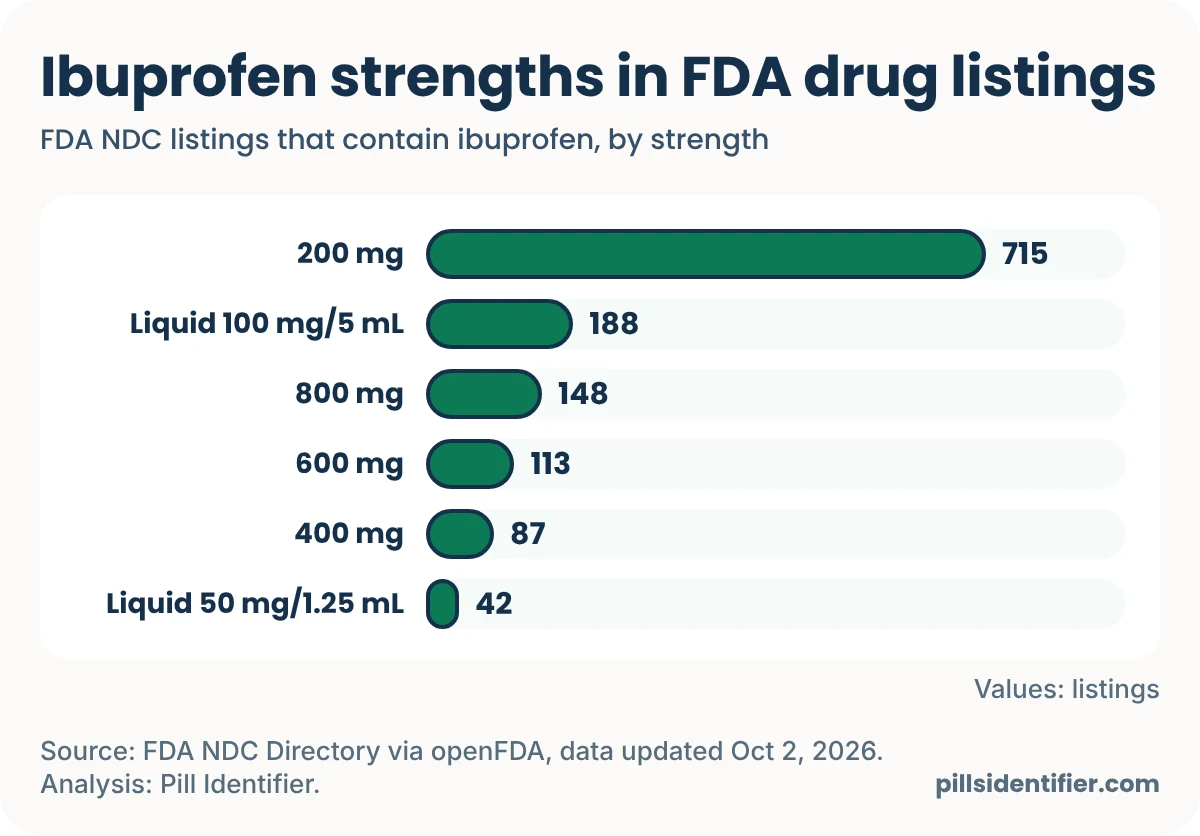
We searched the FDA’s National Drug Code (NDC) Directory through openFDA (data updated October 2, 2026) for every listing that names ibuprofen as an active ingredient, then counted them by strength, by prescription or over-the-counter status, and by other ingredients.
We found 1,483 listings. Of the 1,337 finished human medicines, 985 (73.7%) are over the counter and 352 are prescription. The rest are bulk ingredients or products made for further processing. These are listings in the federal directory, not products on store shelves, and many are the same medicine sold under store brands or by repackagers.
| Strength | All listings | Over the counter | Prescription |
|---|---|---|---|
| 200 mg per unit | 715 | 642 | 5 |
| 400 mg per unit | 87 | 0 | 77 |
| 600 mg per unit | 113 | 0 | 106 |
| 800 mg per unit | 148 | 0 | 141 |
| 100 mg per 5 mL liquid | 188 | 174 | 10 |
| 50 mg per 1.25 mL liquid | 42 | 42 | 0 |
All 324 finished listings at 400, 600 or 800 mg are prescription-only, while 642 of 647 finished 200 mg listings (99.2%) are over the counter. In the US, the strength on the pack is a quick clue to whether a product was meant to be used under a prescriber’s care.
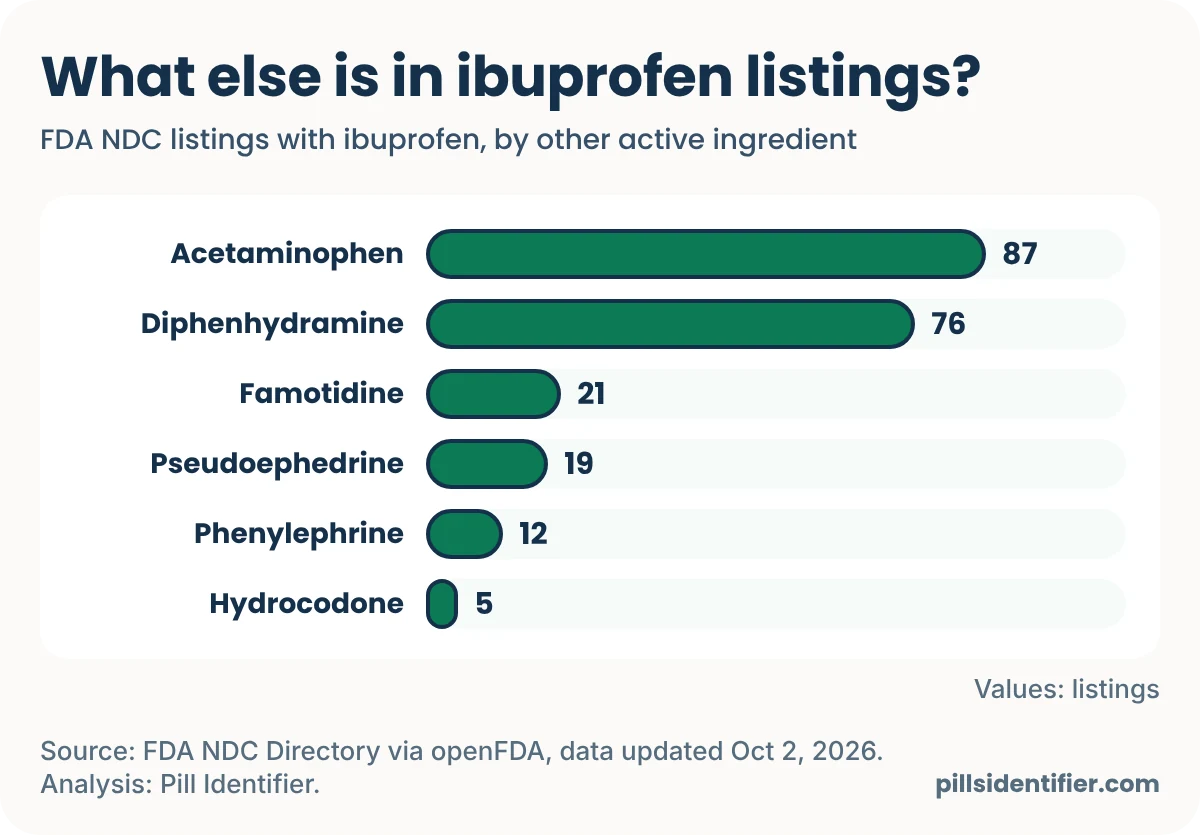
We also counted the other active ingredients. In all, 220 of the 1,483 listings (14.8%) are combination products. Among finished medicines, the figure is 193 of 1,337 (14.4%), or about 1 in 7.
| Other ingredient | What it is | Listings | Status |
|---|---|---|---|
| Acetaminophen | Pain reliever | 87 | 74 over the counter, 7 prescription |
| Diphenhydramine | Sedating antihistamine (“PM” products) | 76 | 63 over the counter |
| Famotidine | Stomach acid reducer | 21 | All prescription |
| Pseudoephedrine | Decongestant | 19 | 14 over the counter |
| Phenylephrine | Decongestant | 12 | 9 over the counter |
| Hydrocodone | Prescription opioid | 5 | All prescription |
Eight listings also contain the antihistamine chlorpheniramine, but all eight include a decongestant, so they are already counted above. Listings not marked over the counter or prescription are bulk or further-processing listings.
Ibuprofen in our five countries
Ibuprofen is sold everywhere our readers live, but strengths, sales rules and label limits differ. Checked October 2026.
| Country | Example brands | Sold without a prescription | Non-prescription label limit | Other rules |
|---|---|---|---|---|
| United States | Advil | 200 mg tablets and capsules; children’s liquids | 6 tablets (1,200 mg) in 24 hours unless a doctor directs | 400, 600 and 800 mg tablets need a prescription; label maximum 3,200 mg a day as prescribed |
| Puerto Rico | Same as the US mainland | Same as the US mainland | Same FDA labels | Follows FDA rules; no local rule found |
| Canada | Advil, Motrin | Up to 400 mg per tablet; modified-release up to 600 mg | 1,200 mg in 24 hours unless a doctor directs (Motrin product monograph) | Higher strengths are on Health Canada’s Prescription Drug List |
| Australia | Nurofen | 200 mg packs of up to 24 in general sale; larger packs in pharmacies | No national figure found; follow the pack | 400 mg (Nurofen Double Strength) is Pharmacy Medicine in small packs and Pharmacist Only in packs of 20 or more |
| India | Combiflam (ibuprofen plus paracetamol) | No national over-the-counter list found | Combiflam: 3 tablets in 24 hours | Ibuprofen 200 mg and 400 mg tablets and 100 mg per 5 mL liquid are on the National List of Essential Medicines 2022 |
Canada’s rule comes from a 2016 Health Canada notice. In Australia, the schedule listed on healthdirect depends on both strength and pack size.
Giving ibuprofen to children
Children’s ibuprofen liquids come in different strengths, so a dose of one is not the same as a dose of another. The Children’s Advil label (100 mg per 5 mL) says to:
- find the right dose on the chart, based on the child’s weight or age;
- “measure only with the dosing cup provided”;
- not use it more than 4 times a day;
- ask a doctor before giving it to a child under 2.
Don’t use a kitchen spoon or another product’s cup, never give adult tablets to a young child, and store all medicines up high and out of sight.
Is it really ibuprofen? Check the pill
Many pain pills look alike. If you find a loose tablet or aren’t sure what someone took, enter its imprint in our pill imprint search, use our NDC and DIN lookup with the number on the box, or see pictures of ibuprofen pills. Pills sold outside pharmacies can copy real imprints exactly, so a matching imprint does not prove a pill is genuine. Our guide on how to spot fake pills explains the warning signs.
Common questions
Is 800 mg of ibuprofen too much?
800 mg is the highest strength on the US prescription ibuprofen tablet label, and it is a normal dose when a prescriber directs it. Without a prescription, the US over-the-counter limit is 1,200 mg in 24 hours, taken as 200 mg tablets. Don’t take 800 mg tablets that were prescribed for someone else.
What happens if you take too much ibuprofen by accident?
Most people have no symptoms or a mild upset stomach, according to StatPearls. Call Poison Help at 1-800-222-1222 to check whether you need care, and get help right away if the product also contained acetaminophen. Taking extra doses regularly over days or weeks raises the risk of stomach bleeding and kidney problems.
Can you take ibuprofen and acetaminophen together?
They are different medicines, and some products, such as Advil Dual Action and Combiflam, combine them. The danger is doubling up: Advil Dual Action’s label says not to use it with any other acetaminophen product. Ask a pharmacist before combining pain relievers, and keep each one within its own label limit.
Can ibuprofen damage your kidneys?
Yes, it can. Large overdoses can cause sudden kidney problems, which StatPearls says are typically reversible with fluids and supportive care. Regular use can also reduce blood flow to the kidneys, especially if you are dehydrated or already have kidney disease.
Can you die from an ibuprofen overdose?
It is rare, but deaths have been reported, according to StatPearls. Large overdoses can cause seizures, coma, breathing problems and kidney injury, and they are not gentle or harmless. If you are thinking about harming yourself, please call or text a crisis line now; the numbers are in the box below.