Melatonin overdose: can you take too much, including gummies?
Too much melatonin is rarely dangerous for adults, but child poisonings rose 530% in a decade. Symptoms, what to do, mislabeled gummies and the rules in five countries.
Yes, you can take too much melatonin, including gummies, but for healthy adults it is rarely dangerous. Too much can cause headaches, dizziness, nausea, next-day grogginess or strange dreams. Young children are the main worry: US poison centers logged 52,563 child melatonin ingestions in 2021, and some children needed intensive care. If a child eats gummies, call Poison Control right away.
At a glance
- In the US, melatonin is sold as a dietary supplement, and the FDA does not approve supplements before sale or limit how much melatonin a serving can contain.
- US poison centers received 260,435 reports of children and teens swallowing melatonin from 2012 to 2021, and yearly reports rose 530% over that time (CDC, 2022).
- Gummies were the most common form in about 11,000 emergency visits by children 5 and under who got into melatonin from 2019 to 2022 (CDC, 2024).
- A 2023 study in JAMA found 22 of 25 melatonin gummy products were mislabeled, holding 74% to 347% of the melatonin stated on the label.
- As of October 2026, Canada requires a prescription for melatonin sold for sleep in anyone under 18, and Australia treats most melatonin as a prescription medicine.
What happens if you take too much melatonin?
For most adults, too much melatonin is unpleasant rather than dangerous. The National Center for Complementary and Integrative Health (NCCIH) lists headache, dizziness, nausea and sleepiness as the main side effects in adults.
Other effects that official sources report include:
- sleepiness that carries into the next day, which StatPearls calls daytime sedation;
- agitation, according to Poison Control;
- abnormal dreams, aggression and tiredness, which Health Canada noted from reports in other countries;
- in children: drowsiness, bedwetting or needing to pee more in the evening, headache, dizziness and agitation (NCCIH);
- rarely, a type of swelling under the skin called angioedema (StatPearls).
StatPearls warns that taking melatonin with benzodiazepines, zolpidem or eszopiclone may cause too much sedation.
When is too much melatonin an emergency?
Call 911 or your local emergency number right away if the person collapses, has a seizure, has trouble breathing or can’t be woken up. That is Poison Control’s advice for any poisoning. For everything else, call Poison Control, especially if melatonin was mixed with alcohol or other medicines. Our guide to the signs of an overdose explains what to watch for, and what an overdose is covers what happens in the body.
Can you overdose on melatonin gummies?
Yes. Gummies contain the same hormone as tablets, and the amount on the label may not match what’s inside. When researchers tested 25 gummy brands sold in the US for a 2023 study in JAMA, only 3 contained within 10% of the stated amount. Across the products, the real melatonin content ranged from 74% to 347% of the label. Five of the gummies also listed CBD (cannabidiol) as an ingredient. Read more in our guide can you overdose on CBD oil.
In a safety advisory first issued in September 2025 and updated in January 2026, Australia’s Therapeutic Goods Administration (TGA) reported lab tests of imported, unregistered melatonin products. Some held up to 417% of the labeled amount, and one brand had no melatonin at all.
Gummies are also the form young children get into most. In CDC’s 2024 report, gummies were the most commonly recorded form (47.3%) in emergency visits for unsupervised melatonin ingestion by children 5 and under.
Why are children most at risk from melatonin?
A CDC report published in June 2022 looked at every pediatric melatonin ingestion reported to US poison centers over 10 years.
| Measure | Figure |
|---|---|
| Total reports, 2012 to 2021 | 260,435 |
| Reports in 2012 | 8,337 |
| Reports in 2021 | 52,563 (a 530% rise) |
| Share of all child ingestion reports | 0.6% in 2012, 4.9% in 2021 |
| Children aged 5 or younger | 83.8% |
| Unintentional | 94.3% |
| No symptoms | 84.4% |
| Admitted to hospital | 4,097 |
| Needed intensive care | 287 |
Some cases were serious. Five children needed a machine to help them breathe, and two children under age 2 died at home. The CDC authors wrote that child-resistant packaging for melatonin “should be considered.”
A second CDC report in March 2024 estimated about 11,000 emergency department visits from 2019 to 2022 by children 5 and under who got into melatonin on their own. That was 7.1% of all emergency visits for unsupervised medicine exposures in that age group. In at least 32.8% of cases, the child got the melatonin from a bottle.
Canada has seen the same trend. Health Canada reported that accidental melatonin ingestions reported to Canadian poison centres increased from January 2016 to April 2022, mostly in children 5 and under and mostly involving gummies. Most had minor or no reactions, and no deaths were reported.
What should you do if a child eats melatonin gummies?
- Call 911 first if the child collapses, has a seizure, has trouble breathing or can’t be woken up.
- Otherwise, call Poison Control. In the US and Puerto Rico, call 1-800-222-1222. It’s free, confidential and open 24 hours a day. The help box above lists numbers for Canada, Australia and India.
- Keep the bottle with you. The label tells the expert the product, the strength and whether it has other ingredients, such as CBD.
- Don’t make the child throw up, and don’t wait for symptoms. MedlinePlus, from the US National Library of Medicine, advises against both.
- Follow the expert’s advice on whether your child can be watched at home.
What happens at the hospital?
Care depends on the symptoms, and most children who are checked go home. In CDC’s 10-year data, 27,795 children were treated at a health care facility. Of those, 71.6% were sent home, 14.7% were admitted and 1.0% needed intensive care.
How much melatonin is too much?
There is no official maximum dose for melatonin in the US. The FDA says there are no laws or regulations that limit the serving size of a dietary supplement or the amount of an ingredient in a serving. The maker decides. Our guide can you overdose on vitamins compares official upper limits for other supplements.
Some limits do exist:
- Canada: Health Canada’s rules let licensed adult melatonin products recommend no more than 10 mg a day.
- US industry guideline: the Council for Responsible Nutrition (CRN), a supplement trade group, adopted voluntary guidelines in March 2024. Members should keep a daily serving at 10 mg or less, label adult products for adult use only, and sell flavored chewables in child-deterrent packaging.
- Australia: the only melatonin sold without a prescription is slow-release tablets of 2 mg or less for adults 55 and older.
Follow the label, and ask a doctor or pharmacist before giving melatonin to a child. NCCIH notes that melatonin appears safe for most people in the short term, but there isn’t enough information on long-term safety.
Who should be careful with melatonin?
- People with epilepsy or taking blood thinners should use melatonin only with medical supervision, according to NCCIH. The TGA warns melatonin may increase seizure frequency in children with seizure disorders.
- People taking sedating medicines such as benzodiazepines or sleeping pills, because of the risk of too much sedation.
- People taking fluvoxamine, an antidepressant that StatPearls says calls for caution with melatonin.
- Anyone drinking alcohol. Health Canada and CRN labels both say to avoid alcohol with melatonin.
- Pregnant or breastfeeding people. NCCIH says research is lacking, and Health Canada’s labels say not to use it.
- People with autoimmune conditions or a transplant, who should use caution, according to StatPearls.
- Drivers. Health Canada’s labels say not to drive or use machinery for 5 hours after taking melatonin.
If you also use an over-the-counter sleep aid, check what’s in it. Many contain diphenhydramine, which carries its own risks. See our guide to Benadryl (diphenhydramine) overdose.
Melatonin rules in our five countries
The same gummy that sits on a US store shelf can be a prescription medicine in Australia, or in Canada when it’s sold for children’s sleep. Method: we read the current rules from the FDA, Health Canada, Australia’s TGA and healthdirect, and India’s FSSAI and CDSCO in October 2026, and where we found no national rule, we say so.
| Country | How it’s sold | Prescription needed? | Label limits | Children’s products | Official source |
|---|---|---|---|---|---|
| United States | Dietary supplement; not FDA approved before sale | No | No legal limit; maker sets serving (CRN voluntary guideline: 10 mg a day or less) | Sold as supplements; child-resistant packaging not required | FDA, CDC |
| Puerto Rico | Same federal rules as the US; no local rule found | No | Same as US | Same as US | FDA |
| Canada | Natural health product with an NPN, for adults only | Yes, for sleep use under 18 (since June 2, 2026) | Licensed adult products: up to 10 mg a day | Prescription only; one authorized drug (Slenyto) | Health Canada |
| Australia | Prescription medicine (Schedule 4); pharmacist-only slow-release tablets for adults 55+ (Schedule 3) | Yes, except that pharmacy product | Non-prescription product: 2 mg or less, packs of 30 or fewer | Prescription only (Slenyto); not for children under 2 | TGA, healthdirect |
| India | Pharmacies list some melatonin tablets as prescription medicines and others as supplements | No national rule found | No national rule found | No national rule found | FSSAI and CDSCO checked; no melatonin rule found |
Canada’s rule changed on June 2, 2026. Before that, only melatonin for insomnia in children with autism spectrum disorder or Smith-Magenis syndrome needed a prescription. Now any melatonin sold for sleep in children and teens under 18 does, and all licensed natural health products with melatonin are for adults only.
In Australia, the TGA says to look for an AUST R or AUST L number on the pack, stop using unregistered melatonin and take it to a pharmacy for disposal.
How do you keep melatonin away from children?
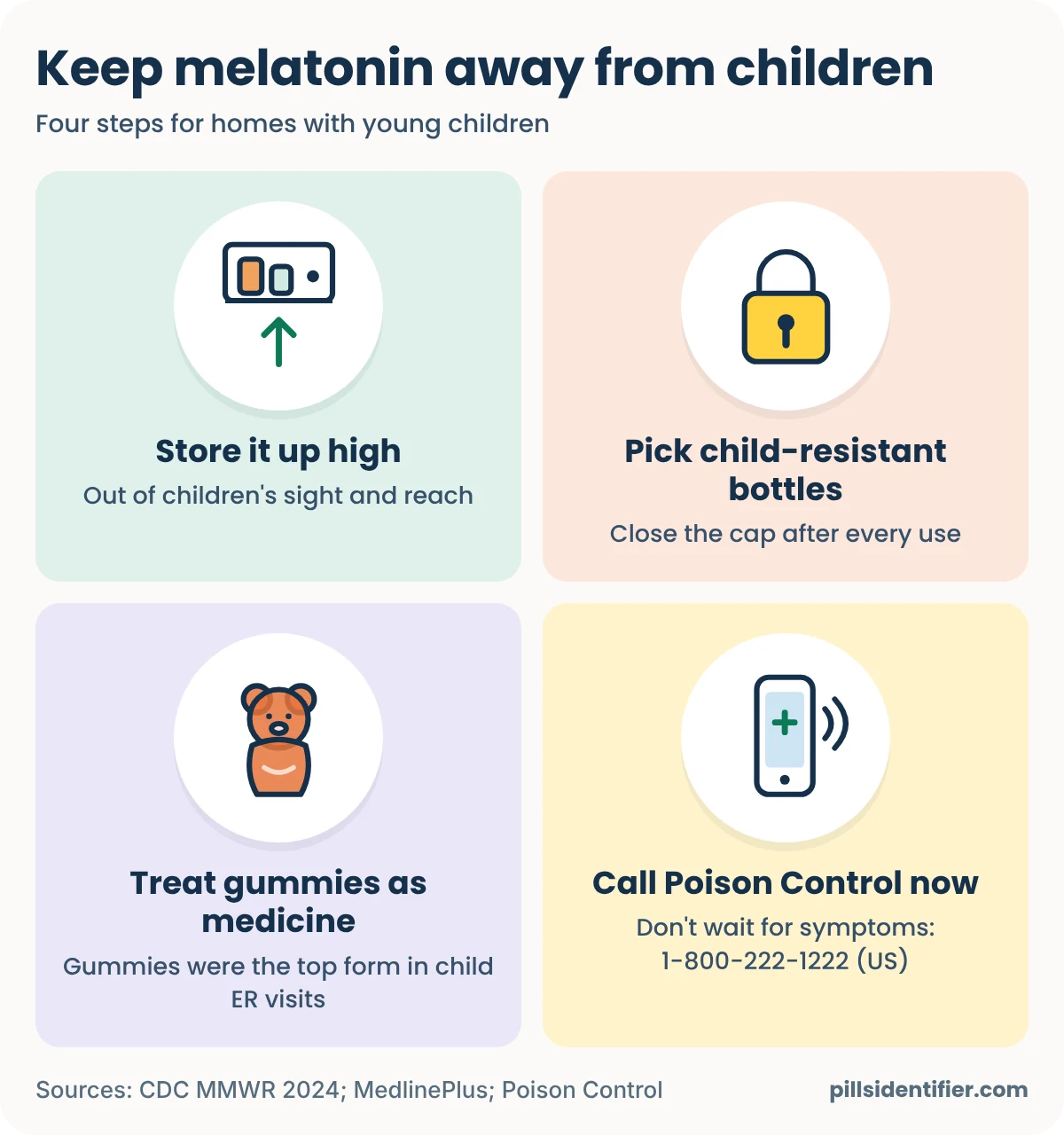
CDC advises keeping all medicines and supplements, including gummies, out of children’s reach and sight. US melatonin products don’t have to come in child-resistant packaging, though makers can choose it, so CDC says picking a child-resistant bottle may be wise.
- Store melatonin up high, out of children’s reach and sight.
- Choose child-resistant bottles and close them after every use.
- Treat gummies as medicine, not as a treat.
- Get rid of melatonin you no longer need. Our guide on how to dispose of unused medicines explains the options.
Found a loose tablet and not sure it’s melatonin? Check it with our pill imprint search, or read our guide to pills with no imprint if it has no markings. A product can look right and still be wrong inside, as the TGA tests showed. Our guide on how to spot fake pills explains the warning signs.
Common questions
Can you overdose on melatonin gummies?
Yes. Too many gummies can cause sleepiness, headache, nausea and dizziness, and a 2023 JAMA study found 22 of 25 gummy products were mislabeled. If a child eats gummies, call Poison Control at 1-800-222-1222 in the US.
Can you die from a melatonin overdose?
Serious harm is uncommon, but it does happen. CDC’s 2022 report counted five children who needed a machine to help them breathe and two young children who died over 10 years of US poison center reports. If you are struggling or thinking about suicide, the crisis lines in the help box above are free and open now.
Is 10 mg of melatonin too much?
There is no official US limit, but 10 mg a day is the most Health Canada allows on licensed adult products and the most the CRN industry guideline allows per daily serving. In Australia, the non-prescription product is 2 mg or less. Ask a doctor or pharmacist what amount suits you, and don’t give adult products to children.
What happens if a child eats one melatonin gummy?
Many children have no symptoms: 84.4% of the child ingestions in CDC’s 10-year study had none. Some become sleepy, dizzy or agitated. Call Poison Control even if your child seems fine, because only an expert can judge the product, the amount and your child’s size.
Is it safe to take melatonin every night?
NCCIH says melatonin appears safe for most people in the short term, but long-term safety information is lacking. The CRN guidelines ask makers to label adult products for occasional use. Talk to a doctor if you need a sleep aid most nights.
Do you need a prescription for melatonin?
Not in the US or Puerto Rico, where it is a dietary supplement. In Canada, you need one for any melatonin sold for sleep in people under 18. In Australia, you need one unless you are 55 or older and buy the low-dose slow-release tablet from a pharmacist.