What Is Opioid? Opioid overdose, symptoms, causes and what to do
The signs of an opioid overdose, the steps to take, how naloxone works and who is most at risk, plus opioid brands, rules and death figures in five countries.
What is an opioid?
An opioid is a drug that works on opioid receptors in the brain and body to relieve pain. Opioids include prescription medicines such as oxycodone, hydrocodone, morphine, codeine, tramadol and fentanyl, and illegal drugs such as heroin and illegally made fentanyl. They are sometimes called narcotics. All of them can slow breathing, which is why an overdose can be deadly.
Opioid Overdose
An opioid overdose happens when an opioid such as fentanyl, oxycodone, heroin or morphine slows or stops a person’s breathing. The three key signs are pinpoint pupils, being unable to wake up, and slow or stopped breathing. If you see them, call emergency services, give naloxone (Narcan) if you have it, and stay with the person until help arrives.
What are the symptoms of an opioid overdose?
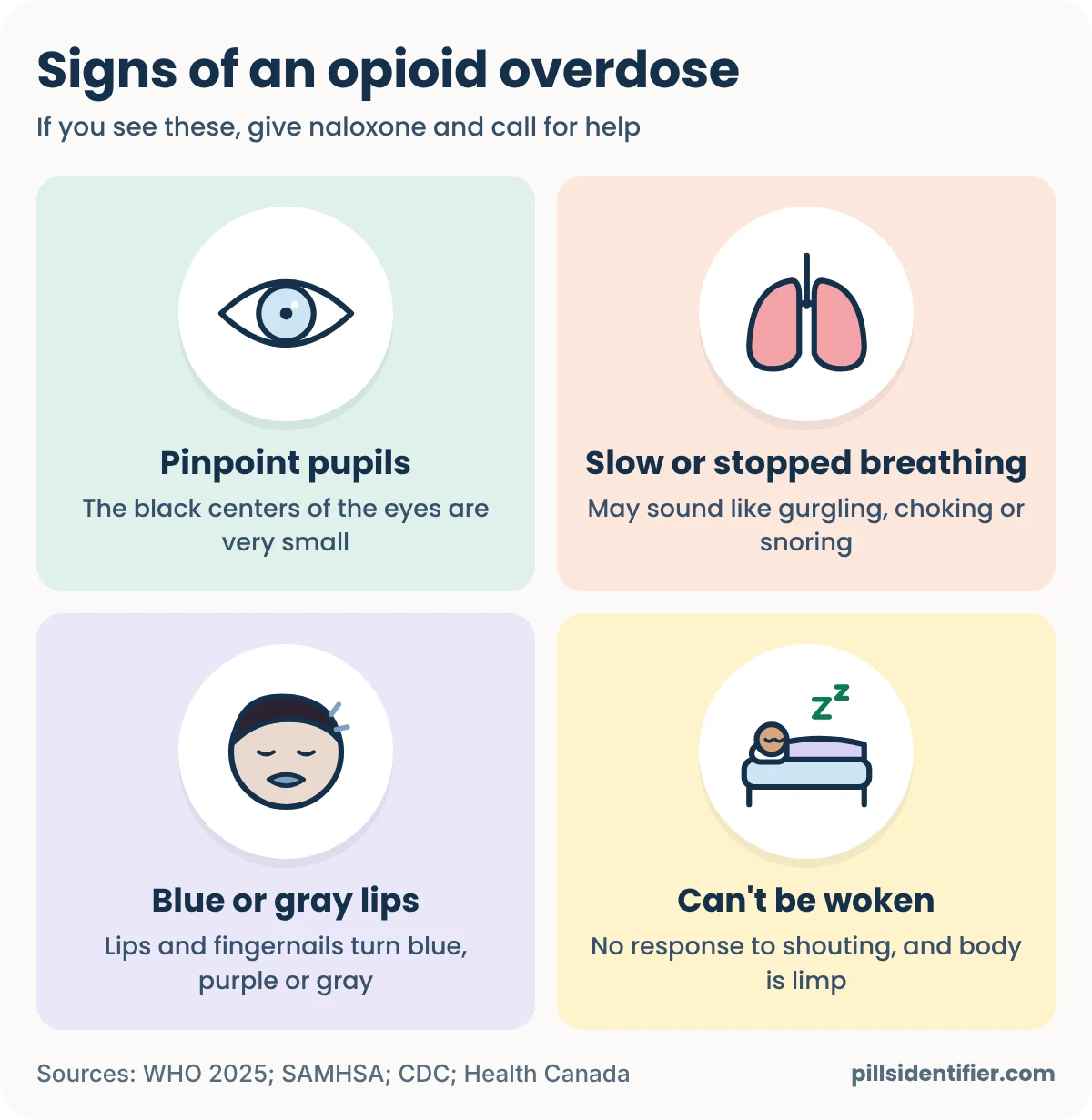
Opioids can slow breathing until it stops. The WHO says three signs together point to an opioid overdose: pinpoint pupils, unconsciousness and difficulty breathing. SAMHSA, the CDC and Health Canada add other signs to look for:
- Pinpoint pupils. The black centers of the eyes are very small.
- Can’t be woken. The person doesn’t respond, even when you shout their name or shake them.
- Slow, shallow or no breathing. You may hear choking, gurgling or snoring sounds.
- Blue, purple or gray lips and fingernails.
- Limp body. Arms and legs are floppy.
- Cold, clammy skin.
- Early warning signs. Trouble walking, talking or staying awake.
Don’t wait on the pupils
Pinpoint pupils are a classic clue, but MedlinePlus lists “narrowing or widening of the pupils” among the signs of an oxycodone overdose. If someone can’t be woken and is barely breathing, act right away. Snoring or gurgling in a person you can’t wake is a warning sign, not sleep.
What should you do if someone is overdosing on opioids?
These steps follow the SAMHSA Overdose Prevention and Response Toolkit, the CDC and Health Canada. If you aren’t sure it’s an opioid overdose, act anyway. SAMHSA says that if the emergency isn’t an opioid overdose, naloxone will generally have no effect and won’t cause extra harm.
- Check for a response. Shout the person’s name. If they don’t respond, rub your knuckles firmly on their upper lip or the center of their chest.
- Call for emergency help. Call 911 in the US, Puerto Rico and Canada, or 000 in Australia. The help box above lists other numbers.
- Give naloxone right away if you have it, following the instructions on the package.
- Give a second dose if needed. If the person doesn’t start breathing or respond after 2 to 3 minutes, give another dose.
- Support their breathing. Give rescue breaths if you know how.
- Turn them on their side. Once they are breathing, place them in the recovery position so they don’t choke.
- Stay with them until emergency workers arrive.
What not to do
- Don’t put them in a cold bath or shower. SAMHSA warns this raises the risk of falling, drowning or going into shock.
- Don’t try to make them vomit. They could choke or breathe vomit into their lungs.
- Don’t leave them alone. The CDC says to stay with the person until help comes.
How does naloxone reverse an opioid overdose?
Naloxone, sold as Narcan and other brands, is a medicine that can temporarily reverse the effects of an opioid overdose. The WHO says it can prevent death “if administered in time.” It comes as a nasal spray or an injection.
The catch is timing. Health Canada says naloxone is active for only 30 to 120 minutes, while the effects of most opioids last longer. The person can stop breathing again when it wears off, so they need emergency care even if they wake up.
Naloxone is easier to get than many people think. The FDA approved Narcan 4 mg nasal spray for sale without a prescription in March 2023. Health Canada changed its prescription status in March 2016, and Australia has given it free with no prescription since July 1, 2022. Our guide to Narcan (naloxone) explains how to use it and where to get it.
What raises the risk of an opioid overdose?
An overdose can happen with a prescribed medicine or with illegal drugs. These are the main risks named by the WHO, SAMHSA and Health Canada:
- Mixing with other sedatives. Alcohol, benzodiazepines such as alprazolam (Xanax), and sleep medicines also slow breathing. MedlinePlus warns that alcohol, street drugs and some medicines taken with oxycodone can cause “serious or life-threatening breathing problems, sedation, or coma.” Read more in our benzodiazepines guide.
- Lost tolerance. After a break from opioids, such as a hospital stay, treatment or time in prison, the body loses tolerance. An amount the person once took can now stop their breathing.
- Taking more, or more often, than prescribed. High prescribed doses also carry more risk.
- Extended-release pills used the wrong way. These pills release medicine slowly. MedlinePlus says they must be swallowed whole, because chewing, crushing, breaking or dissolving them can release too much at once and cause overdose and death.
- Drugs of unknown strength. Illegal drugs and pills bought outside a pharmacy may contain fentanyl.
- Health problems. Liver or kidney disease and breathing problems raise the risk, according to Health Canada. The WHO adds HIV and lung disease.
Prescription opioids vs illegal opioids
Prescription opioids include oxycodone, hydrocodone, morphine, hydromorphone, codeine, tramadol and fentanyl patches. Illegal opioids include heroin and illegally made fentanyl, which can be mixed into other drugs or pressed into fake pills.
Illegally made fentanyl is behind most US opioid deaths today. In 2024, synthetic opioids other than methadone, a group the CDC says covers fentanyl, fentanyl analogs and tramadol, were involved in 47,735 of 54,045 opioid overdose deaths. That is 88%, by our calculation from final CDC data. The CDC says fentanyl is up to 50 times stronger than heroin and 100 times stronger than morphine. Our fentanyl guide has more.
Fake pills look exactly like real ones
The DEA warns that counterfeit pills are made to look like oxycodone (OxyContin, Percocet), hydrocodone (Vicodin) and alprazolam (Xanax). A fake pill can carry the right imprint, color and shape and still contain fentanyl.
Our pill imprint search tells you what a marked pill is supposed to be, but a match can’t prove a pill is real. The DEA advises taking only medicines prescribed by a licensed medical professional and dispensed by a registered pharmacist. See how to spot fake pills before you trust a pill from anywhere else.
What happens at the hospital after an opioid overdose?
Hospital care focuses on breathing. The WHO says first responders should focus on keeping the airway open, helping the person breathe and giving naloxone. In the emergency department, the team may:
- help the person breathe;
- give more naloxone if the opioid’s effects come back;
- watch breathing and alertness for several hours, since SAMHSA’s first-responder guide says people should be watched for at least 4 hours after the last naloxone dose;
- check for other drugs or medicines that were taken.
Many prescription opioid pills also contain acetaminophen (called paracetamol in Australia and India), which carries an FDA boxed warning for severe liver injury. Naloxone is an antidote to opioids, not to acetaminophen. Tell the medical team exactly what was taken, and bring the bottle if you can. Our Percocet overdose guide explains this double danger.
An overdose can also be a turning point. The WHO says opioid agonist maintenance treatment, with medicines such as methadone and buprenorphine, has the strongest evidence of effectiveness for opioid dependence, yet fewer than 10% of people worldwide who need it receive it. The CDC puts it simply: recovery is possible.
Who is most at risk of an opioid overdose?
The WHO names people with opioid use disorder, people who inject drugs, people using again after a break, and people taking prescription opioids without medical supervision. Men and older people are also at higher risk. In Canada, 72% of apparent opioid toxicity deaths from January to June 2025 were male, 26% were people aged 30 to 39, and 97% were accidental. In Puerto Rico, 90% of overdose deaths with fentanyl detected from 2018 to 2024 were men.
Our analysis: opioid medicines and rules in five countries
We checked each brand name and rule in official sources in October 2026: MedlinePlus from the US National Library of Medicine, Health Canada’s Drug Product Database, healthdirect Australia, and India’s National List of Essential Medicines 2022 (NLEM) from the Ministry of Health and Family Welfare. Puerto Rico follows US federal drug rules, so US approvals and brands apply there.
| Medicine | US and Puerto Rico | Canada | Australia | India (on NLEM 2022?) |
|---|---|---|---|---|
| Oxycodone | OxyContin, Roxicodone, Roxybond, Xtampza ER | OxyNEO, Supeudol | Endone, OxyNorm, OxyContin | Not listed |
| Hydromorphone | Dilaudid | Hydromorph Contin | Dilaudid | Not listed |
| Morphine | MS Contin | MS Contin | MS Contin | Listed: tablet and injection |
| Tramadol | ConZip | Durela | Tramal | Listed: capsule and injection |
| Codeine with acetaminophen (paracetamol) | Tylenol with Codeine No. 3 and No. 4 | Tylenol with Codeine No. 2 and No. 3 | Panadeine Forte | Not listed |
Generic versions are also sold in the US, Canada and Australia. We left out brands that MedlinePlus marks as no longer on the market, such as Ultram. India has no official national brand list we could check, so that column shows whether the medicine is on the government’s essential medicines list. Learn more in our guides to oxycodone and tramadol overdose, or see pictures of oxycodone pills.
| Country | What’s different | Since |
|---|---|---|
| US and Puerto Rico | Prescription pills that combine an opioid with acetaminophen may contain no more than 325 mg of acetaminophen per tablet or capsule (FDA limit). | Announced January 2011 |
| US and Puerto Rico | Narcan 4 mg naloxone nasal spray approved for sale without a prescription. | March 2023 |
| Puerto Rico | The Department of Health’s Overdose Prevention Division gives out free naloxone kits and fentanyl test strips. | Announced July 2025 |
| Canada | Pharmacists may sell some low-dose codeine combination products (no more than 8 mg of codeine per tablet) without a prescription under federal Narcotic Control Regulations. | In force in 2026 |
| Canada | The Good Samaritan Drug Overdose Act protects people at an overdose from simple possession charges. | May 4, 2017 |
| Australia | All medicines containing codeine became prescription-only. | February 1, 2018 |
| Australia | Naloxone is free with no prescription through the Take Home Naloxone program. | July 1, 2022 |
| India | Tramadol was added to the psychotropic substances controlled under the NDPS Act, India’s narcotics law. | April 26, 2018 |
| India | Codeine is controlled under the NDPS Act. Mixtures with other ingredients that stay under set strength limits are exempt from its “manufactured drug” rules, as the Central Bureau of Narcotics restated in December 2025. | 1985 notification |
| India | Naloxone injection is on the national essential medicines list; we found no national take-home naloxone program. | NLEM 2022 |
By the numbers: opioid deaths in our five countries
| Country | Latest figure | Year | Source |
|---|---|---|---|
| United States | 44,564 overdose deaths involving opioids (provisional) | 2025 | CDC National Center for Health Statistics |
| Puerto Rico | 577 overdose deaths with fentanyl detected; fentanyl found in more than 80% of overdose deaths since 2022 | 2023 | ASSMCA (Puerto Rico’s mental health and addiction services agency) |
| Canada | 5,608 opioid-related deaths, about 15 a day | 2025 | Council of Chief Medical Officers of Health |
| Australia | 1,082 overdose deaths involving opioids (4.0 per 100,000 people) | 2024 | NDARC analysis of Australian Bureau of Statistics data |
| India | No official national figure found | – | – |
Each country counts these deaths differently, so the figures are not directly comparable. The CDC’s US total excludes Puerto Rico.
How can you prevent an opioid overdose?
- Take opioid medicines only as prescribed, and swallow extended-release pills whole.
- Ask your doctor or pharmacist before combining an opioid with alcohol, benzodiazepines, sleep medicines or any other sedating medicine.
- Keep naloxone at home if anyone in the house takes opioids, and tell family where it is.
- Never use alone. SAMHSA advises having a trusted person with you who is alert and can respond.
- Where it’s legal, test drugs with fentanyl test strips. The CDC and SAMHSA both recommend them.
- Store opioid medicines out of reach, and get rid of leftovers through a take-back program. See how to dispose of unused medicines.
- Check that your pills are the ones your pharmacy gave you with our imprint search, or enter the NDC or DIN from the label in our NDC lookup. If you found a pill you don’t recognize, don’t take it.
Common questions
What are the 3 signs of an opioid overdose?
The WHO names three signs that together point to an opioid overdose: pinpoint pupils, unconsciousness and difficulty breathing. Other signs include blue or gray lips and fingernails, gurgling or snoring sounds, and a limp body. If you see them, call emergency services and give naloxone if you have it.
Is snoring a sign of an opioid overdose?
It can be. SAMHSA lists a gurgling or snoring noise from a person who can’t be woken as an overdose sign. Try to wake them by shouting their name and rubbing your knuckles on their chest. If they don’t respond, treat it as an overdose.
Can someone overdose again after naloxone wears off?
Yes. Health Canada says naloxone is active for only 30 to 120 minutes, and most opioids last longer. Breathing can slow or stop again when naloxone wears off, so the person needs emergency care and someone should stay with them.
Can you overdose on opioids your doctor prescribed?
Yes. MedlinePlus warns that oxycodone can cause serious or life-threatening breathing problems, especially in the first 24 to 72 hours of treatment. Mixing with alcohol or sedatives, taking more than prescribed and breaking extended-release pills all raise the risk. Ask your prescriber about keeping naloxone at home.
Will I get in trouble for calling 911 during an overdose?
Most places protect people who call. Canada’s Good Samaritan Drug Overdose Act, in force since May 4, 2017, protects the caller, the person overdosing and anyone at the scene from simple possession charges. A 2021 GAO review found 47 US states and Washington, DC had both Good Samaritan and naloxone access laws, so check your state’s law.