Iron Overdose: Symptoms, why it’s dangerous for children and what to do
Iron pills and prenatal vitamins can seriously poison a child, often after a quiet spell when they seem fine. Learn the signs, what to do and how labels list iron.
Yes, an iron overdose can be life-threatening, and young children are at the highest risk. Swallowing adult iron pills or prenatal vitamins can injure the stomach and then the liver and other organs, often after a day or more of seeming better. If a child may have swallowed iron, call poison control now (1-800-222-1222 in the US), even if they seem fine.
At a glance
- The FDA requires iron tablets and capsules to carry this warning: “Accidental overdose of iron-containing products is a leading cause of fatal poisoning in children under 6.”
- Iron caused about a third of US child poisoning deaths reported from 1983 to 1991, according to the NIH Office of Dietary Supplements.
- Iron poisoning often seems to ease 6 to 24 hours in, before shock and liver injury follow, according to StatPearls (NIH).
- US poison centers recorded 4,072 iron exposures in 2015, and 2,036 of them involved children age 5 or younger.
- The adult upper limit for iron from all sources is 45 mg a day in the US, Canada, Australia and India (checked October 2026).
- A bottle that says “ferrous sulfate 325 mg” holds about 65 mg of actual (elemental) iron per tablet.
Why is iron overdose so dangerous for children?
Your body needs iron, but too much at once is poisonous. It burns the lining of the stomach and gut, and the iron that reaches the blood damages cells, especially in the liver. StatPearls says the most dangerous cases in children come from adult products such as prenatal vitamins.
The pills also look like sweets. StatPearls notes that children overdose on iron tablets because “they appear as chocolate candy.”
Since 1997, FDA rules (21 CFR 101.17(e) and 21 CFR 310.518) have required this exact warning on iron tablets and capsules:
“WARNING: Accidental overdose of iron-containing products is a leading cause of fatal poisoning in children under 6. Keep this product out of reach of children. In case of accidental overdose, call a doctor or poison control center immediately.”
The NIH Office of Dietary Supplements reports that at least 43 US children died from swallowing high-dose iron supplements between 1983 and 2000, but only one such death was reported from 1998 to 2002, after the 1997 rules. A related rule requiring blister packs for high-strength iron was struck down by a federal appeals court in 2003.
What are the symptoms of iron overdose?
According to MedlinePlus, symptoms of iron overdose can include:
- Stomach and gut: nausea, vomiting (sometimes with blood), diarrhea, stomach pain, black or bloody stools and a metallic taste
- Heart and blood flow: dehydration, low blood pressure, a fast and weak pulse, and shock
- Brain and nerves: drowsiness, chills, fever, seizures (convulsions) and coma
- Skin: pale skin, flushing, bluish lips and fingernails, and later yellow skin (jaundice) from liver damage
MedlinePlus warns that “symptoms may go away in a few hours, then return again after 1 day or later.” That quiet spell is the most misleading part of iron poisoning. For a general checklist, see our guide to the signs of an overdose.
The stages of iron poisoning
| Stage | Typical timing | What can happen |
|---|---|---|
| 1. Stomach and gut | 30 minutes to 6 hours | Vomiting, diarrhea, stomach pain, vomiting blood |
| 2. “Quiet” phase | 6 to 24 hours | The person may seem to recover while iron is still being absorbed |
| 3. Shock | 6 to 72 hours | Symptoms return; shock, acid buildup in the blood, bleeding problems |
| 4. Liver injury | 12 to 96 hours | Liver damage, which can lead to liver failure |
| 5. Scarring | 2 to 8 weeks | The healed stomach or bowel lining can scar and narrow, causing blockages |
The quiet phase can fool families into staying home. Early treatment gives the best chance of recovery.
What should you do if someone took too much iron?
- Call 911 (or your local emergency number) right away if the person is hard to wake, has a seizure, has trouble breathing or collapses.
- Otherwise, call poison control now: 1-800-222-1222 in the US and Puerto Rico. Other countries’ numbers are in the help box above.
- Do not wait for symptoms. The National Capital Poison Center is clear on this. A child who seems fine may be in the quiet phase.
- Have the bottle ready. You will be asked for the person’s age and weight, the product name, the time and how much may be missing.
- Bring the container if you go to the hospital.
Iron is a delayed-harm poison, like acetaminophen and aspirin. Serious damage can start a day or more after the swallow, so get help even if the person seems fine.
What happens at the hospital?
Doctors run blood tests and may take an X-ray, since iron tablets can show up on X-ray in the first few hours. Treatment can include IV fluids, whole bowel irrigation (a fluid that flushes pills out of the gut) and an antidote called deferoxamine, given by IV, which binds iron so the body can remove it. Severe cases may need breathing support.
Activated charcoal, used for many other poisonings, “binds iron poorly and is not effective,” according to StatPearls. MedlinePlus says there is a good chance of recovery if symptoms are gone 48 hours after the overdose, but severe liver damage can show up 2 to 5 days later.
What is elemental iron, and why does the label matter?
Iron supplements contain iron bonded to another compound, called an iron salt. Only part of the salt’s weight is the iron itself, called elemental iron.
This causes real mix-ups. A ferrous sulfate tablet may say “325 mg” on the front, while the Supplement Facts panel says “Iron (as ferrous sulfate) 65 mg.” Both describe the same tablet. The patient safety group ISMP has reported that this confuses shoppers and even nurses and pharmacists. When you call poison control, read them the Supplement Facts panel.
Our analysis: elemental iron in common iron forms
We compiled this table on October 7, 2026 from the NIH Office of Dietary Supplements and real Supplement Facts labels in the NIH Dietary Supplement Label Database.
| Iron form | Share that is iron | Real label example | What to know |
|---|---|---|---|
| Ferrous sulfate | 20% | “Iron (as ferrous sulfate) 65 mg” for a 325 mg tablet | The most common iron pill; the front may show 325 mg |
| Ferrous gluconate | 12% | Sold as Fergon | Less iron per milligram of salt than sulfate |
| Ferrous fumarate | 33% | Sold as Femiron and Feostat | The most iron per milligram of the three salts |
| Carbonyl iron | Label lists iron directly | “Iron (as iron carbonyl) 54 mg” per 2 tablets | The amount listed is the iron itself |
| Polysaccharide-iron complex | Label lists iron directly | “150 mg elemental iron” per capsule | The label states elemental iron |
| Iron bisglycinate | Label lists iron directly | “Iron 25 mg (as iron bisglycinate chelate)” | One brand sells it as “Gentle Iron” |
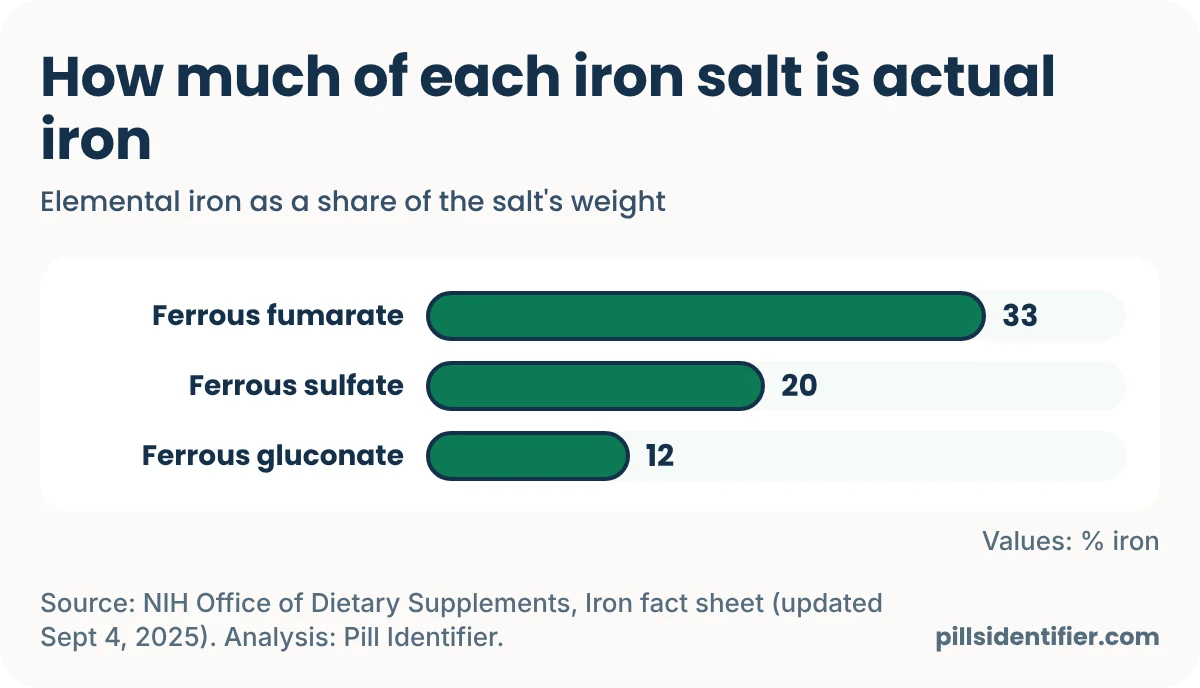
The takeaway: the number on the front of the bottle may not be the iron number. The Supplement Facts panel lists elemental iron, and every iron tablet or capsule carries the same child warning, whatever the form.
How much iron is too much? Upper limits by country
Health agencies set a daily “upper limit” for iron: the most a healthy person should get each day from food and supplements combined, over the long term. These limits do not tell you whether a one-time swallow is safe, so call poison control about any accidental swallow.
| Country | Adults | Children 1 to 3 | Official source |
|---|---|---|---|
| United States | 45 mg | 40 mg | NIH Office of Dietary Supplements |
| Puerto Rico | 45 mg | 40 mg | Uses US values and FDA label rules |
| Canada | 45 mg | 40 mg | Health Canada Dietary Reference Intakes |
| Australia | 45 mg | 20 mg | NHMRC Nutrient Reference Values |
| India | 45 mg | Not confirmed | ICMR-NIN Nutrient Requirements for Indians 2020 |
| Europe (EFSA) | 40 mg | 10 mg | EFSA 2024 “safe level of intake” |
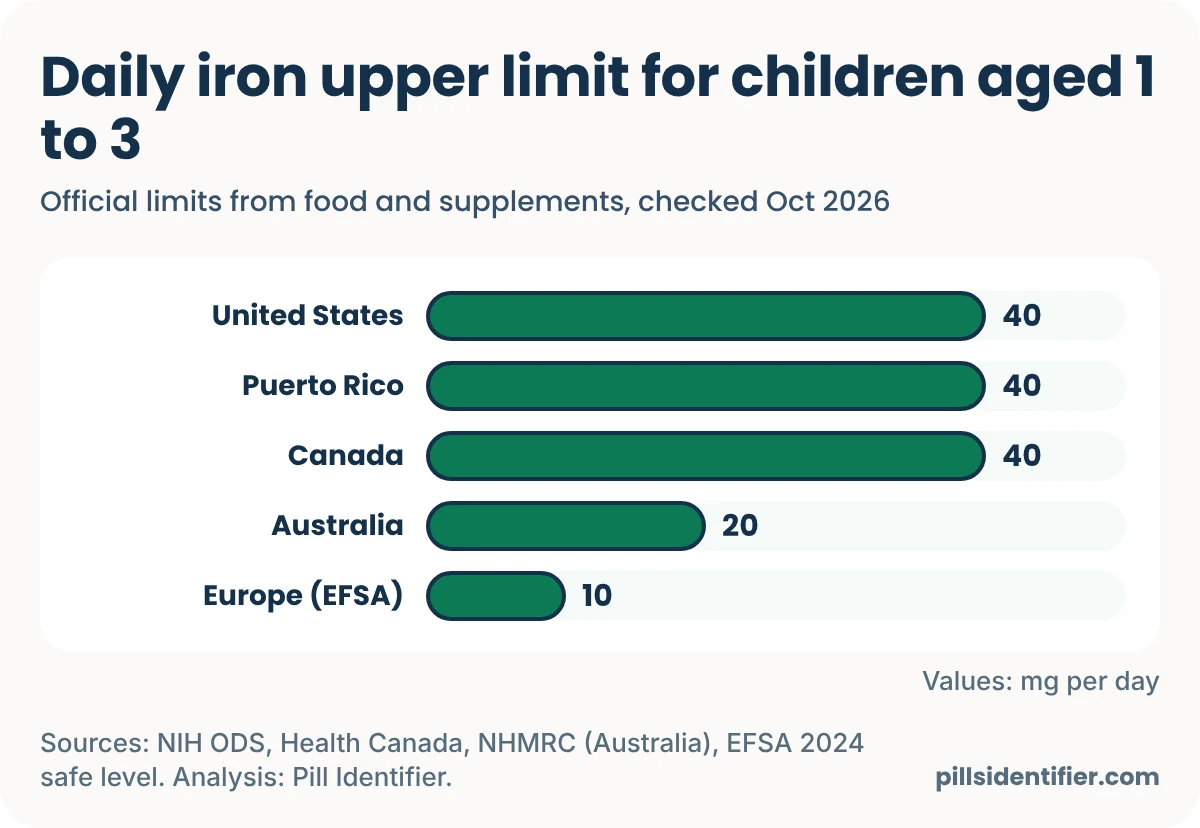
All five countries agree on 45 mg a day for adults. The limits for toddlers differ a lot: Australia’s is half the US and Canadian figure, and Europe’s food safety agency set an even lower level in 2024 after finding the data too thin to set a formal upper limit.
These limits are for healthy people. The NIH Office of Dietary Supplements notes that a doctor may prescribe more than the upper limit for a while to treat iron deficiency. For other nutrients, see can you overdose on vitamins?
Iron tablets in India: keep IFA tablets out of reach
India hands out iron-folic acid (IFA) tablets through Anemia Mukt Bharat, launched in 2018. According to the Ministry of Health and Family Welfare, children aged 6 to 59 months get IFA syrup twice a week, school-age children get a weekly pink tablet, and adolescents and women get a weekly blue or red tablet. Pregnant women take red IFA tablets daily from the second trimester.
The ministry reports that 15.4 crore (154 million) children and adolescents received IFA supplements in the July to September 2024 quarter alone. That means many homes hold iron tablets. Store them like any medicine, out of children’s reach and sight, and if a child swallows extra tablets, call a doctor or poison center straight away.
Is iron overload the same as iron overdose?
No. An iron overdose is a sudden poisoning from swallowing too much iron at once. Iron overload builds up slowly over years. Its most common cause is hemochromatosis, a genetic condition in which “extra iron builds up in the body to harmful levels,” according to the NIDDK. Over time it can damage the liver, heart, pancreas, glands and joints. Doctors treat it by removing blood on a regular schedule.
How can you prevent iron poisoning at home?
The CDC’s Up and Away campaign and poison centers recommend a few simple habits:
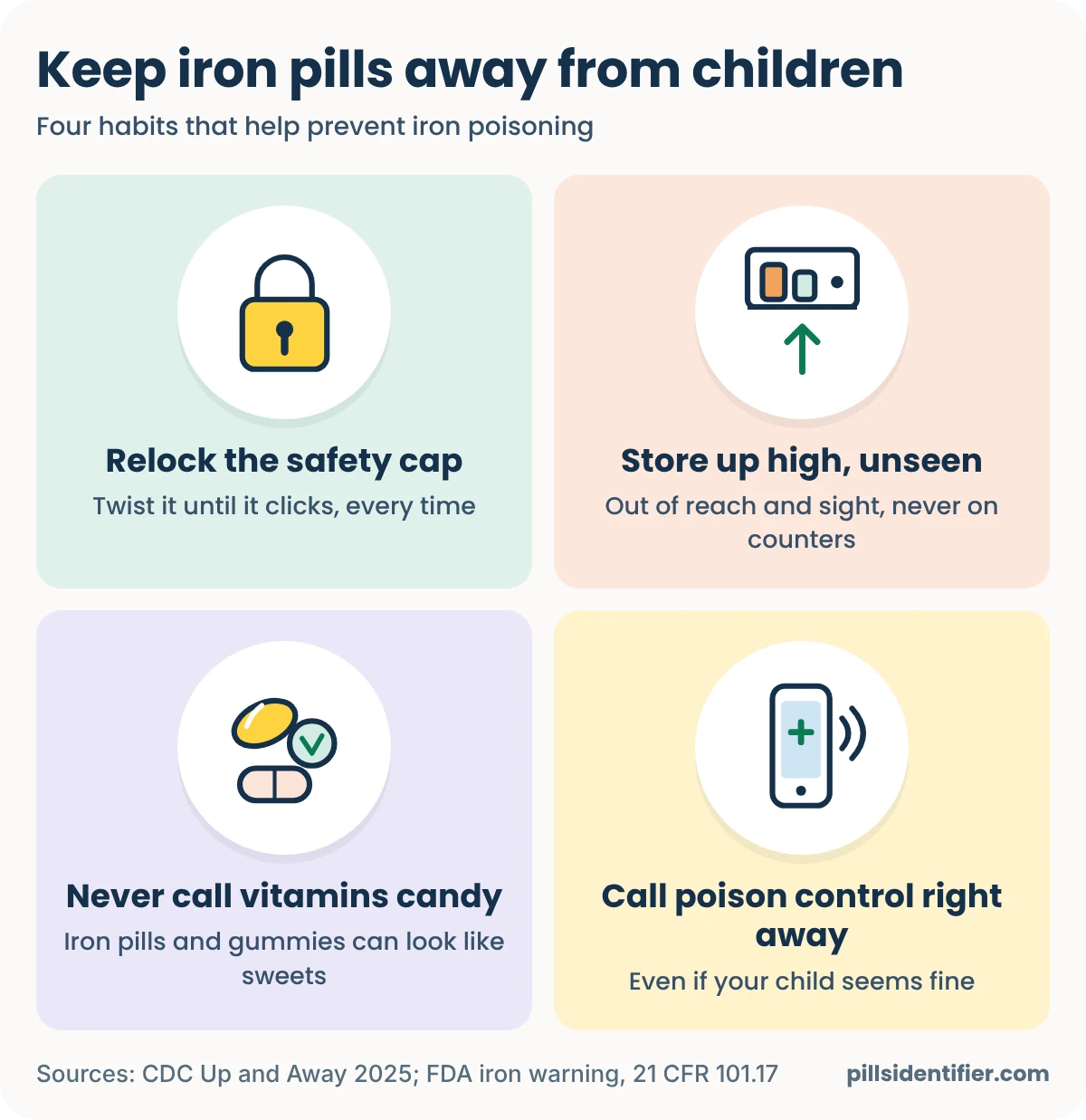
- Relock the cap every time. Keep iron in its original child-resistant bottle and twist the cap until it clicks. Child-resistant does not mean childproof; some young children can still open these caps.
- Store it up high and out of sight. Never leave iron, prenatal vitamins or gummies on a kitchen counter or bedside table.
- Never call vitamins or medicine candy. CDC guidance says this applies even if your child doesn’t like taking them.
- Clear out what you no longer need. See our guide on how to dispose of unused medicines.
The same habits protect children from other products that look like treats, such as melatonin gummies.
Found an iron pill, or not sure what was swallowed?
Iron tablets can look like candy, and many brands look alike. If you find a loose pill, look for letters or numbers stamped on it and check them with our pill imprint search, or see pictures of ferrous sulfate pills. If you have the bottle, use our NDC lookup, or see what to do if you find a pill.
If a child may have swallowed an unknown pill, don’t spend time identifying it first. Call poison control and describe what you can see.
Common questions
Can you overdose on iron gummies?
Yes, especially a small child who eats adult or prenatal gummies. Children’s gummy vitamins usually contain little or no iron, but prenatal vitamins have the most iron of any multivitamin. If a child eats any iron gummies, call poison control and read them the Supplement Facts label.
What happens if a child eats one iron pill or prenatal vitamin?
It depends on the product and the child’s size, and only poison control can judge that safely. Call 1-800-222-1222 in the US right away, even if your child seems well.
How long does it take for iron poisoning symptoms to show?
Vomiting, diarrhea and stomach pain usually start within 6 hours. The person may then seem better for up to a day, while iron is still damaging the body. Shock and liver injury can follow over the next few days, which is why you should get help even if symptoms fade.
Is 65 mg of iron too much?
65 mg is the elemental iron in one common 325 mg ferrous sulfate tablet. It is above the 45 mg daily upper limit for healthy adults, but doctors sometimes prescribe this much or more for a while to treat iron deficiency. Take that amount only if your doctor recommends it, and keep it well away from children.
Can adults overdose on iron?
Yes. The NIH says high doses can cause stomach pain, vomiting and ulcers, and extremely high doses can cause organ failure, seizures, coma and death. Adults who took too much should call poison control, even if they feel fine.