Aspirin overdose (salicylate poisoning): symptoms and hidden sources
Aspirin poisoning can worsen for hours, even when someone seems fine. Learn the signs, where salicylates hide, the risks for children and older adults, and what to do.
Yes, you can overdose on aspirin, and it is a medical emergency. An aspirin overdose, also called salicylate poisoning, can cause ringing in the ears, vomiting, fast breathing, confusion and fever. It often gets worse over several hours, especially with coated tablets. Call Poison Control (1-800-222-1222 in the US) right away, even if the person seems fine.
At a glance
- StatPearls says early signs of salicylate poisoning include nausea, vomiting, fast breathing and ringing in the ears, and symptoms can start 3 to 8 hours after a large amount is swallowed.
- Coated and extended-release tablets, and clumps of tablets in the stomach, can delay absorption, so blood levels can keep rising for hours (StatPearls).
- StatPearls reports about 30,000 cases of salicylate toxicity and 39 deaths in the United States in 2011.
- Aspirin-like drugs called salicylates also hide in Pepto-Bismol, muscle rubs and oil of wintergreen, which contains methyl salicylate, the most poisonous form according to MedlinePlus.
- US federal rules require a Reye’s syndrome warning on aspirin labels, and Health Canada’s 2013 label standard says not to give ASA to anyone under 18 with chickenpox, cold or flu symptoms.
What are the symptoms of an aspirin overdose?
According to StatPearls, early signs are usually nausea, vomiting and belly pain, along with fast breathing. Headache, dizziness and ringing in the ears (tinnitus) are also common. MedlinePlus adds blurred vision, heartburn, diarrhea and a rash.
Signs that it is getting worse
- confusion, agitation, slurred speech or hallucinations;
- very fast breathing and a racing heartbeat;
- feeling faint when standing up, from low blood pressure;
- vomiting blood, or stomach pain that may mean bleeding;
- seizures, collapse or coma;
- breathing that changes from fast to slow, which StatPearls says is a sign breathing may soon fail.
Children get sicker faster. StatPearls notes that they move from mild to severe symptoms more quickly than adults. Our guide to the signs of an overdose compares aspirin with other common medicines.
Why can an aspirin overdose get worse hours later?
Aspirin doesn’t always absorb all at once. StatPearls lists several reasons levels can keep climbing:
- Coated or extended-release tablets release the drug slowly.
- Tablets can clump together in the stomach into a mass called a bezoar, which releases the drug over time.
- Aspirin can make the stomach outlet spasm, so tablets stay in the stomach longer.
- Food in the stomach slows absorption.
- The body clears aspirin more slowly as levels rise, and kidney or liver disease slows it further.
MedlinePlus warns that if treatment is delayed, symptoms will keep getting worse. Hospitals repeat blood tests over several hours for the same reason.
What is chronic aspirin poisoning?
Poisoning doesn’t only happen after one large overdose. MedlinePlus explains that a chronic overdose happens when a normal daily dose builds up in the body over time. It can happen when the kidneys aren’t working well or a person is dehydrated, and it is usually seen in older people in hot weather.
Signs of chronic poisoning include tiredness, a slight fever, confusion, a fast heartbeat and fast breathing that the person can’t control. StatPearls says complications were more common when the diagnosis was missed at the first visit, so tell doctors about every product with aspirin that the person takes.
Where do salicylates hide?
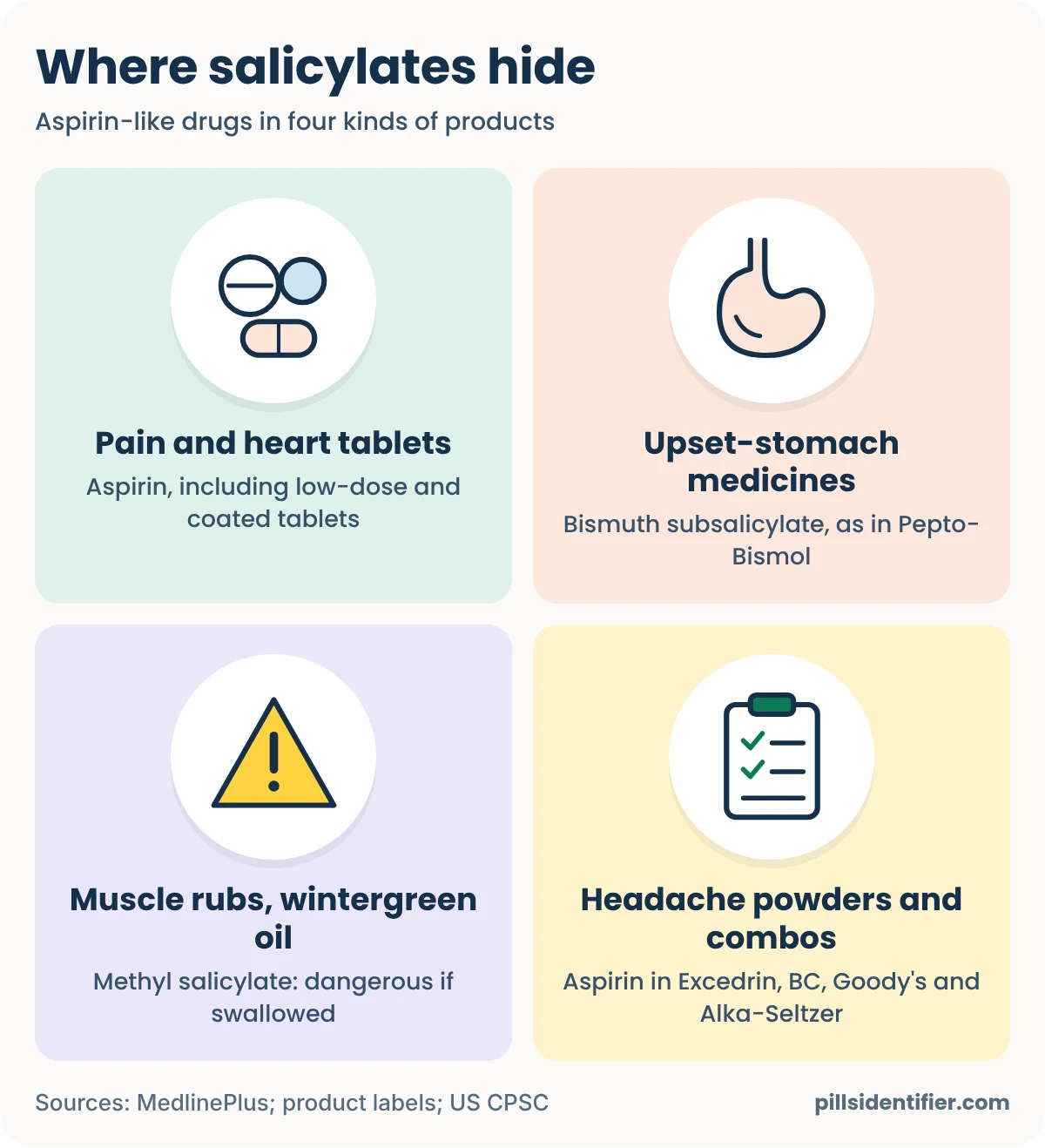
Aspirin is one of a family of drugs called salicylates. Several other everyday products contain them, and they add up. In October 2026 we checked these product types against makers’ websites and MedlinePlus.
| Product type | Examples | Salicylate |
|---|---|---|
| Pain and heart tablets | Bayer, Bufferin, Ecotrin, St. Joseph Low Dose Aspirin, Vazalore | Aspirin |
| Headache combinations | Excedrin Extra Strength and Goody’s Extra Strength powder (with acetaminophen and caffeine); BC Original powder (with caffeine); Alka-Seltzer | Aspirin |
| Prescription combinations | Percodan (with oxycodone), Fiorinal | Aspirin |
| Upset-stomach medicines | Pepto-Bismol | Bismuth subsalicylate |
| Muscle rubs and oils | Deep-heating creams such as Ben Gay and Icy Hot; oil of wintergreen; some vaporizer solutions and mouthwashes | Methyl salicylate |
Sources: Excedrin, Goody’s and BC product pages; MedlinePlus for the other brands.
Muscle rubs and oil of wintergreen
These are the most dangerous hidden source. MedlinePlus calls methyl salicylate the most poisonous form of salicylate. Swallowing it can cause vomiting, ringing in the ears, seizures and kidney failure. In December 2025, the US Consumer Product Safety Commission warned that a wintergreen essential oil sold without child-resistant packaging posed a risk of serious injury or death if young children swallowed it. Under federal law, products like this must come in child-resistant packaging.
Keep rubs and essential oils locked away. If a child swallows any, call Poison Control at once.
Combination products
Headache powders and tablets often mix aspirin with acetaminophen or caffeine. The Goody’s label says not to use it with any other medicine that contains acetaminophen or with other NSAIDs such as ibuprofen or naproxen. If someone took too much of a combination product, read our guides to acetaminophen overdose and caffeine overdose. Some “PM” pain relievers also add the sleep aid diphenhydramine; see our Benadryl overdose guide.
Why shouldn’t children and teens take aspirin?
Aspirin is linked to Reye’s syndrome, a rare illness that causes sudden brain damage and liver problems. MedlinePlus says it has occurred in children given aspirin when they had chickenpox or the flu, and it has become very rare since aspirin stopped being routine for children. Its advice: never give a child aspirin unless your child’s provider tells you to.
The same caution covers other salicylates. MedlinePlus says oil of wintergreen and Pepto-Bismol contain aspirin-like compounds and should not be given to a child with a cold or fever. MedlinePlus also notes that children can be harmed at much lower levels than adults.
Is low-dose aspirin safe?
Low-dose aspirin is a medicine with real risks, even at normal doses. In April 2022, the US Preventive Services Task Force said adults 60 or older should not start aspirin to prevent a first heart attack or stroke. For adults 40 to 59 with a higher heart risk, starting it should be an individual decision. The reason is bleeding: aspirin raises the risk of bleeding in the gut and in the brain.
This advice does not apply to people who have already had a heart attack or stroke. If a doctor told you to take daily aspirin, talk to them before you change anything.
Low-dose tablets are often coated, which can delay absorption in an overdose. Daily use can also lead to chronic poisoning in older adults who become dehydrated or have kidney problems.
What should you do if someone took too much aspirin?
- Call 911 or your emergency number if the person has collapsed, has a seizure, has trouble breathing or can’t be woken up.
- Otherwise, call Poison Control now, even if the person seems fine. In the US and Puerto Rico, call 1-800-222-1222. The help box above lists numbers for Canada, Australia and India. US law requires aspirin labels to say: “In case of overdose, get medical help or contact a Poison Control Center right away.”
- Don’t wait for symptoms. A Health Canada product monograph advises calling a doctor or hospital immediately after an accidental overdose, “even if there are no symptoms.”
- Keep the package. It tells the expert the product, whether it is coated, and whether it has other drugs in it.
- Don’t make the person vomit unless Poison Control or a doctor tells you to, as MedlinePlus advises.
Found tablets and not sure they’re aspirin? Check the imprint with our pill imprint search or see pictures of aspirin pills. A matching imprint shows what a pill should be, but it can’t prove a pill is real.
What happens in the hospital?
MedlinePlus says the team checks breathing, heart rate and blood pressure, and runs blood and urine tests, including the level of salicylate in the blood. They may also do a chest x-ray and an ECG. Because levels can rise late, StatPearls recommends repeating the blood tests.
Treatment may include activated charcoal and fluids and medicines through a vein, such as sodium bicarbonate, to help the body clear aspirin. In severe cases, doctors use hemodialysis, a machine that cleans the blood. Some people need a breathing tube and a ventilator.
Salicylate poisoning can cause serious illness, and StatPearls notes that some survivors have nerve and brain problems that last a few years. It also says the poisoning can be treated when it is diagnosed and treated promptly. MedlinePlus agrees: the faster help arrives, the better the chance of recovery.
How is aspirin sold in other countries?
Aspirin goes by different names and follows different rules across our readers’ countries. In October 2026, we compiled this table from each country’s official medicine listings, label rules and essential medicines list, plus makers’ and pharmacy listings for Indian brands.
| Country | Name and common brands | How it’s sold | Child warning rule |
|---|---|---|---|
| US and Puerto Rico | Aspirin; Bayer, Bufferin, Ecotrin, St. Joseph Low Dose, plus combinations such as Excedrin | Over the counter; some combinations need a prescription | Federal label rule: children and teens who have or are recovering from chickenpox or flu-like symptoms should not use it |
| Canada | ASA (acetylsalicylic acid); Aspirin by Bayer, including enteric-coated low-dose tablets | Non-prescription | 2013 label standard: do not give to anyone under 18 with chickenpox, cold or flu symptoms without asking a doctor or pharmacist |
| Australia | Aspirin; Disprin, Aspro Clear, Cartia (low dose) | Some smaller packs are unscheduled; larger packs are Pharmacy Medicines (Schedule 2); Cartia is for use under medical supervision | No national rule found in our check |
| India | Acetylsalicylic acid; Disprin (Reckitt), Ecosprin (USV, low dose) | On the National List of Essential Medicines 2022 as a pain reliever, migraine medicine and antiplatelet; pharmacies list Ecosprin as prescription only | No national rule found in our check |
Where we found each entry:
- US: the federal label rule, 21 CFR 201.314, which also applies in Puerto Rico.
- Canada: Health Canada’s 2013 ASA labelling standard and the Drug Product Database, where Bayer’s Aspirin 81 mg enteric-coated tablet has DIN 02237726. You can search a DIN with our NDC and DIN lookup.
- Australia: healthdirect, using TGA register data. For example, Disprin Original in packs of 6 or 24 is not scheduled, while packs of 48 or 96 are Pharmacy Medicines.
- India: the Ministry of Health and Family Welfare’s National List of Essential Medicines 2022.
Two points stand out. Health Canada and many Canadian products use the name “ASA”, so a search for “aspirin” may miss them. In Australia, pack size can decide whether a pack is unscheduled or a Pharmacy Medicine, which only pharmacies can sell.
Common questions
Can you die from an aspirin overdose?
Yes. StatPearls reports 39 deaths among about 30,000 US salicylate toxicity cases in 2011. MedlinePlus warns that symptoms keep getting worse when treatment is delayed. StatPearls says the poisoning can be treated when it is diagnosed and treated promptly.
How long after an aspirin overdose do symptoms start?
StatPearls says symptoms of a large overdose can start within about 3 to 8 hours. With coated or extended-release tablets, levels can keep rising for longer. That is why you should call Poison Control right away, even if the person feels fine.
Does Pepto-Bismol count as aspirin?
Not exactly, but it is related. Pepto-Bismol contains bismuth subsalicylate, a salicylate like aspirin, and its label carries the same Reye’s syndrome warning for children and teens. Tell Poison Control about Pepto-Bismol if someone has also taken aspirin.
Can you overdose on low-dose aspirin?
Yes. Taking more than prescribed at one time can cause an overdose, and daily use can build up in older adults who are dehydrated or have kidney problems. Low-dose tablets are often coated, so harm can be delayed. Call Poison Control even if the person seems well.