Acetaminophen (Tylenol) Overdose: Symptoms, Timeline and when to get help
Acetaminophen overdose often causes few symptoms at first while the liver is harmed. See the stages, the official daily limits, where it hides, and when to get help.
Yes, you can overdose on Tylenol (acetaminophen), and it is one of the most common medicine poisonings in the US. The danger is easy to miss: a person may feel fine, or only a little sick, for the first day while the liver is being damaged. Call Poison Help at 1-800-222-1222 right away, even if there are no symptoms, because treatment works best early.
At a glance
- The FDA says adults and children 12 and older should not take more than 4,000 mg of acetaminophen in 24 hours, counting every medicine they take.
- US Tylenol Extra Strength caplets (500 mg) carry a lower label limit of 6 caplets, or 3,000 mg, in 24 hours unless a doctor directs otherwise.
- Overdose symptoms may not start until 12 or more hours after the pills were swallowed, according to MedlinePlus.
- Acetaminophen is the leading cause of acute liver failure in the US, according to StatPearls (updated March 2026).
- In 2024, acetaminophen was among the substance groups linked to the most deaths reported to US poison centers.
- Our count found that 30% of the 3,838 FDA drug listings that contain acetaminophen also contain the cough medicine dextromethorphan.
Can you overdose on Tylenol?
Yes. StatPearls, a medical reference from the US National Library of Medicine, says acetaminophen “is responsible for more pharmaceutical overdoses than any other medication in the United States and worldwide.” About half of these poisonings are unintentional.
Acetaminophen is the same medicine as paracetamol. It is called acetaminophen in the US and Canada, and paracetamol in Australia, India and the UK. Prescription labels may shorten it to APAP.
An overdose can happen in two ways:
- A single large amount taken at one time, on purpose or by mistake.
- A little too much over several days, often by taking two products that both contain acetaminophen. Doctors call this a repeated or staggered overdose. It is harder to assess, so it needs medical advice too.
What are the symptoms of an acetaminophen overdose?
Early symptoms are often mild or missing. MedlinePlus says symptoms “may not occur until 12 or more hours after the acetaminophen was swallowed.” When they do appear, they can include:
- nausea and vomiting
- loss of appetite
- sweating
- belly pain, especially on the upper right side
- diarrhea and irritability
- yellow skin or eyes (jaundice)
- confusion, seizures or coma in severe cases
Feeling better does not mean the danger has passed. On the second and third day, a person may look improved while blood tests show the liver getting worse.
The four stages of acetaminophen poisoning
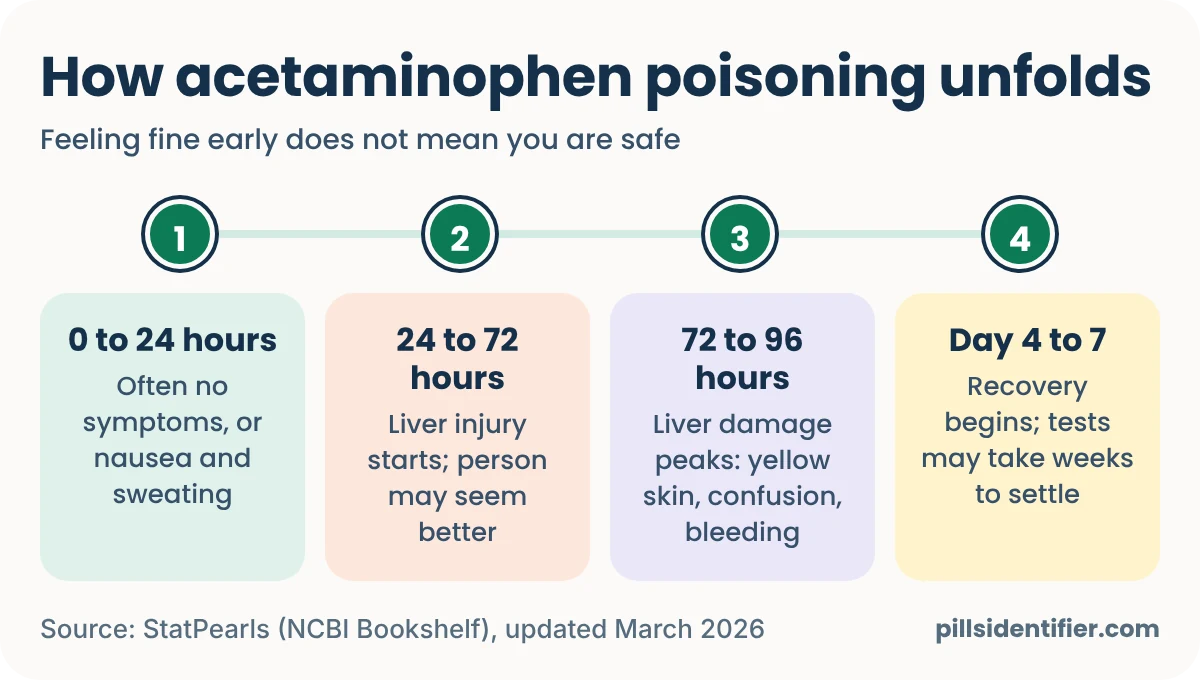
Doctors describe acetaminophen poisoning in four stages. The timing below comes from StatPearls.
| Stage | Time after the overdose | What can happen |
|---|---|---|
| Stage 1 | First 30 minutes to 24 hours | Often no symptoms. Some people have nausea, vomiting, sweating, pale skin, tiredness or feel unwell. |
| Stage 2 | 24 to 72 hours | Liver injury begins and shows up in blood tests. The person may seem better. Pain in the upper right belly and kidney problems are possible. |
| Stage 3 | 72 to 96 hours | Liver damage peaks. Yellow skin, confusion and bleeding problems can appear, and kidney failure is common. This is the stage when deaths most often happen. |
| Stage 4 | From about day 4 to day 7 | Recovery for people who survive stage 3. Symptoms and blood tests can take several weeks to return to normal. |
Why does too much acetaminophen damage the liver?
Your liver breaks down acetaminophen. A small part of each dose turns into a harmful by-product called NAPQI. At normal doses, the liver neutralizes it with a natural protective substance called glutathione.
In an overdose, the liver makes more NAPQI than it can handle. Its glutathione runs out, and NAPQI starts to damage liver cells. That damage builds over hours and days, which is why symptoms come late.
Severe cases can lead to liver failure. StatPearls reports that acetaminophen accounts for 50% of reported liver failure cases in the US and 20% of all US liver transplants.
What is the maximum daily dose of Tylenol?
These are the official limits. They are ceilings, not targets, and they include every product you take that day.
- FDA limit: the FDA says the total amount of acetaminophen in 24 hours “should not be more than 4,000 mg for adults and children 12 years of age and older.”
- Tylenol Extra Strength label (US): 2 caplets every 6 hours while symptoms last, and no more than 6 caplets in 24 hours unless a doctor directs. With 500 mg per caplet, that is a 3,000 mg label limit.
- Health Canada: adults should never take more than 4,000 mg a day. That equals 8 extra strength 500 mg tablets or 12 regular strength 325 mg tablets.
- Children: doses depend on age and weight. Follow the children’s product label and use the measuring device that comes with it. Never give adult tablets to a young child.
If you have liver disease, or you drink three or more alcoholic drinks a day, talk to your doctor or pharmacist first. Health Canada notes that the amount you can safely take may be less.
Is it dangerous to drink alcohol with Tylenol?
It can be. The FDA warns that “severe liver damage may occur if you have three or more alcoholic drinks per day while using acetaminophen.” The same warning is printed on US Tylenol packs.
StatPearls lists underlying liver disease and alcohol use disorder among the factors that raise the risk of liver injury. Fasting or poor nutrition also matters, because it leaves the liver with fewer reserves to process acetaminophen safely. If you drink heavily and have taken acetaminophen for several days, ask a pharmacist or call Poison Help about whether you need a check. Our guide to alcohol poisoning signs covers the dangers of alcohol on its own.
How do people take too much acetaminophen by accident?
The most common trap is double dosing. A person takes Tylenol for a headache, then a cold and flu medicine, then a nighttime “PM” product, and does not realize all three contain acetaminophen.
The FDA says more than 600 prescription and over-the-counter medicines contain acetaminophen. Health Canada says more than 700 medicines in Canada do. They include:
- cold, cough and flu medicines
- nighttime pain relievers and sleep aids
- headache and migraine products
- prescription pain relievers such as Percocet (oxycodone and acetaminophen) and hydrocodone combinations
How to spot acetaminophen on a label
- Over-the-counter packs: since a 2009 FDA rule (in force from April 2010), US over-the-counter products must name acetaminophen on the front of the pack and carry a liver warning. Check the “Active ingredients” line on the Drug Facts label too.
- Prescription bottles: pharmacy labels may use short forms such as APAP, Acetaminoph, Acetaminop, Acetamin or Acetam.
- Prescription combinations: since 2011, the FDA has limited these to 325 mg of acetaminophen per tablet or capsule, with a boxed warning about severe liver injury.
The FDA’s advice is simple: don’t take more than one over-the-counter medicine with acetaminophen, and don’t combine a prescription and an over-the-counter acetaminophen product unless your health care provider tells you to. If you take a prescription combination, our guide to Percocet overdose explains why these pills carry two separate dangers.
Our analysis: how much acetaminophen hides in combination medicines?
We searched the FDA’s National Drug Code (NDC) Directory through openFDA (data updated October 2, 2026) for every listing that names acetaminophen as an active ingredient, then counted the other active ingredients in those listings.
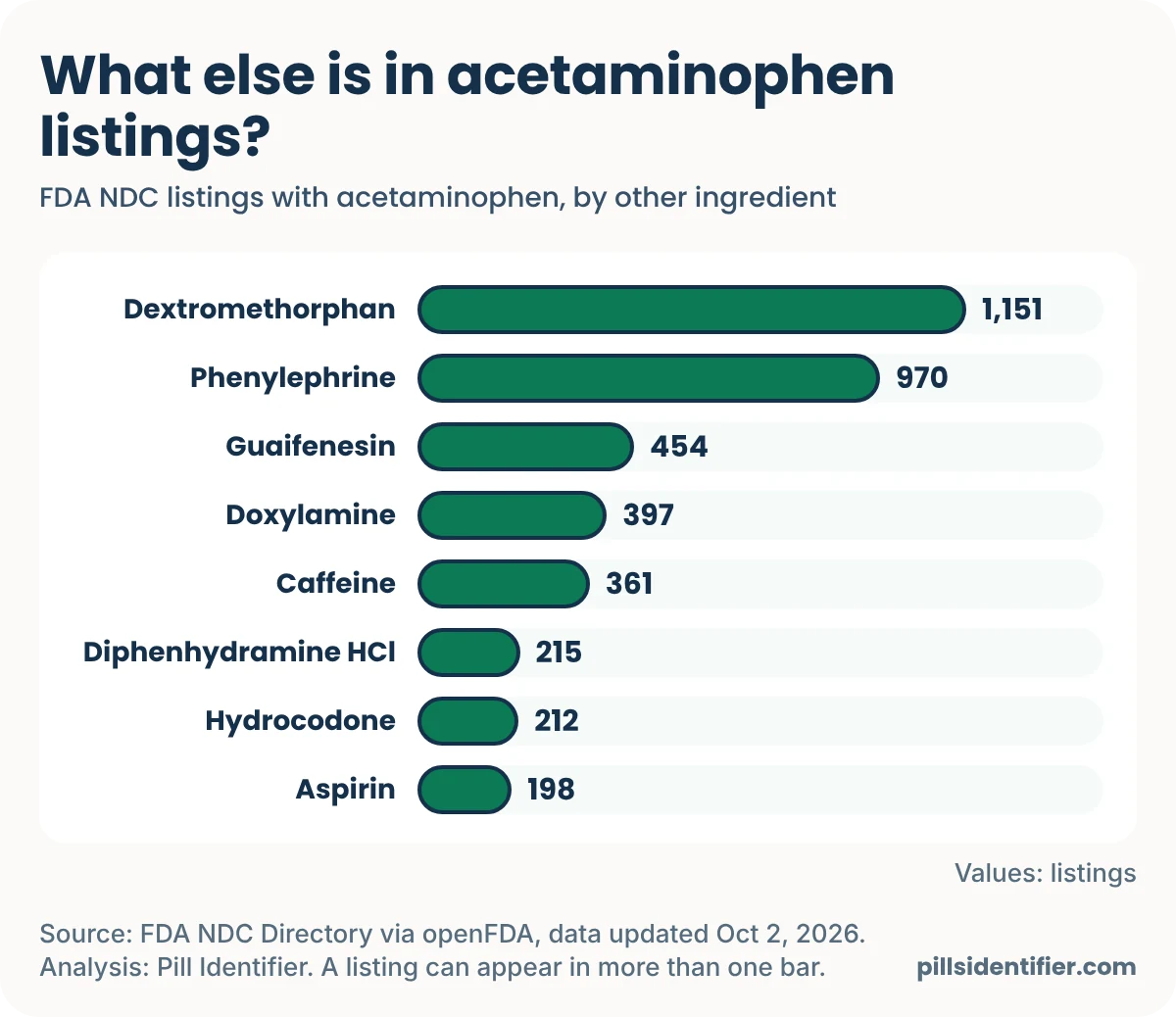
We found 3,838 listings that contain acetaminophen. At least 1,151 of them, or 30%, also contain dextromethorphan, a cough medicine. That alone means at least 3 in 10 acetaminophen listings are combination products. These are listings in the federal directory, not products on store shelves, and many are the same medicine sold under store brands or by repackagers.
| Other ingredient | What it is | Listings | Share of 3,838 |
|---|---|---|---|
| Dextromethorphan | Cough medicine | 1,151 | 30.0% |
| Phenylephrine | Decongestant | 970 | 25.3% |
| Guaifenesin | Chest congestion medicine | 454 | 11.8% |
| Doxylamine | Sedating antihistamine (nighttime cold products) | 397 | 10.3% |
| Caffeine | Stimulant (headache products) | 361 | 9.4% |
| Diphenhydramine hydrochloride | Sedating antihistamine (“PM” products) | 215 | 5.6% |
| Hydrocodone | Prescription opioid | 212 | 5.5% |
| Aspirin | Pain reliever (NSAID) | 198 | 5.2% |
| Chlorpheniramine | Antihistamine | 133 | 3.5% |
| Oxycodone hydrochloride | Prescription opioid | 132 | 3.4% |
| Butalbital | Prescription sedative (headache products) | 92 | 2.4% |
| Ibuprofen | Pain reliever (NSAID) | 87 | 2.3% |
| Codeine phosphate | Prescription opioid | 83 | 2.2% |
A listing with several extra ingredients is counted once in each row, so the rows overlap and should not be added together. A typical nighttime cold product, for example, appears in the dextromethorphan, phenylephrine and doxylamine rows.
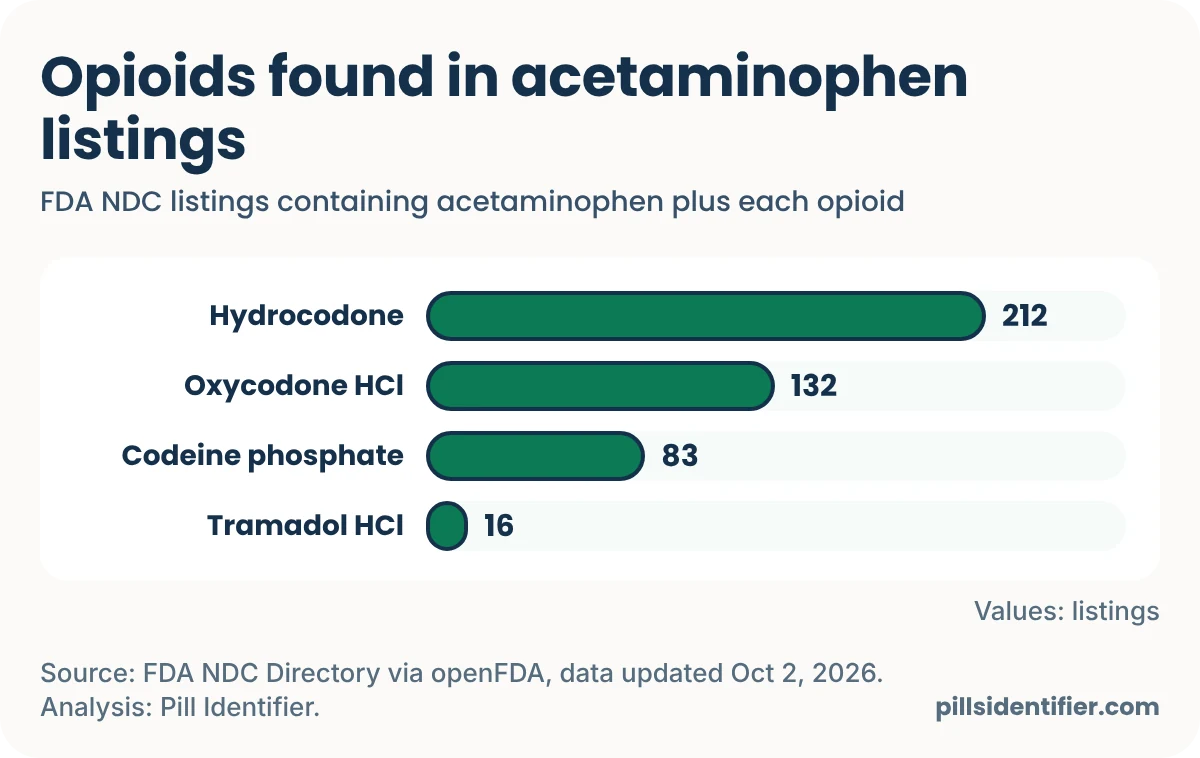
Prescription opioids are the other big group. Hydrocodone bitartrate appears in 212 acetaminophen listings, oxycodone hydrochloride in 132, codeine phosphate in 83 and tramadol hydrochloride in 16. If you take one of these and also reach for Tylenol, you can go over the daily limit without knowing it. These pills also carry the separate risks covered in our guide to opioid overdose symptoms and what to do.
What should you do if someone took too much Tylenol?
MedlinePlus is clear: “There is no home treatment. Seek medical help right away.”
- Call 911 first if the person is unconscious, having a seizure, struggling to breathe or cannot be woken.
- Otherwise, call Poison Help at 1-800-222-1222 right away. It is free, confidential and open 24 hours. Call even if the person seems completely fine.
- Have the facts ready if you can: the product name and strength, how much was taken, when, and the person’s age, weight and condition. Don’t delay the call to find them.
- Bring the bottle or box to the hospital, including any other medicines taken that day.
- If the person is unconscious but breathing, lay them on their side in the recovery position while you wait for help.
Do not try to make the person vomit, and do not wait to see whether symptoms appear. By the time symptoms show, the best window for treatment may have passed. If you are not sure what pills were taken, our pill imprint search can help you or the poison center identify them from the letters and numbers stamped on each one.
What happens at the hospital?
Staff will take blood tests, including the level of acetaminophen in the blood and tests of liver function. The acetaminophen level is usually measured at least 4 hours after the pills were swallowed, so the result can be read accurately.
The antidote is called acetylcysteine (also known as NAC). StatPearls says it is most effective when given within the first 8 hours after an overdose, and MedlinePlus says treatment within 8 hours gives “a very good chance of recovery.” If the time of the overdose is unknown, doctors usually start it right away. For the full picture of treatment, recovery and outcomes, read our guide to paracetamol overdose treatment and recovery.
Who is most at risk?
- People taking several medicines at once, especially cold and flu products alongside a pain reliever.
- People with liver disease or alcohol use disorder.
- People who are fasting, unwell and not eating, or malnourished.
- Older adults: StatPearls says the risk of liver injury increases with age.
- Young children who find adult tablets. In 2021, Health Canada warned that children getting into adult acetaminophen tablets “may pose serious health risks.”
- Teens and young adults: in Australia, the TGA reports that intentional overdose rates are highest among adolescents and young adults.
Acetaminophen around the world: names, limits and rules
The medicine is the same everywhere, but names, tablet strengths and sales rules differ across our five countries. Checked October 2026.
| Country | Name and example brands | Common adult strengths | Official adult daily limit | Notable rules |
|---|---|---|---|---|
| United States | Acetaminophen (APAP on some prescription labels); Tylenol | 500 mg (Tylenol Extra Strength); up to 325 mg per tablet in prescription combinations | 4,000 mg in 24 hours from all sources (FDA); Tylenol Extra Strength label: 6 caplets (3,000 mg) unless a doctor directs | Acetaminophen named on the front of over-the-counter packs, with a liver warning (since 2010); prescription combinations capped at 325 mg per unit (2011) |
| Puerto Rico | Same as the US mainland | Same as the US mainland | Same FDA limit | Follows FDA rules; no local rule found |
| Canada | Acetaminophen; Tylenol, Tempra (children’s) | 325 mg, 500 mg and 650 mg | 4,000 mg a day (Health Canada) | Front of pack must say “Contains Acetaminophen” (Health Canada labelling standard, 2016) |
| Australia | Paracetamol; Panadol, Panamax | 500 mg; 665 mg modified-release (for example Panadol Osteo) | 4 g a day for adults and children 12 and over (healthdirect) | Since February 1, 2025: packs of up to 16 in supermarkets, up to 50 in pharmacies, blister packs only; larger packs need a pharmacist. Modified-release is pharmacist-only since June 1, 2020 |
| India | Paracetamol; Crocin | 500 mg and 650 mg tablets | No national limit found; follow the pack | Paracetamol and its antidote, N-acetylcysteine, are both on the National List of Essential Medicines 2022 |
Australia’s TGA moved 665 mg modified-release tablets behind the pharmacy counter because an overdose of them is “very difficult to treat in emergency situations.” If a modified-release product was taken, tell poison control and hospital staff exactly which product it was.
Is it really acetaminophen? Check the pill
Many white pain pills look alike. If you find loose tablets or are not sure what someone took, look for the imprint (the letters and numbers on the pill) and enter it in our pill imprint search, or start with our guide on how to identify a pill. You can also see pictures of acetaminophen pills.
Pills with the same color and shape can contain very different medicines, so the imprint is a better guide than looks. Fake pills sold outside pharmacies can also copy real imprints exactly, so a matching imprint does not prove a pill is genuine. Our guide on how to spot fake pills explains the warning signs.
How to prevent an accidental acetaminophen overdose
- Read the active ingredients on every medicine before you take it, including cold and sleep products.
- Use only one acetaminophen product at a time.
- Never go over the label limit, even if pain continues. Call your doctor instead.
- Write down the time of each dose if you are sick and taking medicine around the clock.
- Ask your pharmacist whether your prescription contains acetaminophen, especially if the label says APAP.
- Store medicines up high and locked, in child-resistant packaging, and get rid of old ones safely using our guide on how to dispose of unused medicines.
Common questions
How long after taking too much Tylenol do symptoms start?
Symptoms may not start until 12 or more hours after the overdose, and some people have none at all on the first day. Liver damage shows up in blood tests from about the second day and peaks around days 3 to 4. That is why you should call Poison Help right away instead of waiting for symptoms.
Can you overdose on Tylenol by accident?
Yes. About half of acetaminophen poisonings are unintentional, according to StatPearls. The most common cause is taking two or more products that each contain acetaminophen, such as a pain reliever plus a cold and flu medicine.
What is a Tylenol overdose like?
It is not quick or gentle. Liver damage builds over several days and can bring vomiting, belly pain, yellow skin, confusion and bleeding problems, and some people need a liver transplant. Early treatment prevents most of this harm, so get help straight away.
What should I do if I took one extra dose of Tylenol by mistake?
Call Poison Help at 1-800-222-1222 (in the US) and tell them what you took and when. A specialist will tell you whether you need to be seen or can stay home. The call is free and confidential, and it is much better to ask than to guess.
Can you fully recover from a Tylenol overdose?
Most people treated early recover well. StatPearls says people who survive without a liver transplant are not expected to have long-term liver problems. The longer treatment is delayed, the higher the risk of liver failure, which is why early care matters so much.
Is paracetamol the same as acetaminophen?
Yes. Paracetamol and acetaminophen are two names for the same medicine. The US and Canada use acetaminophen, while Australia, India and the UK use paracetamol. The same overdose risks and daily limits apply under both names.