Oxycodone: Uses, Pill identification And Overdose Risk
What oxycodone treats, how immediate- and extended-release forms differ, how real tablets are marked, why fake M30 pills are a risk, and how to store and dispose of it.
Oxycodone is a prescription opioid pain medicine used for severe pain, usually when other pain relief hasn’t worked. It comes as immediate-release tablets (such as Roxicodone), extended-release tablets (such as OxyContin), and combined with acetaminophen in Percocet. It is a Schedule II controlled drug in the US, and taking too much can slow or stop breathing.
At a glance
- Oxycodone is a Schedule II controlled substance in the US (DEA), a Schedule 8 controlled drug in Australia, and a narcotic under Canadian and Indian law.
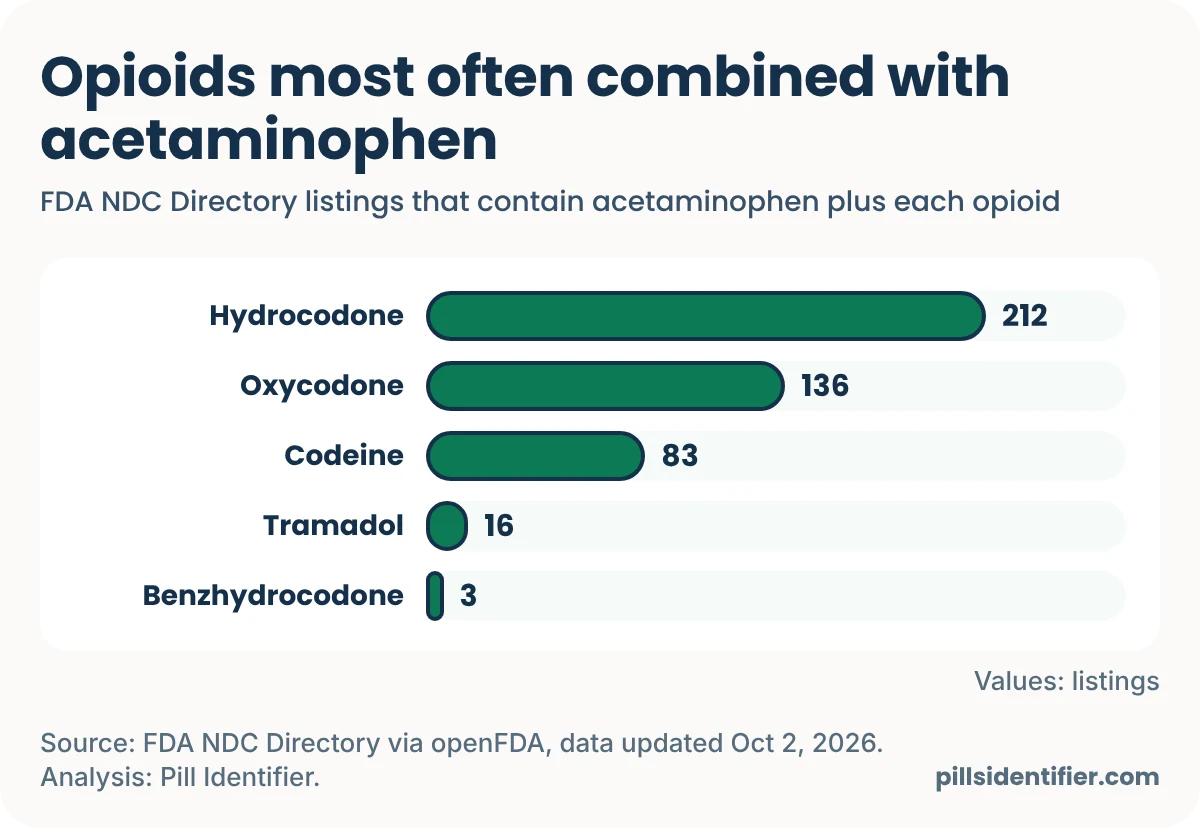
- The FDA’s National Drug Code Directory has 136 listings that combine oxycodone with acetaminophen, second only to hydrocodone (212), in data updated October 2, 2026 (our analysis).
- In 2024, 7,989 US overdose deaths involved natural and semisynthetic opioids, the group that includes oxycodone, hydrocodone and morphine, and the death rate fell 20.7% from 2023 (CDC).
- MedlinePlus warns that oxycodone can cause life-threatening breathing problems, especially in the first 24 to 72 hours of treatment and after a dose increase.
- The DEA says many counterfeit pills are made to look like oxycodone, and it has found fake “M30” tablets that contained fentanyl.
- The FDA lists oxycodone on its flush list for when no take-back option exists, while Australia’s healthdirect says never to flush medicines and to return them to a pharmacy.
What is oxycodone used for?
Oxycodone is an opioid (narcotic) pain reliever. MedlinePlus, from the US National Library of Medicine, says it is used to relieve severe pain and works by changing how the brain and nervous system respond to pain.
Australia’s healthdirect gives examples: pain after major injury or surgery, labor pain and cancer pain. It says oxycodone is generally meant for when other pain relief hasn’t worked or can’t be taken, and is only available with a prescription.
Immediate-release vs extended-release oxycodone
Oxycodone comes in two main types, and the difference matters for safety.
- Immediate-release (IR). Tablets, capsules and liquid that work quickly and are usually taken as needed for pain. In the US, Roxicodone and RoxyBond are immediate-release tablets, according to their FDA labels.
- Extended-release (ER). Tablets or capsules that release oxycodone slowly and are taken on a fixed schedule. Examples are OxyContin and Xtampza ER in the US, OxyNEO in Canada, and Targin, a modified-release tablet with naloxone, in Australia.
Extended-release tablets must be swallowed whole. MedlinePlus warns that chewing, breaking, crushing or dissolving them can release too much oxycodone at once instead of slowly over 12 hours, which can cause an overdose and death.
Combination products
- Oxycodone and acetaminophen (called paracetamol in Australia and India), sold in the US as Percocet. The FDA limits prescription combination products to 325 mg of acetaminophen per tablet and says not to go over the maximum total daily dose of 4,000 mg (4 grams) of acetaminophen. Read more in our guide to Percocet overdose.
- Oxycodone and aspirin, sold in the US as Percodan.
- Oxycodone and naloxone, sold in Australia as Targin. Healthdirect says the naloxone is there to reduce common side effects.
Oxycodone brand names by country
Brand names, legal status and disposal advice differ across our five countries. We checked each country’s official medicine database or health agency in October 2026.
| Country | Brands we verified | Combined with | Legal status | Disposal advice |
|---|---|---|---|---|
| United States | Roxicodone, RoxyBond (IR); OxyContin, Xtampza ER (ER); Oxaydo discontinued | Acetaminophen (Percocet), aspirin (Percodan) | Schedule II controlled substance (DEA) | Take-back first; flush only if no take-back option (FDA) |
| Puerto Rico | Same as the US | Same as the US | US federal rules apply | Same as the US |
| Canada | OxyNEO (ER), Supeudol, both listed as marketed (Health Canada Drug Product Database) | Not verified | Narcotic under the Controlled Drugs and Substances Act | Return to your local pharmacy (Health Canada) |
| Australia | Endone, OxyNorm, OxyContin (healthdirect) | Naloxone (Targin) | Schedule 8: Controlled Drug | Return to any pharmacy; never flush or bin (healthdirect) |
| India | No official brand list found | No official list found | Manufactured narcotic drug (S.O. 826(E), 1985); not on the National List of Essential Medicines 2022 | No national rule found |
By the numbers: oxycodone combination products in the US
We searched the FDA’s National Drug Code (NDC) Directory (data updated October 2, 2026) for every listing that contains acetaminophen, then counted which opioids appear alongside it. Oxycodone came second only to hydrocodone.
| Opioid in the listing | Listings that also contain acetaminophen |
|---|---|
| Hydrocodone bitartrate | 212 |
| Oxycodone (oxycodone hydrochloride 132, oxycodone 4) | 136 |
| Codeine phosphate | 83 |
| Tramadol hydrochloride | 16 |
| Benzhydrocodone hydrochloride | 3 |
These are listings in the FDA’s National Drug Code Directory, not products on pharmacy shelves. Many listings are repackagers selling the same tablet under a new code.
How many deaths involve oxycodone?
US death statistics group oxycodone with similar drugs. The CDC’s Data Brief 549 reports 7,989 overdose deaths in 2024 involving natural and semisynthetic opioids, which include morphine, codeine, hydrocodone and oxycodone. That was down from 10,112 in 2023, a 20.7% drop in the death rate. A death that involved more than one type of opioid is counted in each group.
How to identify oxycodone pills
Most oxycodone tablets carry an imprint, a code of letters and numbers stamped or printed on the pill. Imprints, colors and shapes differ by manufacturer and strength, so two real oxycodone tablets can look quite different.
- Type the imprint into our pill imprint search, or see pictures of oxycodone pills in our database.
- Use our NDC lookup to check the name, NDC or DIN on your bottle or box.
- If a refill looks different, your pharmacy may have switched manufacturers. Check the imprint and ask your pharmacist before you take it (see refill looks different).
We compiled the markings of brand-name oxycodone tablets from their official labels. Generic tablets from other makers have different markings.
| Brand (country) | Type | Marking | Color by strength |
|---|---|---|---|
| Roxicodone (US) | Immediate-release | “54 710” (15 mg) or “54 199” (30 mg), scored | 15 mg green; 30 mg blue |
| RoxyBond (US) | Immediate-release | “IDT/O” and the strength printed on one side | 5 mg white; 15 mg green; 30 mg blue |
| OxyContin (US) | Extended-release | “OP” on one side, strength on the other | 10 mg white; 15 mg gray; 20 mg pink; 30 mg brown; 40 mg yellow; 60 mg red; 80 mg green |
| Endone (Australia) | Tablet | “O 5” on one side, break bar on the other | 5 mg white, round |
| Targin 10/5 (Australia) | Modified-release, with naloxone | “OXN” on one side, “10” on the other | White, oblong |
Sources: FDA and DailyMed labels for Roxicodone (April 2026), OxyContin (December 2025) and RoxyBond (April 2017); healthdirect Australia (data updated October 1, 2026).
The fake “M30” warning
The DEA says many counterfeit pills are made to look like oxycodone, OxyContin and Percocet. In 2020 it reported that the most common counterfeit pill in Minnesota was an oxycodone substitute “known as M30’s for its markings”, and its 2026 warning materials show rainbow-colored fake M30 tablets that contained fentanyl.
A fake pill can carry the same imprint, color and shape as a real one, so a match in any pill identifier, ours included, doesn’t prove a pill is genuine. The DEA’s One Pill Can Kill fact sheet says pills bought outside a licensed pharmacy are illegal, dangerous and potentially lethal. Read our guides on fentanyl and fake pills and how to spot fake pills.
What are the side effects of oxycodone?
MedlinePlus and healthdirect list these common side effects:
- Constipation
- Nausea, vomiting or loss of appetite
- Drowsiness, tiredness or weakness
- Headache or dizziness
- Trouble falling or staying asleep
- Lower sex drive
Get medical help right away for serious effects: seizures, extreme drowsiness, chest pain or a change in heartbeat, trouble breathing or swallowing, or unusual snoring or long pauses in breathing during sleep (MedlinePlus).
What are the signs of an oxycodone overdose?
MedlinePlus lists these signs of an oxycodone overdose:
- Trouble breathing, or slow or shallow breathing
- Unusual snoring
- Extreme sleepiness, or the person can’t respond or wake up
- Limp or weak muscles
- Pupils that are very small or very large
- Cold, clammy skin and a slow heartbeat
If you see these signs, call 911 (or your local emergency number), give naloxone if you have it, and stay with the person. The FDA says naloxone can reverse an opioid overdose, and MedlinePlus advises asking your doctor or pharmacist about keeping naloxone or nalmefene at home if you take oxycodone. See our guides to opioid overdose and Narcan (naloxone).
Get help even if the person seems fine. Extended-release oxycodone is released slowly over hours, and Health Canada notes that naloxone lasts only 30 to 120 minutes while most opioids last longer, so symptoms can come back. If the pills also contained acetaminophen, tell the medical team, because too much acetaminophen can cause severe liver damage (FDA).
Which medicines are dangerous to mix with oxycodone?
- Benzodiazepines such as alprazolam (Xanax). In 2016 the FDA added its strongest warning because the combination can cause extreme sleepiness, slowed or difficult breathing, coma or death. See our guide to benzodiazepines.
- Alcohol, other medicines and street drugs. MedlinePlus warns these raise the risk of serious breathing problems, sedation or coma.
- Extra acetaminophen if you take Percocet or a similar product. Many cold and flu medicines also contain it. Our guide to acetaminophen overdose explains the risk to the liver.
Dependence, withdrawal and stopping safely
The DEA defines Schedule II drugs, including oxycodone, as drugs whose use can lead to severe psychological or physical dependence. Don’t stop taking it suddenly or cut back quickly without talking to your prescriber. MedlinePlus says your doctor will probably lower the dose gradually, and healthdirect advises reducing it under your doctor’s supervision after longer-term use.
Stopping suddenly can cause withdrawal symptoms such as restlessness, sweating, muscle aches, nausea and diarrhea (MedlinePlus). If you are worried about how you use oxycodone, talk to your doctor or pharmacist. Treatment for opioid use disorder works, and the WHO says medicines such as methadone and buprenorphine have the strongest evidence.
How to store and dispose of oxycodone
MedlinePlus warns that oxycodone can harm or kill other people who take it, especially children. Keep it in its original container, tightly closed, up and away and out of sight and reach of children, and somewhere visitors can’t easily get to.
Disposal rules differ by country:
- US and Puerto Rico: Use a drug take-back location or mail-back envelope first. If neither is available, the FDA’s flush list includes every medicine that contains oxycodone, so you can flush it.
- Canada: Health Canada asks people to return unneeded or expired prescription medicines to their local pharmacy, any day of the year.
- Australia: Healthdirect says to return unused oxycodone to any pharmacy and never to put medicines in the bin or flush them.
Our guide on how to dispose of unused medicines has more options.
Common questions
Is oxycodone the same as OxyContin?
OxyContin is a brand of extended-release oxycodone, which releases the drug slowly over about 12 hours. Oxycodone is the generic name, and it also comes as immediate-release tablets such as Roxicodone. Percocet is a different product that combines oxycodone with acetaminophen.
What schedule is oxycodone?
Oxycodone is a Schedule II controlled substance in the US, the same schedule as fentanyl and methadone (DEA). In Australia it is Schedule 8, a controlled drug. Canada lists it as a narcotic, and India lists it as a manufactured narcotic drug.
Are M30 pills real oxycodone?
Not always. The DEA says many fake pills are made to look like oxycodone, and it has found fake M30 tablets that contained fentanyl. Treat any pill that didn’t come from a pharmacy as possibly fake, even if its imprint matches a real medicine.
What does OxyContin look like?
According to its FDA label, OxyContin is a round, film-coated tablet with “OP” on one side and the strength on the other. The color changes with the strength, from white for 10 mg to green for 80 mg. Check any tablet in our pill imprint search, but remember that fakes can copy these markings.
Can you flush oxycodone?
In the US, the FDA says take-back is best, but oxycodone is on its flush list, so you can flush it if no take-back option is available. In Australia, healthdirect says never to flush medicines and to return them to a pharmacy instead. In Canada, return them to your local pharmacy.
Does naloxone work on an oxycodone overdose?
Yes. Naloxone reverses opioid overdoses, including those caused by oxycodone. Its effect lasts 30 to 120 minutes, which is shorter than most opioids, so the person still needs emergency care after it works (Health Canada).