Paracetamol Overdose: Treatment, Recovery and can it be fatal?
Paracetamol overdose is treated with an antidote drip that works best within 8 hours. See each hospital step, recovery times, death figures and how treatment differs by country.
Paracetamol (acetaminophen) overdose is treated in hospital with an antidote called acetylcysteine (NAC), usually given as a drip over 12 to 21 hours. It works best when started within 8 hours, and MedlinePlus says treatment in that window gives “a very good chance of recovery.” Without prompt care, it can cause liver failure and death, so get help now, even if the person feels fine.
At a glance
- The antidote, acetylcysteine (NAC), is most effective when started within the first 8 hours after an overdose, according to StatPearls (updated March 2026).
- Doctors measure paracetamol in the blood at least 4 hours after it was taken, because earlier results can’t be read on the treatment chart.
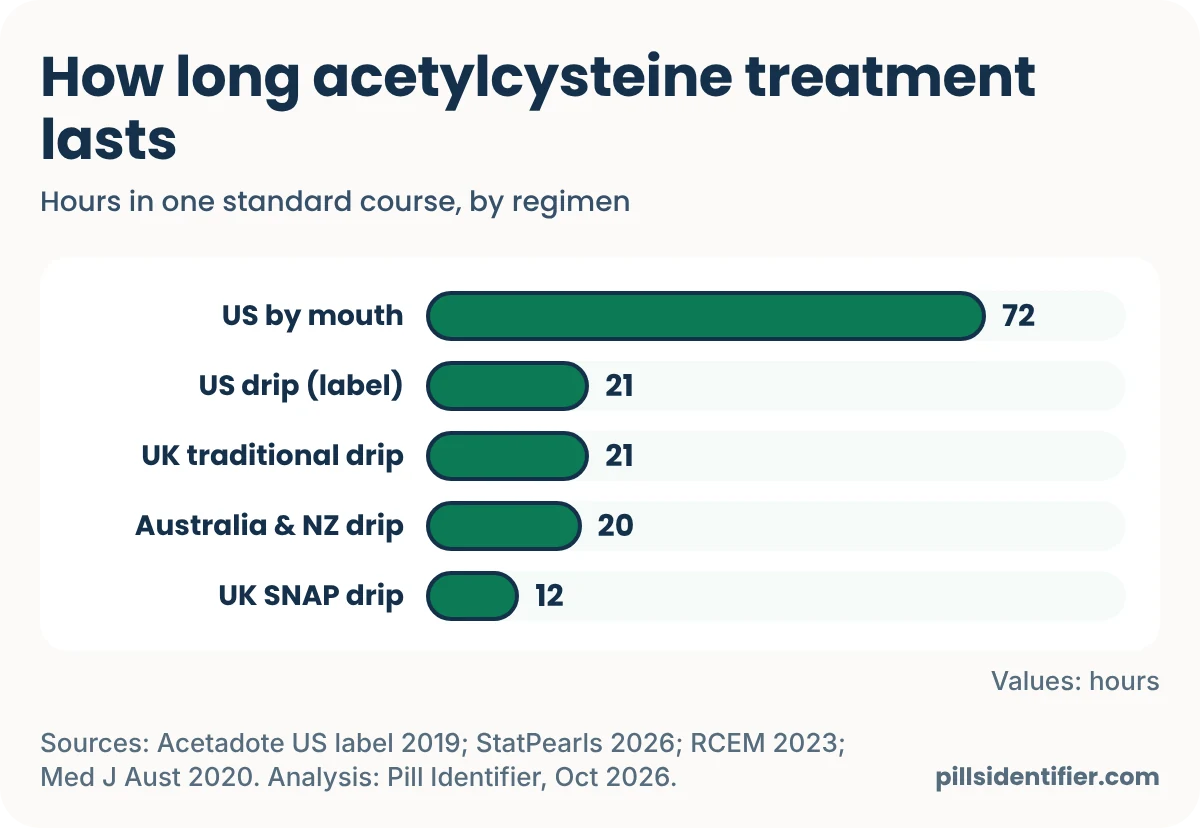
- The drip lasts 21 hours on the US label, 20 hours under the 2020 Australia and New Zealand guidelines, and 12 hours under the SNAP regimen that UK emergency doctors made their default in 2023.
- Acetaminophen (paracetamol) causes 50% of reported liver failure cases in the US, StatPearls says.
- In Australia, about 50 people die and about 225 are hospitalized with liver injury from paracetamol overdose each year, according to the TGA.
- After the UK limited paracetamol pack sizes in 1998, deaths from paracetamol poisoning in England and Wales fell by 43%, a 2013 BMJ study found.
How is a paracetamol overdose treated?
There is no home treatment. MedlinePlus says to “seek medical help right away,” even when the person has no symptoms. Paracetamol damages the liver slowly, so a person can feel well for the first day while harm builds.
Paracetamol and acetaminophen are two names for the same medicine. For symptoms, daily limits and how the liver damage happens, see our guide to acetaminophen (Tylenol) overdose symptoms and timeline. If you are not sure whether someone has overdosed at all, read our guide to the signs of an overdose.
What happens at the hospital, step by step?
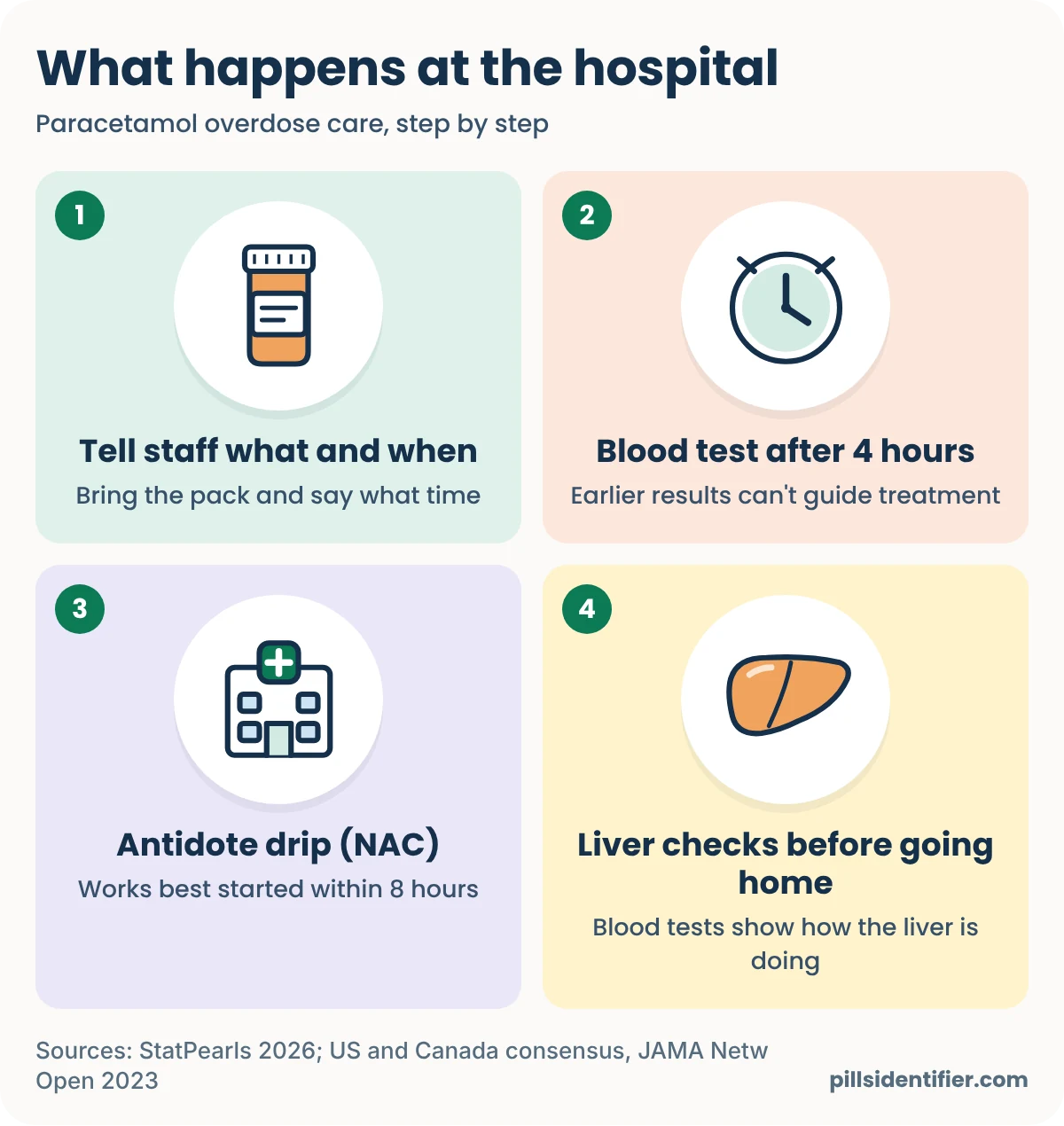
- Staff ask what was taken and when. The time matters most, because it decides how the blood test is read. Bring the pack or bottle if you can.
- Blood tests. Staff measure the paracetamol level and check the liver and blood clotting. The paracetamol level is read from a sample taken at least 4 hours after the overdose.
- Activated charcoal, in some early cases. If the person arrives within a few hours of a single overdose and is awake, doctors may give activated charcoal to help stop the body absorbing paracetamol still in the gut.
- The antidote. If the blood level is on or above the treatment line, or the timing is unknown, the person gets acetylcysteine, usually through a drip.
- Liver checks. Doctors repeat liver blood tests. If results keep getting worse, the antidote can be continued and a liver transplant team may be contacted.
- A mental health assessment, if the overdose was intentional.
How do doctors decide who needs the antidote?
Doctors plot the paracetamol blood level against the hours since the overdose on a chart called a nomogram (the Rumack-Matthew nomogram). If the result lands on or above the treatment line, the person gets acetylcysteine. In the UK, the MHRA changed its advice in 2012 so that everyone on or above a single treatment line is treated “regardless of risk factors” such as alcohol use or poor nutrition.
The chart only works for a single overdose taken at a known time. A 2023 consensus statement from US and Canadian toxicology experts says a sample drawn before 4 hours “cannot be used” on the nomogram. After a large overdose, though, doctors should not hold back the antidote if waiting for the test would push treatment past 8 hours.
How does acetylcysteine work?
When the liver breaks down paracetamol, it makes a small amount of a harmful by-product called NAPQI, which the liver normally neutralizes with a protective substance called glutathione. StatPearls explains that acetylcysteine stands in for glutathione and helps the body make its own antioxidants, which protects liver cells.
It can be given as a drip or by mouth. The US label for the drip says the best protection against severe liver injury comes when treatment starts within 0 to 8 hours. Doctors still give it to people who arrive later or don’t know when they took the pills.
Does the antidote have side effects?
StatPearls says about 5% of people given the drip have a reaction called an anaphylactoid reaction, mostly early in the drip. The newer two-bag regimens used in Australia and the UK cause fewer of these reactions. The MHRA says a past reaction does not rule out treatment, because the benefits outweigh the risks.
What if the overdose was taken over several hours or days?
Doctors call it a staggered overdose when paracetamol is taken in several lots over a period of time. When a person takes more than the label allows, day after day, they call it a repeated supratherapeutic ingestion. This often happens by accident, for example when someone with flu takes a pain reliever and a cold remedy that both contain paracetamol.
These overdoses are harder to judge. StatPearls says the nomogram cannot be used, because there is no single time to measure from. The MHRA says that if there is any doubt about the timing, including overdoses taken over one hour or more, acetylcysteine “should be given without delay.” The US and Canada consensus says that for repeated overdoses over more than 24 hours, care depends on the person’s symptoms and blood tests.
If you have taken more than the label allows for a few days, or can’t remember how much you took, call your poison center or go to the emergency department. Don’t wait for symptoms.
Our analysis: acetylcysteine regimens by country
The antidote is the same everywhere, but the way it is given differs. We compiled this table in October 2026 from each country’s approved drug label and its national or professional treatment guidelines, and where we found no national guideline, we say so.
| Country | Main guidance | Drip regimen | Other details |
|---|---|---|---|
| United States | No formal national guideline; 2023 US and Canada expert consensus (JAMA Network Open) | 3 infusions over 21 hours (Acetadote label, revised 2019) | A by-mouth course over 72 hours is also used (StatPearls) |
| Puerto Rico | Follows US federal rules; no local guideline found | Same as the US | Same as the US |
| Canada | No formal national guideline; same 2023 consensus | 3 infusions over about 20 hours (Health Canada product monograph, 2023) | The consensus covers both the US and Canada |
| United Kingdom | MHRA guidance (2012); Royal College of Emergency Medicine position statement (May 2023) | Traditional: 3 infusions over 21 hours. Recommended default: SNAP, 2 infusions over 12 hours | One treatment line for everyone since 2012 |
| Australia and New Zealand | Australia and New Zealand guidelines, Medical Journal of Australia (2020) | 2 infusions over 20 hours | Replaced the 3-bag regimen: similar effect, fewer reactions |
| India | No national guideline found | No national regimen found | Acetylcysteine sachets and injection are on the National List of Essential Medicines 2022 |
Faster regimens exist because the older three-bag drip causes more reactions and keeps people in hospital longer. The Royal College of Emergency Medicine says the 12-hour SNAP regimen is “as effective as the traditional regimen in preventing liver injury, with fewer adverse reactions.” The Australia and New Zealand guidelines moved to a two-bag drip for the same reason.
The US and Canada consensus counts at least 15 regimens in the medical literature and notes that good studies comparing them are not available. If you are treated away from home, your drip may run for a different length of time. That is normal: each one is an accepted way to give the antidote.
Can a paracetamol overdose be fatal?
Yes. A paracetamol overdose can cause liver failure and death. StatPearls says acetaminophen causes 50% of reported liver failure cases in the US and 20% of US liver transplants, and Health Canada calls it a leading cause of acute liver failure in Canada.
It is not quick or painless. The liver is damaged over several days, and people can become very ill with vomiting, belly pain, yellow skin, confusion and bleeding problems. Deaths most often happen on the third and fourth days, and some people who survive need a liver transplant.
Early treatment prevents most of this harm. StatPearls reports that:
- the risk of liver damage is very low when the antidote starts within 8 hours, but about 40% of people develop it when treatment is delayed beyond 16 hours;
- fewer than 2% of people die when they are treated promptly;
- once liver failure develops, 28% of people die.
By the numbers: paracetamol overdose harm by country
| Country | What the figures show | Year and source |
|---|---|---|
| United States | More than 80,000 poison center cases involved an acetaminophen product | 2021; US and Canada consensus statement, 2023 |
| United States | Acetaminophen was among the substance groups linked to the most deaths reported to poison centers | 2024; National Poison Data System |
| Puerto Rico | No separate figure found | None |
| Canada | About 4,500 hospitalizations a year because of acetaminophen overdose | US and Canada consensus statement, 2023 |
| Australia | About 225 people hospitalized with liver injury and 50 deaths each year | TGA, pack-size decision (in force February 1, 2025) |
| United Kingdom | Deaths from paracetamol-only poisoning (suicide or undetermined intent) in England and Wales fell 43%, an estimated 765 fewer deaths, over the 11¼ years after 1998 pack-size limits | BMJ, 2013 |
| India | No national figure found | None |
For more on how poisoning affects the body, see what happens in the body during an overdose.
How long does recovery take?
When blood tests are reassuring at the end of treatment, many people can leave soon after the drip finishes, once any mental health assessment is done. When the liver has been damaged, recovery takes longer. StatPearls says recovery typically begins by day 4 and is complete by day 7, but symptoms and blood tests can take several weeks to return to normal.
The long-term outlook is good for people who recover without a transplant. StatPearls says they “are not expected to have any long-term liver dysfunction.” When the liver is failing, doctors use set criteria, such as the King’s College Criteria, to decide who should go to a liver transplant center.
Support after an intentional overdose
If the overdose was intentional, the hospital should care for your mental health as well as your liver. In the UK, NICE self-harm guidance (last reviewed August 2024) says people should be offered a psychosocial assessment “as soon as possible after arrival,” without waiting until medical treatment is finished. It also recommends:
- a safety plan made together with the person, including steps to restrict access to means of self-harm at home;
- follow-up care within 48 hours of the assessment when there are ongoing safety concerns;
- clear written communication with the person’s family doctor.
Wherever you are, ask the care team before you leave who will follow up with you and when. You can call or text a crisis line at any time; the numbers are in the boxes at the top and bottom of this page.
Who is most at risk of serious harm?
- People who arrive late, because the risk of liver damage rises the longer the antidote is delayed.
- People who took paracetamol over several hours or days, because the blood test is harder to read.
- People who took modified-release paracetamol, such as Panadol Osteo in Australia. The TGA says these overdoses are “very difficult to treat in emergency situations.”
- Teens and young adults in Australia, who have the highest rates of intentional overdose, according to the TGA.
Make sure you know what was taken
Tell staff if it was a cold and flu medicine, a modified-release tablet, or a prescription pill such as Percocet, which contains both oxycodone and acetaminophen. Our guide to Percocet overdose explains why combination pills carry two dangers, and our guide to ibuprofen overdose covers a pain reliever that harms the body in a different way.
If you find loose tablets, enter the imprint (the letters and numbers stamped on the pill) in our pill imprint search, use our NDC and DIN lookup with the number on the box, or see pictures of acetaminophen pills. Pills bought outside a pharmacy can copy real imprints exactly, so a matching imprint does not prove what is inside. Read how to spot fake pills to learn more.
To lower the risk of another overdose, use one paracetamol product at a time, keep only small amounts at home, and dispose of unused medicines safely.
Common questions
How long do you stay in hospital after a paracetamol overdose?
The drip itself takes about 12 to 21 hours, depending on the regimen your hospital uses, and some hospitals give the antidote by mouth over 72 hours instead. You may stay longer if blood tests show the liver is affected, or while a mental health assessment is arranged.
Is it too late to treat a paracetamol overdose after 24 hours?
No. Get help right away, whatever the time. StatPearls says doctors should start the antidote immediately if the time of the overdose is unknown, and it may still help people whose liver is failing days later.
Can you survive a paracetamol overdose?
Yes. StatPearls says fewer than 2% of people die when treated promptly, and MedlinePlus says treatment within 8 hours gives “a very good chance of recovery.” The risk of liver damage rises sharply when treatment is delayed, so go to hospital even if you feel well.
Does a paracetamol overdose cause permanent liver damage?
Usually not. StatPearls says people who recover without a liver transplant are not expected to have long-term liver problems, although blood tests can take several weeks to return to normal. In the most severe cases, the liver fails and a transplant may be needed.
What is the antidote for paracetamol overdose?
The antidote is acetylcysteine, also called N-acetylcysteine or NAC. It helps the liver deal with the harmful by-product made when paracetamol is broken down. Hospitals give it as a drip or by mouth, and there is no home treatment.
Is a paracetamol overdose painful?
It often is. The harm builds over days, with vomiting, belly pain, yellow skin, confusion and bleeding problems, and some people need a liver transplant. It is not quick or peaceful. If you are thinking about harming yourself, please call or text a crisis line now; the numbers are in the box below.