Warfarin Overdose: Bleeding Signs, Treatment And Pill Colors To Know
What too much warfarin looks like, when to get emergency help, how hospitals reverse it, and our check of warfarin tablet colors in five countries.
A warfarin overdose means you have too much of this blood thinner in your body, which raises your risk of serious bleeding. It can happen after an extra dose, when a new medicine or diet change boosts warfarin’s effect, or when a child swallows a tablet. Signs can take hours or days to appear, so call your anticoagulation clinic or poison control right away, even if you feel fine.
At a glance
- The FDA label carries a boxed warning that warfarin “can cause major or fatal bleeding” and calls for regular INR blood tests for everyone who takes it.
- After a large ingestion, clotting tests are not expected to rise for about 12 hours, according to StatPearls, so an early normal test does not rule out a problem.
- US poison centers recorded 1,766 single exposures to prescription warfarin in 2014, and 84% were unintentional, StatPearls reports.
- In US adults 65 and older, blood thinners, diabetes medicines and opioid pain relievers were together implicated in an estimated 59.9% of emergency visits for harms from medicines in 2013 and 2014 (JAMA, 2016).
- Every US and Canadian warfarin label we checked in October 2026 uses the same color for each strength, from pink 1 mg to white 10 mg.
- Australia’s two brands, Coumadin and Marevan, are not interchangeable, the TGA says, and their colors differ: a green tablet is 5 mg in Australian Coumadin but 2.5 mg in the US.
What counts as a warfarin overdose?
Warfarin (sold as Jantoven and generic warfarin, and as Coumadin or Marevan in some countries) is a blood thinner. It blocks the vitamin K cycle your body uses to switch on clotting factors, according to StatPearls. It has a narrow therapeutic index: the gap between a dose that protects you and one that causes bleeding is small.
Too much warfarin usually happens in one of three ways:
- An extra dose by mistake, such as taking a dose twice or mixing up two tablet strengths.
- Something else boosts its effect. The FDA label says “drugs, dietary changes, and other factors affect INR levels,” even when you take your dose exactly right.
- Someone swallows tablets that aren’t theirs, most often a young child.
Doctors measure warfarin’s effect with a blood clotting test called the INR. A higher INR means your blood takes longer to clot, so bleeding is more likely.
What are the signs of too much warfarin?
Bleeding is the main sign. It can be obvious, like a nosebleed, or hidden inside the body. These lists come from MedlinePlus, the NHS and the FDA label.
Call emergency services (911 in the US) for:
- A sudden, severe headache, especially with confusion, slurred speech, trouble moving your arms or legs, or being sick. The NHS says this can mean bleeding in the brain.
- Vomiting blood or material that looks like coffee grounds, or coughing up blood
- Red, black or tarry stools
- Bleeding that won’t stop
- Collapse, a seizure, trouble breathing, or a person who can’t be woken
Call your doctor or anticoagulation clinic right away for:
- Nosebleeds or bleeding gums
- Easy bruising, or small, flat, round red spots under the skin
- Pink, red or dark brown urine
- Heavier periods or unusual vaginal bleeding
- Small cuts that keep oozing
- New headache, dizziness or weakness
- Any fall with an injury, “especially if you hit your head,” MedlinePlus says
StatPearls says outcomes are generally good with treatment, but bleeding in the brain usually has “poor outcomes,” so a bad headache or head injury always needs urgent care. See also signs of an overdose.
What should you do if you took too much warfarin?
- Call emergency services for heavy bleeding or a severe headache, or if the person has collapsed, had a seizure, has trouble breathing or can’t be woken.
- Otherwise, call poison control or your anticoagulation clinic now, even if you feel fine. In the US, the Poison Help line is 1-800-222-1222. Warfarin’s effect builds over hours, so problems can show up later.
- Have the bottle ready. Say which strength you take, how much extra was taken and when. Ask what to do about your next dose rather than changing it yourself.
- Don’t try to undo it at home. Don’t make yourself vomit, and don’t take vitamin K pills or eat lots of greens to “reverse” it. The NHS advises against vitamin K supplements on warfarin; reversal is a doctor’s decision.
- Watch for bleeding signs over the next several days.
What if you took a double dose by accident?
Treat it as urgent. The NHS says “taking an extra dose of warfarin can be dangerous” and tells anyone who took more than their prescribed dose to get help. For people already on warfarin, StatPearls recommends an INR test and a recheck about 2 days later, because it can keep rising.
What if you missed a dose?
Never take two doses to make up for a missed one. The US label says to take a missed dose as soon as possible on the same day; the NHS says to skip it if you don’t remember until the next day. Follow your own clinic’s instructions.
What if a child swallowed warfarin?
Call poison control right away, even if the child seems completely well. StatPearls notes that warfarin poisoning in children can follow “exploratory ingestion,” when a young child finds and swallows a pill. Because clotting tests may not change for about 12 hours, the poison center may advise watching the child or blood tests.
MedlinePlus advises keeping warfarin “out of sight and reach of children as many containers are not child resistant.” A locked box helps. For old tablets, see how to dispose of unused medicines.
How do hospitals treat a warfarin overdose?
Treatment depends on whether the person is bleeding and how high the INR is.
- No bleeding: Doctors may hold warfarin, recheck the INR and decide whether vitamin K is needed. StatPearls says plasma and clotting factor treatments are not for people who aren’t bleeding.
- Vitamin K: This is warfarin’s antidote. By IV it often reverses the effect within 4 to 6 hours; by mouth it can take up to 24 hours, StatPearls says.
- Prothrombin complex concentrate (PCC): For serious bleeding, this concentrate of clotting factors can reverse the effect within 15 to 30 minutes.
- Fresh frozen plasma: Used when PCC isn’t available, though it often takes several hours to give.
StatPearls notes that warfarin poisoning usually means a hospital stay. Your doctor will decide when it’s safe to restart warfarin.
Which foods, medicines and supplements raise the risk?
StatPearls says most drug interactions push the INR up, unless the other medicine speeds up certain liver enzymes (a CYP450 inducer), which can push it down. A high INR raises bleeding risk; a low one means warfarin may not protect you from clots.
| Type | Examples named by MedlinePlus, the NHS or StatPearls |
|---|---|
| Antibiotics and antifungals | Antibiotics in general, metronidazole, antifungals |
| Pain relievers | Aspirin and NSAIDs such as ibuprofen or naproxen |
| Other medicines | Amiodarone, cimetidine, omeprazole, famotidine, antidepressants, statins |
| Supplements and herbs | St. John’s wort, ginkgo, garlic, ginseng, echinacea, goldenseal, coenzyme Q10, vitamin K supplements |
| Food and drink | Leafy greens and some vegetable oils (vitamin K), cranberry products, grapefruit juice, large amounts of alcohol |
| Health changes | Thyroid changes, reduced kidney function, liver disease |
Ask a pharmacist before starting or stopping anything on this list, and keep vitamin K in your diet steady from week to week, as MedlinePlus advises. See our guides to aspirin overdose and ibuprofen overdose, and can you overdose on vitamins.
Who is most at risk?
- Older adults. A CDC-led study in JAMA (2016) named warfarin among the 15 drugs most often behind emergency visits for medicine harms in people 65 and older.
- People starting warfarin or changing their dose, a time StatPearls flags for unintentional toxicity.
- Anyone starting or stopping another medicine, especially an antibiotic.
- People with liver disease, kidney problems or thyroid changes.
- Young children in homes where an adult takes warfarin.
- People who switch brands or travel, because colors and brands differ between countries.
Warfarin tablet colors: our five-country check
On every US and Canadian label we checked, warfarin’s color tells you the strength, which helps you spot a mix-up.
How we did this: We compared the tablet descriptions in three US warfarin labels on FDA websites (Teva and Amneal tablets, dated January 2023 to September 2026), Upsher-Smith’s Jantoven product page, Health Canada’s Taro-Warfarin monograph (authorized April 8, 2026), and Australian government pages from the TGA and HealthyWA, checked October 2026.
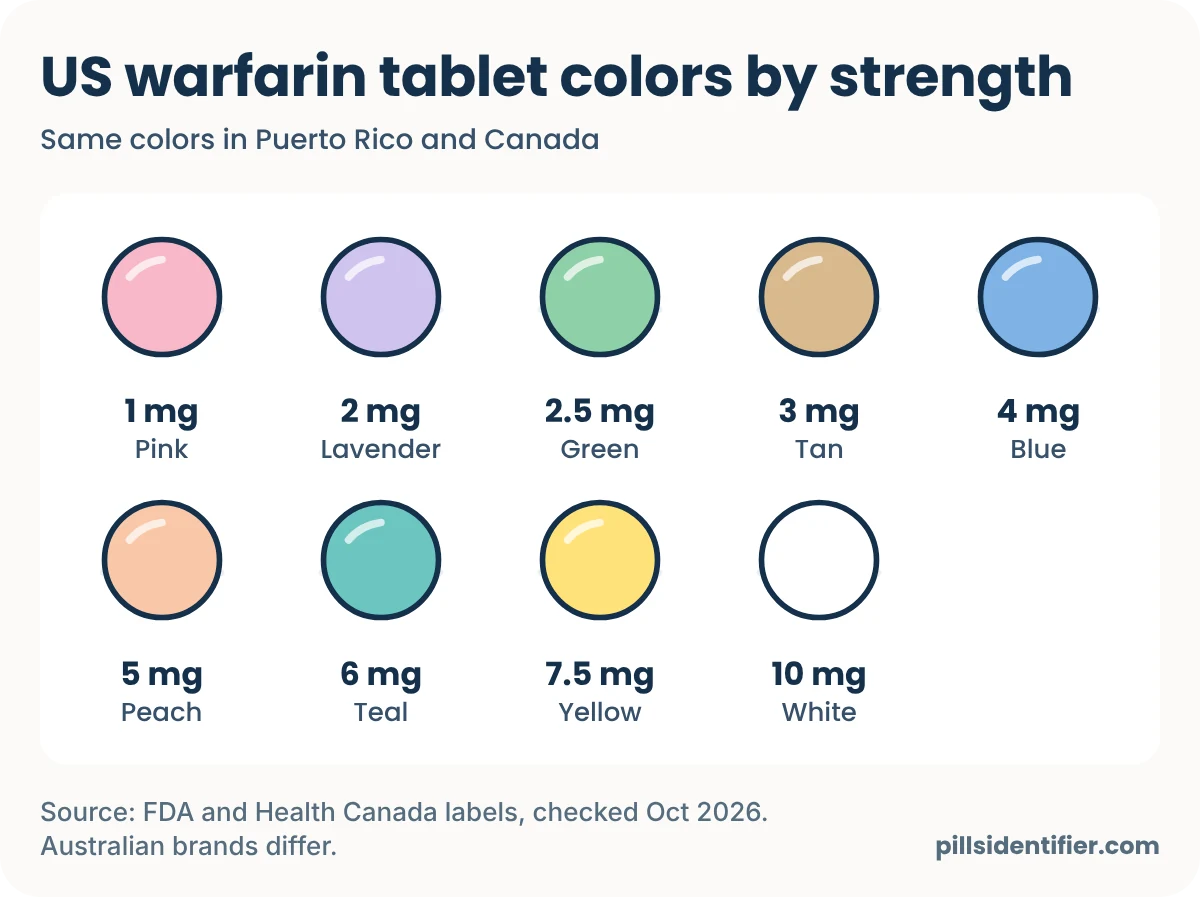
| Strength | Label color | FDA listing color | Teva imprint | Amneal imprint |
|---|---|---|---|---|
| 1 mg | Pink | Pink | TV/1, 1712 | 761 1, AN |
| 2 mg | Lavender | Purple | TV/2, 1713 | 762 2, AN |
| 2.5 mg | Green | Green | TV/2½, 1714 | 763 2½, AN |
| 3 mg | Tan | Brown | TV/3, 1715 | 764 3, AN |
| 4 mg | Blue | Blue | TV/4, 1716 | 765 4, AN |
| 5 mg | Peach | Orange | TV/5, 1721 | 766 5, AN |
| 6 mg | Teal | Turquoise | TV/6, 1718 | 767 6, AN |
| 7.5 mg | Yellow | Yellow | TV/7½, 1719 | 768 7½, AN |
| 10 mg | White | White | TV/10, 1720 | 769 10, AN |
Imprints show the scored side, then the other side. Jantoven and Canada’s Taro-Warfarin use the same nine colors; Taro tablets read “WARFARIN” plus the strength on one side and “TARO” on the other. Puerto Rico follows US FDA rules, so the same tablets apply.
One finding matters if you search a pill database. The label text says lavender, tan, peach and teal, but the FDA’s structured listing data for the same Amneal tablets records them as purple, brown, orange and turquoise. If a color search finds nothing, try the broader name.
Australia: two brands, two color codes
The TGA says Coumadin and Marevan “are not bioequivalent and should not be interchanged unless under medical supervision.” HealthyWA advises: “Always use the same brand unless your doctor specifically tells you to change.”
| Strength | Coumadin | Marevan |
|---|---|---|
| 1 mg | Light tan | Brown |
| 2 mg | Lavender | Not listed |
| 3 mg | Not listed | Blue |
| 5 mg | Green | Pink |
Three colors clash with the US scheme. Green is 2.5 mg in the US but 5 mg Coumadin in Australia. Pink is 1 mg in the US but 5 mg Marevan. Blue is 4 mg in the US but 3 mg Marevan. If you move or travel, go by the strength stamped on the tablet and box, not the color.
All five countries side by side
| Country | Warfarin brands we found | Tablet colors | Good to know |
|---|---|---|---|
| United States | Generic warfarin, Jantoven; MedlinePlus also lists Coumadin | Same color per strength on every label we checked | Database color names can differ |
| Puerto Rico | Same FDA-approved products as the US | Same as the US | No separate local rule found |
| Canada | Generic warfarin such as Taro-Warfarin | Same nine colors as the US | Coumadin 1 mg was discontinued August 31, 2020 |
| Australia | Coumadin, Marevan | Different colors for each brand | Not interchangeable |
| India | Warf, Uniwarfin | No national color code found | Acitrom is acenocoumarol, a related but different blood thinner |
In India, don’t swap warfarin and acenocoumarol (Acitrom) on your own. Both are coumarin blood thinners, but they are different medicines.
How can you check a warfarin tablet?
- Use color, imprint and strength together. Search the code in our pill imprint search, see pictures of warfarin pills, or identify a pill by color and shape.
- Refill looks different? A new maker can change the shape and imprint, but on every US label we checked, the color still matched the strength. If it doesn’t, ask your pharmacist first. See what to do if your refill looks different.
- Found a loose tablet? Don’t take it. Fake pills can look identical to real ones, so a matching imprint doesn’t prove a pill is real; see how to spot fake pills.
How can you prevent a warfarin overdose?
- Take warfarin at the same time every day, with a pill organizer or a written dose record.
- Keep every INR appointment, and ask about an extra test when another medicine starts or stops.
- Tell every doctor, dentist and pharmacist you take warfarin. The NHS gives patients an anticoagulant alert card to carry at all times.
- If your dose changes, ask what to do with tablets of the old strength so they don’t get mixed up.
- Store warfarin out of sight and reach of children, ideally locked.
Common questions
What happens if you accidentally take 2 warfarin pills?
An extra dose can raise your INR and bleeding risk, so call your anticoagulation clinic, doctor or poison control right away, even if you feel fine. They may order an INR test and change your next doses. Don’t adjust doses on your own.
How long does it take for a warfarin overdose to show?
StatPearls says clotting tests are not expected to rise for about 12 hours after a large ingestion, and they can keep rising after that. That’s why you should get help even if the person seems fine at first.
What is the antidote for warfarin?
Vitamin K is the antidote, given in hospital by IV or by mouth. For serious bleeding, doctors also use prothrombin complex concentrate or fresh frozen plasma to replace clotting factors. Don’t take vitamin K at home unless a doctor tells you to.
Can a warfarin overdose kill you?
Yes. The FDA label warns that warfarin “can cause major or fatal bleeding,” and bleeding in the brain usually has a poor outcome. With quick treatment most people recover, so call for help as soon as you suspect too much warfarin.
What color is a 5 mg warfarin tablet?
In the US, Puerto Rico and Canada, 5 mg warfarin is peach on every label we checked. In Australia, 5 mg Coumadin is green and 5 mg Marevan is pink. Always check the strength stamped on the tablet too.
Is warfarin the same as rat poison?
Not exactly. Many rat and mouse poisons contain “superwarfarins,” which StatPearls calls considerably more potent than prescription warfarin. If anyone swallows rodent bait, call poison control right away.