Fentanyl: What It Is, Fake Pills And Overdose Risk
What fentanyl is, why fake pills that match real imprints can still contain it, how naloxone helps, and how the US, Puerto Rico, Canada, Australia and India compare.
Fentanyl is a synthetic opioid that is up to 50 times stronger than heroin and 100 times stronger than morphine, according to the CDC. Doctors prescribe it as skin patches, lozenges and injections for severe pain. Most recent fentanyl overdoses, though, are linked to illegally made fentanyl, which is often pressed into fake pills that look almost exactly like real oxycodone, Xanax or Adderall.
At a glance
- The CDC says fentanyl is up to 50 times stronger than heroin and 100 times stronger than morphine.
- In 2024, 47,735 US overdose deaths involved synthetic opioids other than methadone (mainly fentanyl), which is 88% of the 54,045 opioid overdose deaths that year (CDC data, our calculation).
- DEA lab testing found that 29% of fentanyl pills tested in fiscal year 2025 contained a potentially lethal dose, down from about 7 in 10 in 2023.
- In Canada, fentanyl was involved in more than 70% of apparent opioid toxicity deaths in 2024, by our calculation from Public Health Agency of Canada data.
- Naloxone (Narcan) reverses fentanyl overdoses, but more than one dose may be needed, according to SAMHSA.
- You can’t see, smell or taste fentanyl, so you can’t tell by looking whether a pill or powder contains it (CDC).
What is fentanyl?
Fentanyl is a man-made (synthetic) opioid. The CDC describes two kinds: pharmaceutical fentanyl, which doctors prescribe for severe pain, and illegally made fentanyl, which is sold through illegal drug markets.
Prescription fentanyl
Fentanyl was first made in 1959 and came into use in the 1960s as an anesthetic given into a vein, according to the DEA. In the US it is approved for pain in several forms: skin patches (such as Duragesic), lozenges (such as Actiq), tablets that dissolve against the cheek or under the tongue, under-the-tongue and nasal sprays, and injections. It is a Schedule II controlled substance under US federal law.
In Canada, fentanyl is prescription only and usually comes as a slow-release patch. Health Canada advises keeping your supply in a secure place and disposing of used patches properly (see how to dispose of unused medicines).
Illegally made fentanyl
Illegally made fentanyl comes as a powder or a liquid. The CDC says it is commonly mixed with heroin, cocaine and methamphetamine and made into pills that look like prescription opioids. In liquid form it has been found in nasal sprays, eye drops, and dropped onto paper or small candies.
Fentanyl also turns up where people don’t expect it. In its 2025 National Drug Threat Assessment, the DEA reported that one in four cocaine samples and one in eight methamphetamine samples it tested also contained fentanyl.
How strong is fentanyl compared with morphine?
The CDC says fentanyl is up to 100 times stronger than morphine and 50 times stronger than heroin, and the DEA gives the same comparison. That strength is why the DEA tracks how many seized pills carry a potentially lethal dose (see our table below).
Why is fentanyl behind most opioid deaths?
Fentanyl and similar synthetic opioids now drive most opioid deaths in the US and Canada. The CDC says most recent fentanyl overdoses are linked to illegally made fentanyl, not prescriptions.
Final US data for 2024 from the CDC’s National Center for Health Statistics (Data Brief 549) count 79,384 overdose deaths. Of these, 54,045 involved an opioid, and 47,735 involved synthetic opioids other than methadone. That group is mainly fentanyl but also includes fentanyl analogues and tramadol. By our calculation, it accounts for 88% of opioid overdose deaths and 60% of all overdose deaths.
The numbers are falling. The synthetic opioid death rate dropped 35.6% from 2023 to 2024, and provisional CDC data show an estimated 69,973 overdose deaths in 2025, the third yearly fall in a row.
Canada shows the same pattern. The Public Health Agency of Canada reports that fentanyl without analogues was involved in 41% of apparent opioid toxicity deaths in 2024, and fentanyl together with fentanyl analogues in over 30%. Combined, by our count, that is more than 70%. Canada recorded 5,608 opioid-related deaths in 2025, an average of 15 a day.
Fake pills: how fentanyl hides in counterfeit medicines
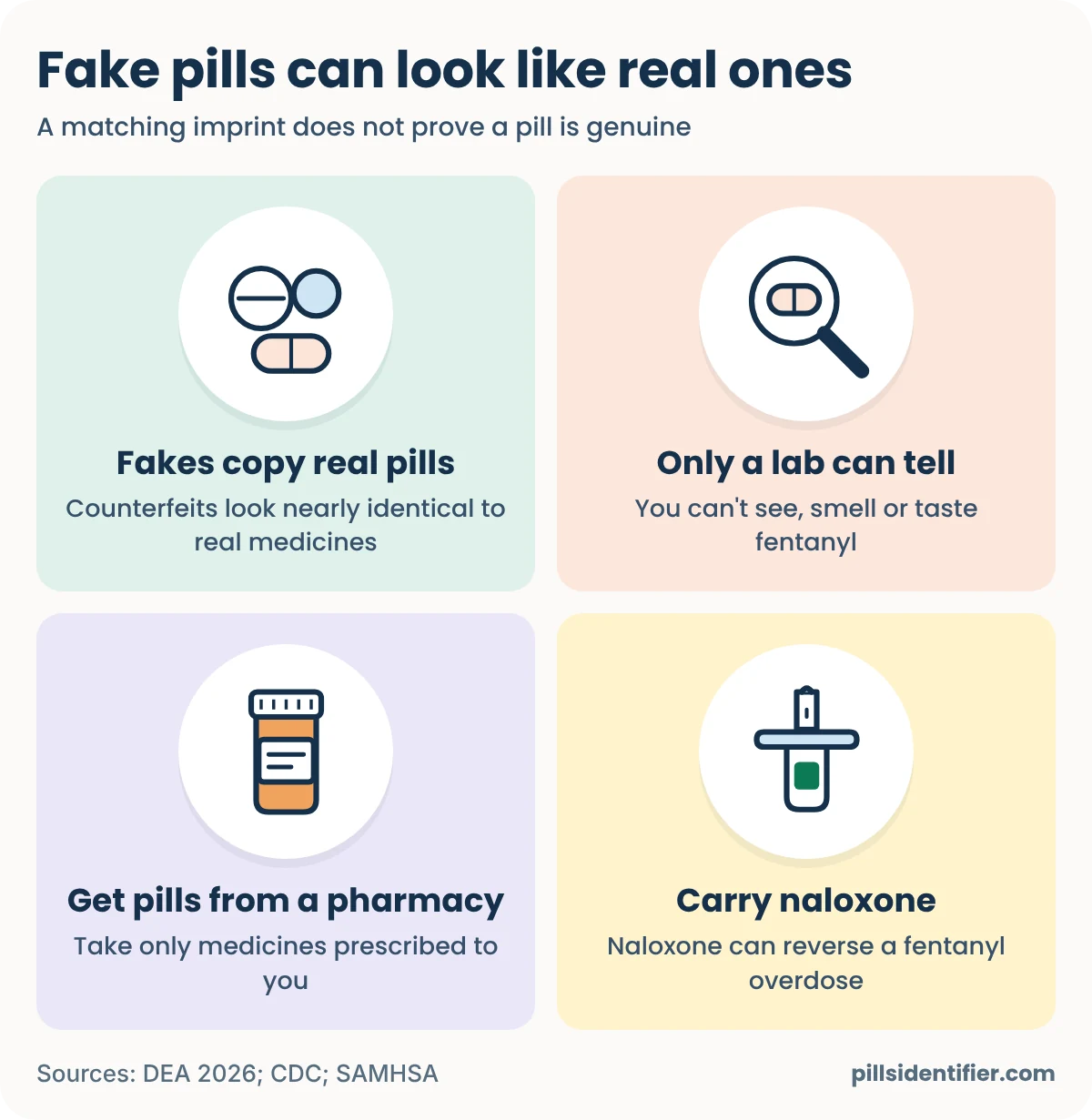
Criminal groups press fentanyl into pills made to look like OxyContin, Percocet, Xanax, Adderall and other medicines, according to the DEA’s One Pill Can Kill fact sheet. The DEA says these counterfeit pills contain no real medicine and are nearly identical to genuine prescription pills. Its warning materials show fake oxycodone tablets stamped “M30”, including “rainbow” versions in bright colors.
The DEA seized more than 47 million fentanyl pills in 2025, and counterfeit pills have been found in all 50 states and the District of Columbia. The DEA says internet marketplaces and social media are the major sources of fake pills, and that no pill bought on social media is safe.
By the numbers: how many fake pills carry a potentially lethal dose?
Each year the DEA’s labs test seized fentanyl pills and report the share that contains a potentially lethal dose. We compiled every yearly figure it has published since 2021.
| Year tested | Share with a potentially lethal dose | Where the DEA reported it |
|---|---|---|
| 2021 | 4 in 10 | DEA laboratory testing alert |
| 2022 | 6 in 10 | DEA laboratory testing alert |
| 2023 | 7 in 10 | DEA press release, December 2024 |
| 2024 | 5 in 10 | DEA press release, December 2024 |
| Fiscal year 2025 | 29% | DEA fact sheets, February and March 2026 |
Method: we collected the DEA’s lab-testing figures from its public alerts, press releases and fact sheets published from 2022 to 2026 (checked October 2026). The DEA rounded to “out of 10” until 2024 and gave an exact 29% for fiscal year 2025. Its February 2026 report puts the exact figure for fiscal year 2023 at 76%.
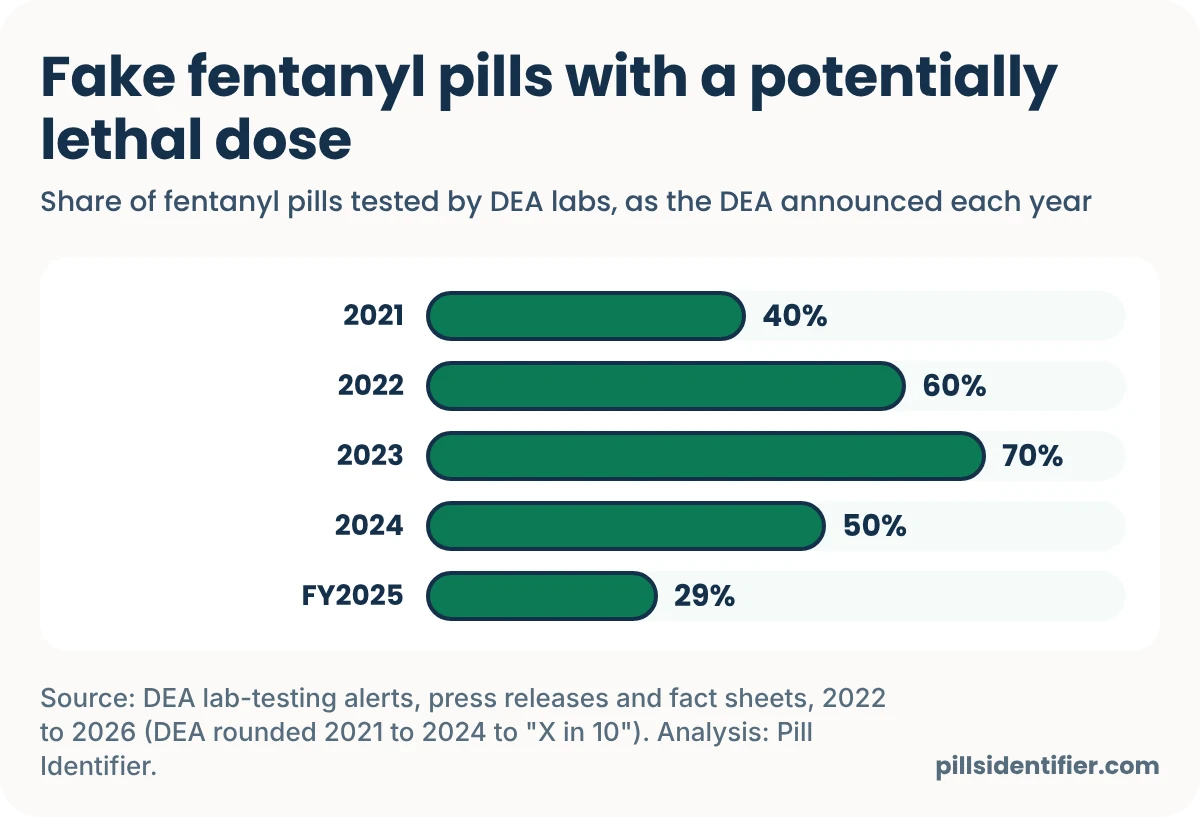
The drop is real progress, but 29% still means roughly 3 in 10 fentanyl pills tested carried a potentially lethal dose.
Can a pill identifier tell if a pill is fake?
No. A pill identifier, ours included, matches a pill’s imprint, color and shape to the label of a real medicine. Counterfeiters copy exactly those features. A fake “M30” may match a real oxycodone listing in any imprint search, including our pill imprint search, because it was made to.
So a match tells you what a pill is supposed to be, not what is in it. You can’t see, smell or taste fentanyl, and only lab testing can show what a pill contains. The DEA’s advice is to take only medicines prescribed by a licensed professional and dispensed by a pharmacist.
Our tools are still useful. If you find a loose pill at home, an imprint search can show whether it matches a real medicine or matches nothing, which is a warning sign. See our guides on how to spot fake pills and what to do when a refill looks different, and our oxycodone guide for how genuine tablets are marked.
What else is mixed with fentanyl?
- Xylazine (“tranq”). A veterinary sedative, not an opioid, and the top adulterant in fentanyl powder (DEA). The CDC says no approved medicine reverses it and it can cause skin wounds, but naloxone should still be given for signs of an opioid overdose.
- Medetomidine. A more powerful veterinary anesthetic that the DEA says has emerged in the fentanyl supply.
- Nitazenes. A group of illegal synthetic opioids never approved as medicines in the US. A CDC report found some are far more potent than fentanyl. Naloxone has reversed nitazene overdoses, but multiple doses might be needed.
- Fentanyl analogues. In Canada, fluorofentanyl was found in 32% of apparent opioid toxicity deaths in 2024. Puerto Rico’s Department of Health confirmed carfentanil on the island in July 2025.
What are the signs of a fentanyl overdose?
A fentanyl overdose looks like any opioid overdose. The CDC lists these signs:
- Very small, “pinpoint” pupils
- Falling asleep or losing consciousness
- Slow, shallow breathing
- Choking or gurgling sounds
- A limp body
- Discolored skin, especially on the lips and nails
Fake pills may contain methamphetamine instead of fentanyl, so the signs can differ. For more detail, see our guides to opioid overdose symptoms and signs of an overdose.
What should you do if someone overdoses on fentanyl?
- Call for emergency help. The help box above lists numbers for each country.
- Give naloxone right away if you have it.
- Wait 2 to 3 minutes. If normal breathing hasn’t returned, give a second dose, as the CDC advises.
- Keep them breathing. Try to keep the person awake. Give rescue breaths if you are trained.
- Lay them on their side so they don’t choke.
- Stay with them until help arrives.
Naloxone works on fentanyl. SAMHSA says all naloxone products reverse fentanyl-involved overdoses, though overdoses involving potent opioids like fentanyl may need more doses. Narcan nasal spray has been sold over the counter in the US since the FDA approved it for nonprescription use in March 2023. See our guide to Narcan (naloxone).
Don’t put the person in a cold bath or shower, and don’t try to make them vomit. SAMHSA warns these can cause falls, shock or choking. Good Samaritan laws in 47 US states, Washington, D.C. (GAO, 2021) and Canada (since 2017) protect people who call for help.
What happens in hospital?
Paramedics and hospital teams keep the airway open, help the person breathe and give naloxone (WHO). Naloxone lasts only 30 to 120 minutes, and most opioids last longer (Health Canada), so SAMHSA advises watching people for at least 4 hours after the last dose.
Do fentanyl test strips work?
Fentanyl test strips show whether a drug sample contains fentanyl. The CDC says they are inexpensive and usually give results within 5 minutes, but they may not detect more potent analogues such as carfentanil.
A negative result doesn’t mean a drug is safe. Health Canada warns that “no test is 100 per cent effective”, that a false negative could result in a fatal overdose, and that people should treat all illegal drugs as though they may be contaminated. Rules on strips and drug checking services differ by country, as the table below shows.
Fentanyl in our five countries
We compiled this table in October 2026 from each country’s own health agencies and official data. Death figures use different definitions, so compare them with care.
| Country | Fentanyl in deaths (latest official data) | Prescription forms | Test strips and drug checking | Getting naloxone |
|---|---|---|---|---|
| United States | 88% of opioid overdose deaths in 2024 involved synthetic opioids, mainly fentanyl (CDC) | Patches, lozenges, mouth tablets and sprays, nasal sprays, injections (DEA) | Federal grants may fund strips since April 2021; state laws vary | Narcan nasal spray over the counter since March 2023 (FDA) |
| Puerto Rico | Detected in more than 80% of overdose deaths since 2022; 577 deaths in 2023 (ASSMCA forensic data, not in CDC national totals) | US federal rules apply | Free strips from the Department of Health (July 2025) | Free kits from the Department of Health; US over-the-counter rules apply |
| Canada | More than 70% of apparent opioid toxicity deaths in 2024 (our calculation, PHAC data) | Prescription only, usually a slow-release patch (Health Canada, 2015) | Strips not reviewed for drug checking; drug checking sites run under federal exemptions | No prescription needed since 2016; most pharmacies; free kits in some provinces |
| Australia | No separate national fentanyl count; opioids contributed to 1,082 deaths in 2024 (NDARC, ABS data) | Patches, lozenges, mouth tablets, nasal spray, injection (healthdirect) | No national rule found; state services in the ACT (since 2022), Victoria and NSW festivals (from October 2026) | Free with no prescription since July 1, 2022 |
| India | No official national figure found | Injection listed on the National List of Essential Medicines 2022 | No national rule or program found | Injection on the essential medicines list; no national take-home program found |
Who is most at risk from fentanyl?
- Anyone taking pills that didn’t come from a pharmacy, including from friends, websites or social media. The DEA says students often buy Xanax or Adderall online, and many of these sites sell fakes containing fentanyl or methamphetamine.
- People who use cocaine, methamphetamine or heroin, because fentanyl is often mixed into these drugs.
- People whose tolerance has dropped, such as those using again after release from prison (WHO).
- People who mix opioids with alcohol or benzodiazepines, which also slow breathing (WHO).
How can you lower the risk?
- Take only medicines prescribed to you and dispensed by a pharmacy.
- Carry naloxone. It is free in Australia and Puerto Rico and needs no prescription in the US or Canada.
- If you use drugs, don’t use alone. SAMHSA advises having someone with you who is alert and can respond.
- Don’t mix drugs, including alcohol.
- Use fentanyl test strips or drug checking where legal, knowing they can miss some substances.
- Keep prescription fentanyl patches in a secure place, and dispose of used patches properly.
Treatment for opioid use disorder works. The WHO says treatment with medicines such as methadone and buprenorphine has the strongest evidence of effectiveness.
Common questions
Does Narcan work on fentanyl?
Yes. SAMHSA says all naloxone products, including Narcan, reverse fentanyl-involved overdoses, but overdoses involving potent opioids like fentanyl may need more than one dose. Give one dose, call for emergency help, and give another if breathing hasn’t returned after 2 to 3 minutes.
Can you tell if a pill has fentanyl in it?
Not by looking at it. The CDC says you can’t see, smell or taste fentanyl, and the DEA says fake pills are nearly identical to real ones. A pill identifier match can’t prove a pill is real either, because counterfeiters copy the imprint, color and shape.
What is rainbow fentanyl?
The DEA says fentanyl can be made in a rainbow of colors so it looks like candy. Its warning materials show brightly colored fake oxycodone tablets stamped “M30” that contained fentanyl. The color doesn’t tell you anything about how strong or safe a pill is.
Is fentanyl a prescription drug?
Yes, pharmaceutical fentanyl is a prescription medicine for severe pain. In the US it is a Schedule II controlled substance, and in Canada it is prescription only. Fentanyl made and sold outside the medical system is illegal, and the CDC links it to most recent fentanyl overdoses.
Are fentanyl deaths going down?
Yes. US overdose deaths fell for the third year in a row in 2025, to an estimated 69,973, according to provisional CDC data. DEA testing also found fewer fake pills with a potentially lethal dose, 29% in fiscal year 2025. Even so, fentanyl is still involved in most opioid deaths in the US and Canada.