Can you overdose on perfume? (And what “overdose” perfume means)
Wearing perfume can't cause an overdose, but swallowing it can cause alcohol poisoning. Signs, what to do, and how its alcohol compares with drinks.
You can’t overdose on perfume by wearing or smelling it, but swallowing perfume, cologne or aftershave can cause alcohol poisoning. Most fragrances are mostly alcohol (ethanol), so a child who drinks some can become drunk, very sleepy and dangerously low in blood sugar. If anyone swallows perfume, call Poison Control right away. “Overdose” is also a perfume style, and the name of some scents.
At a glance
- Poison Control lists typical alcohol levels of 60% for eau de cologne and 90% for eau de parfum, while the Royal Children’s Hospital Melbourne lists spirits at about 45%.
- In children, the alcohol in perfume can cause drowsiness, slow breathing, seizures and dangerously low blood sugar, according to Poison Control.
- US poison centers logged 78,721 cases involving cosmetics and personal care products in children 5 and under in 2024, the third-largest category in America’s Poison Centers’ annual report.
- Canada’s poison centres recorded 6,541 cosmetics and personal care cases in children aged 0 to 12 in 2022, also the third-largest category.
- Poison Control says not to make the person vomit; in the US, call 1-800-222-1222.
What does “overdose” mean in perfume?
In perfume, “overdose” is a style, not a health problem: an ingredient used at a much higher level than usual so one note stands out. Matière Première calls its Radical Rose an “overdose of absolute rose.” Xerjoff’s Accento Overdose, an eau de parfum, uses what the brand calls “the overdose concept,” in which special molecules amplify certain notes. These are still perfumes, so keep them away from children.
What happens if you swallow perfume?
Poison Control says the most important risk from fragrance products is alcohol poisoning. Perfume is fragrance mixed into alcohol (usually ethanol) and water, and most types hold more alcohol than spirits such as vodka or whisky. The Ontario Poison Centre adds that it can cause nausea, vomiting or diarrhea.
Why is perfume more dangerous for children?
Alcohol makes children drowsy and drunk just as it does adults, and Poison Control warns it can also drop their blood sugar to dangerously low levels. The Royal Children’s Hospital Melbourne says infants and young children are prone to profound low blood sugar, coma and low body temperature after relatively small amounts of alcohol. Low blood sugar can itself make a child hard to wake.
Watch for these signs:
- upset stomach, nausea or vomiting;
- drowsiness, or acting drunk or clumsy;
- slurred speech;
- slow breathing;
- passing out or being hard to wake;
- seizures.
Our guide to the signs of an overdose explains other warning signs.
What should you do if a child drinks perfume?
- Take the bottle away and keep it so you can read the label to the poison specialist.
- Call Poison Control right away, even if the child seems fine. In the US, call 1-800-222-1222 or use the webPOISONCONTROL online tool. Elsewhere, call your local poison centre.
- Call emergency services if the child collapses, has a seizure, has trouble breathing or can’t be woken.
- Don’t make them vomit. Poison Control says not to induce vomiting, and ipecac syrup is no longer recommended.
- If the child is fully awake and can swallow, Poison Control suggests a light snack to keep their blood sugar from dropping. Give nothing by mouth to a child who is very sleepy or having a seizure.
The Ontario Poison Centre says a taste-sized amount won’t make a child drunk. You often can’t tell how much was swallowed, though, so call either way and let the specialist decide.
How is perfume poisoning treated in hospital?
Alcohol has no specific antidote, so hospitals give supportive care to keep the person stable while the body clears it. StatPearls, a clinical reference, says children have a higher risk of low blood sugar and may need closer blood sugar checks. Our alcohol overdose guide covers alcohol poisoning signs and treatment in more detail.
Why do some adults drink perfume or cologne?
StatPearls says alcohol poisoning can come from non-beverage products such as mouthwash, hand sanitizer and cologne. It happens more often in children, in people with alcohol use disorder, and when someone can’t get ordinary alcoholic drinks. Fragrance is not a safer swap: it is stronger than most drinks and contains chemicals not made to be swallowed. If you or someone close to you drinks these products for the alcohol, talk to a doctor or nurse.
Is inhaling body spray or aerosol deodorant dangerous?
Yes. MedlinePlus lists air freshener, deodorant and hair spray among the aerosols people inhale to get high, sometimes called huffing. It warns that inhalants can cause sudden sniffing death syndrome, in which irregular or fast heart rhythms stop the heart from pumping blood, and lasting nerve, brain and liver damage. If someone collapses after inhaling a spray, call emergency services and start CPR if you’re trained.
Can you get sick from too much perfume smell?
Strong scents don’t cause an overdose, but they can make some people unwell. The FDA says people sensitive to certain fragrances may get a headache, coughing, a stuffy nose, chest tightness, wheezing or shortness of breath from breathing them in, especially if they have asthma or allergies. Fragrance is also a common cause of itchy, red skin rashes.
If a scent keeps bothering you, avoid it and see a doctor, who may suggest patch testing. Get medical help right away for signs of a severe allergic reaction (anaphylaxis).
Alcohol content: perfume compared with drinks
Most perfumes, colognes and aftershaves hold more alcohol than spirits.
| Product | Typical alcohol | Source |
|---|---|---|
| Parfum (extrait) | About 98% | Poison Control |
| Eau de parfum | About 90% | Poison Control |
| Eau de toilette | About 80% | Poison Control |
| Aftershave | About 80% | Royal Children’s Hospital Melbourne |
| Eau de cologne | About 60% | Poison Control |
| Perfumes and colognes | Over 60% | Royal Children’s Hospital Melbourne |
| Hand sanitizer (some) | 60% to 70% | Royal Children’s Hospital Melbourne |
| Spirits | About 45% | Royal Children’s Hospital Melbourne |
| Mouthwash (some) | About 25% | Royal Children’s Hospital Melbourne |
| Wine | 10% to 15% | Royal Children’s Hospital Melbourne |
| Beer | 5% to 8% | Royal Children’s Hospital Melbourne |
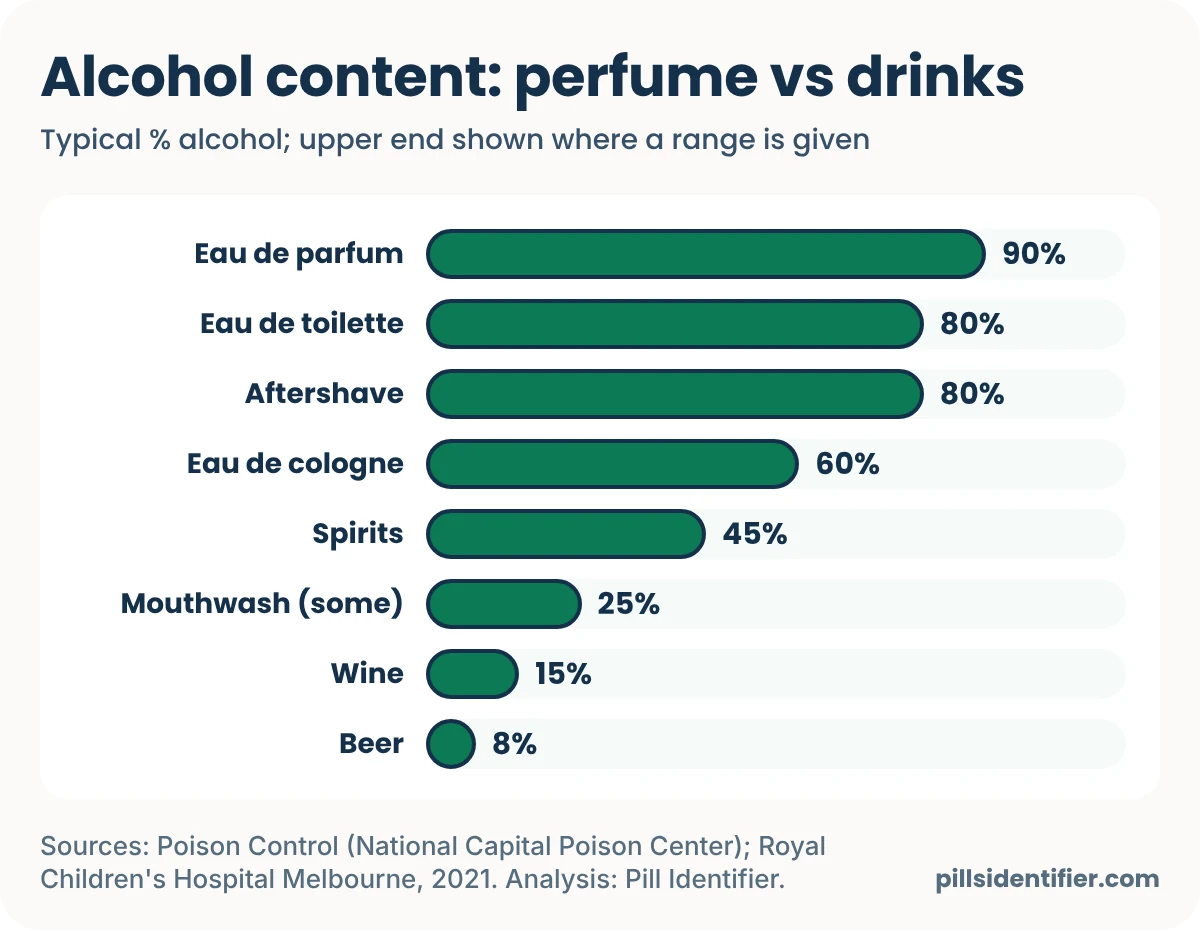
How we did this: On October 9, 2026, we compared Poison Control’s typical alcohol figures for each fragrance type with the approximate levels in the Royal Children’s Hospital Melbourne ethanol poisoning guideline (updated April 2021). Poison Control doesn’t say whether its figures cover the whole bottle or only the alcohol and water base, so treat them as approximate.
By the numbers: cosmetics and personal care poisonings in young children
Categories and age groups differ by country, so compare the patterns rather than the totals.
| Country | Data source (year) | Age group | Cases | How it compares |
|---|---|---|---|---|
| United States | NPDS annual report, America’s Poison Centers (2024) | 5 and under | 78,721 cosmetics and personal care cases (9.1%) | 3rd, after household cleaners (87,031) and pain relievers (78,993) |
| Puerto Rico | No separate figure found | Not available | Not available | Not available |
| Canada | Pan-Canadian Poison Centres Annual Report (2022) | 0 to 12 | 6,541 cosmetics and personal care cases (9.4%) | 3rd, after pain relievers (10,796) and household cleaners (8,374) |
| Australia | ACCC analysis of NSW Poisons Information Centre calls (June 2014 to May 2015) | 1 to 4 | 240 perfume, cologne or aftershave exposures | Hand sanitizer: 548 exposures |
| India | No national figure found | Not available | Not available | The AIIMS National Poisons Information Centre (set up in 1995) publishes no call data on its site |
How we did this: On October 9, 2026, we opened the most recent national or large regional poison centre report we could find for each country and took its figures for cosmetics, personal care or fragrance products in young children.
- It’s mainly a young child’s problem. In the US in 2024, cosmetics and personal care products were about 2% of substances in adult poison exposures, compared with 9.1% for children 5 and under.
- Almost as common as pain relievers. US poison centers logged just 272 fewer cosmetics cases than pain reliever cases in young children (our calculation).
How can you keep perfume away from children?
- Store fragrances out of children’s reach, as Poison Control advises, along with aftershave, mouthwash and hand sanitizer.
- Don’t spray perfume in front of young children, who may copy you later.
- Teach any child who wears fragrance never to put it on alone.
If a child got into a bathroom or bedroom cabinet, check whether any medicines were within reach too. If you find loose pills, our pill imprint search can help you tell Poison Control what they might be. Learn more in what is an overdose.
Common questions
Can perfume get you drunk?
Yes, if it’s swallowed. Poison Control lists typical alcohol levels of 60% to 90% or more, which is stronger than spirits, and says the main danger is alcohol poisoning. In children it can cause drowsiness, slow breathing, seizures and low blood sugar, so call Poison Control if anyone drinks perfume.
What happens if a child drinks a little perfume?
The Ontario Poison Centre says a taste-sized amount won’t make a child drunk, but you often can’t tell how much was swallowed. Don’t make them vomit. Call 1-800-222-1222 in the US, or your local poison centre, even if the child seems fine.
Can smelling perfume give you a headache?
It can for some people. The FDA says people sensitive to certain fragrances may get a headache, cough, stuffy nose, chest tightness or wheezing from breathing them in, especially if they have asthma or allergies. This is a reaction, not an overdose.
What should you do if perfume gets in your eyes or on your skin?
For eyes, take out contact lenses and rinse gently with lukewarm water for 15 minutes, as Poison Control advises, then call a poison center. For skin irritation, wash with soap and water and stop using the product.
Is “Overdose” perfume dangerous?
No more than any other perfume worn as directed. In perfumery, “overdose” means a scent that pushes certain notes or ingredients higher than usual, as with Xerjoff’s Accento Overdose. Like all perfumes, it contains alcohol, so keep it away from children.