Can You Overdose On Vitamin D: Symptoms And Can You Take Too Much D3?
Too much vitamin D raises blood calcium. See the warning signs, what to do, IU to mcg conversions and how product strengths compare with official limits in five countries.
Yes, you can overdose on vitamin D, including vitamin D3. Taking too much, usually over a long time, raises the calcium in your blood (hypercalcemia), which can cause nausea, vomiting, weakness, confusion, extreme thirst and kidney damage. It almost always comes from high-dose supplements or product and prescribing errors, not from sunlight. The adult upper limit in the US and Canada is 4,000 IU (100 mcg) a day.
At a glance
- Too much vitamin D raises blood calcium, which can cause vomiting, muscle weakness, confusion, thirst and kidney stones, according to the NIH Office of Dietary Supplements.
- The adult upper limit is 4,000 IU (100 mcg) a day in the US, Puerto Rico, Canada and India, and 3,200 IU (80 mcg) in Australia (checked October 2026).
- One microgram (mcg) of vitamin D equals 40 IU, so a 60,000 IU sachet holds 1,500 mcg, which is 15 times the US, Canadian and Indian adult daily limit.
- Canada requires a prescription for oral vitamin D above 2,500 IU per dose, and Australia for products above 1,000 IU per daily dose, except pharmacist-only weekly doses of up to 7,000 IU (checked October 2026).
- In a 2019 study of 32 people treated for vitamin D toxicity in Srinagar, India, all had received repeated vitamin D3 injections, and their high calcium took a median of 7 months to settle.
- About 3.2% of US adults took supplements with 4,000 IU or more of vitamin D in 2013 to 2014, according to the NIH.
What are the symptoms of a vitamin D overdose?
The symptoms come from too much calcium in the blood, not from the vitamin itself. Early signs can be vague, so tell your doctor about every supplement you take.
Common signs
- Nausea, vomiting and loss of appetite
- Constipation
- Feeling very thirsty and passing a lot of urine
- Tiredness, muscle weakness, aches and stiffness
- Confusion or changes in mood and thinking
- Weight loss
- High blood pressure
Serious problems
Over time, high calcium can cause dehydration, kidney stones and kidney damage. In severe cases, the NIH lists kidney failure, calcium deposits in soft tissues throughout the body, heart rhythm problems and even death. The MedlinePlus page on hypervitaminosis D says recovery is expected, but permanent kidney damage can occur.
For warning signs that apply to any substance, see signs of an overdose.
What causes vitamin D toxicity?
The NIH Office of Dietary Supplements says vitamin D toxicity “is almost always a result of excessive intakes of vitamin D through supplements.” Reported cases involve supplements taken in excess, products with too much vitamin D because of manufacturing errors, and vitamin D that doctors prescribed incorrectly. Repeated high-dose injections are another cause, as the Indian study below shows.
Sunlight is not the problem. According to the NIH, experts “do not believe that excessive sun exposure results in vitamin D toxicity.”
Can you overdose on vitamin D3?
Yes. Vitamin D3 (cholecalciferol) and vitamin D2 (ergocalciferol) are the two main forms in supplements, and too much of either raises blood calcium. D3 is not a “safer” form in large amounts.
The NIH says vitamin D3 raises blood levels of vitamin D “to a greater extent than vitamin D2” and keeps them higher for longer. The US label for Drisdol, a prescription vitamin D2 capsule, warns in capital letters that the range between a treatment dose and a harmful one is narrow.
How much vitamin D is too much?
Health authorities set a tolerable upper limit (UL): the most you can take every day, from all sources, without a likely risk of harm. It is a ceiling, not a target. If a doctor prescribes more, follow their plan and keep any follow-up blood tests.
| Country | IU per day | mcg per day | Set by |
|---|---|---|---|
| US and Puerto Rico | 4,000 | 100 | NIH Office of Dietary Supplements |
| Canada | 4,000 | 100 | Health Canada |
| Australia | 3,200 | 80 | NHMRC |
| India | 4,000 | 100 | ICMR-NIN (2020) |
Children’s limits are lower. In the US, they are 1,000 IU (25 mcg) for babies up to 6 months, 1,500 IU (38 mcg) for 7 to 12 months, 2,500 IU (63 mcg) for ages 1 to 3 and 3,000 IU (75 mcg) for ages 4 to 8. Canada uses the same limits for ages 1 to 8. From age 9, the US limit is the adult 4,000 IU.
IU and mcg: how to read a vitamin D label
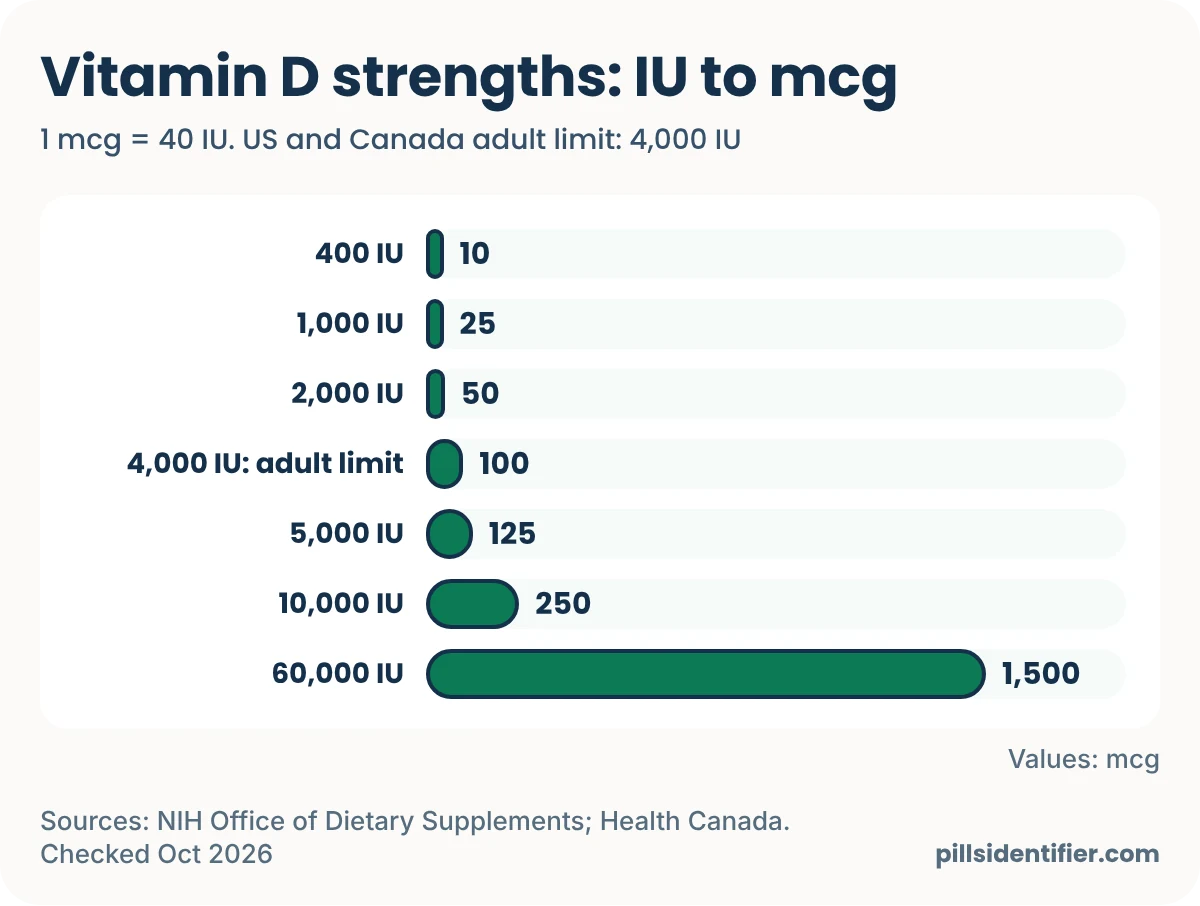
Labels list vitamin D in international units (IU), micrograms (mcg or µg), or both. 1 mcg equals 40 IU, so divide IU by 40 to get mcg.
| Strength (IU) | Micrograms (mcg) | Share of the US and Canada adult daily limit |
|---|---|---|
| 400 IU | 10 mcg | 10% |
| 1,000 IU | 25 mcg | 25% |
| 2,000 IU | 50 mcg | 50% |
| 4,000 IU | 100 mcg | 100% (the limit) |
| 5,000 IU | 125 mcg | 125% |
| 10,000 IU | 250 mcg | 250% |
| 50,000 IU | 1,250 mcg | 1,250% |
| 60,000 IU | 1,500 mcg | 1,500% |
Some labels use milligrams: 1.25 mg is the same as 50,000 IU. Weekly products pack several days’ worth into one dose, so check how often a product is meant to be taken.
Our analysis: vitamin D strengths vs limits in 5 countries
Method: In October 2026 we checked each country’s official adult upper limit (NIH, Health Canada, NHMRC and ICMR-NIN) against its rules for selling vitamin D (Health Canada’s ingredient database, Australia’s Poisons Standard as published by the TGA, and US labels on DailyMed), plus a published survey of the Indian market.
| Country | Adult daily limit | Most you can buy without a prescription | Higher-strength example |
|---|---|---|---|
| US | 4,000 IU (100 mcg) | No national rule found | 50,000 IU vitamin D2 capsules, prescription only |
| Puerto Rico | 4,000 IU (100 mcg) | Same federal rules as the US | Same as the US |
| Canada | 4,000 IU (100 mcg) | 2,500 IU (62.5 mcg) per dose | Anything above 2,500 IU per dose needs a prescription |
| Australia | 3,200 IU (80 mcg) | 1,000 IU (25 mcg) per daily dose; weekly doses up to 7,000 IU (175 mcg) from a pharmacist | Anything stronger needs a prescription |
| India | 4,000 IU (100 mcg) | No national rule found | 60,000 IU D3, mostly sachets taken weekly (2016 survey) |
What we found
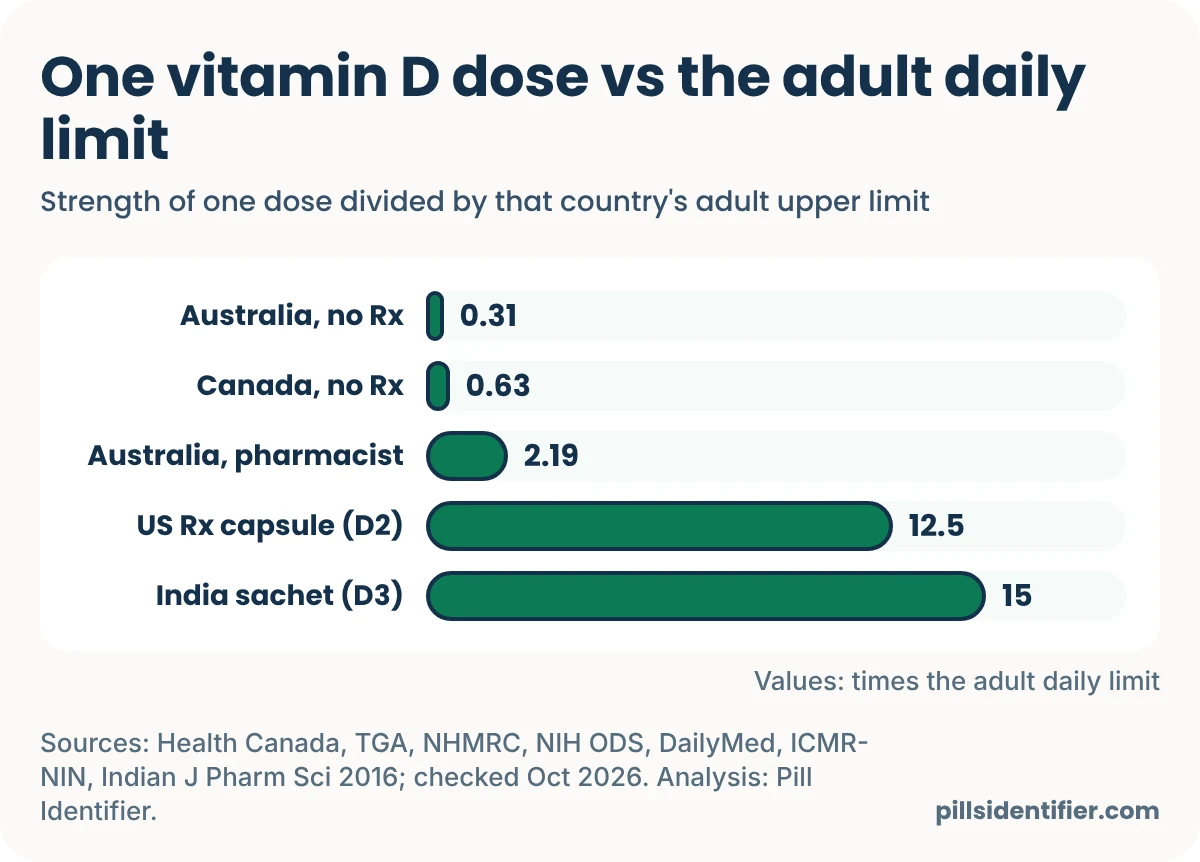
- Canada and Australia keep non-prescription daily doses under their own limits. Canada caps them at 2,500 IU and Australia at 1,000 IU.
- Australia is the strictest, with an adult limit 20% lower than the other countries.
- We found no national cap on supplement strength in the US or India.
- One dose of the most common Indian D3 strength, 60,000 IU, holds 15 times the adult daily limit. A US prescription 50,000 IU capsule holds 12.5 times.
A product made for one country can be over another country’s limit. For limits on other vitamins, see can you overdose on vitamins.
What does Indian research show about vitamin D toxicity?
A 2016 survey in the Indian Journal of Pharmaceutical Sciences counted 258 vitamin D products on the Indian market. Most of the D3 (cholecalciferol) products contained 60,000 IU, often as granules in sachets given weekly.
About 9 in 10 products in that survey contained calcitriol or alfacalcidol, active forms of vitamin D, including in calcium tablets. The authors warned that calcitriol is linked to a high rate of hypercalcemia and that “blanket prescription” of these supplements for long periods should stop.
A 2019 study in the Indian Journal of Endocrinology and Metabolism followed 32 people treated for vitamin D toxicity over 3 years at a hospital in Srinagar, Kashmir. All had received repeated vitamin D3 injections, and 78% had signs of reduced kidney function. Their high calcium took a median of 7 months to return to normal, and up to 18 months. The authors called vitamin D toxicity “an increasingly common cause” of high calcium with symptoms.
If you take a 60,000 IU product, ask your doctor how often to take it, when to stop and when to recheck your levels.
Who is most at risk?
- People taking high-strength products or injections with no plan to stop or retest.
- People taking several products with vitamin D, such as a multivitamin, a calcium-plus-D tablet and a separate D3.
- Young children, who have lower limits. The CDC warns that supplements in gummy form can look like candy.
- People taking calcitriol, an active form of vitamin D that needs calcium checks.
- People with granulomatous disorders, some lymphomas or rare inherited conditions such as Williams syndrome, according to a 2018 review in Frontiers in Endocrinology.
How is vitamin D toxicity tested?
A blood test for 25-hydroxyvitamin D, written 25(OH)D, is the main measure of vitamin D in your body. MedlinePlus says it is a routine blood draw from your arm and that routine testing “is not recommended for everyone.” If toxicity is suspected, doctors also check calcium in the blood and urine, phosphorus and parathyroid hormone, which is low when too much vitamin D is the cause. They may also take x-rays.
| Level in nmol/L | Level in ng/mL | What it means |
|---|---|---|
| Under 30 | Under 12 | Deficient |
| 30 to under 50 | 12 to under 20 | Generally too low for bone and overall health |
| 50 or more | 20 or more | Generally enough for bone and overall health |
| Over 125 | Over 50 | Linked to possible harm, especially over 150 nmol/L (60 ng/mL) |
1 ng/mL equals 2.5 nmol/L. Ask your doctor what your result means for you.
What should you do if you took too much vitamin D?
- Call emergency services if the person has collapsed, is very confused, has trouble breathing or can’t be woken.
- Call poison control now if a child swallowed vitamin D or someone took a lot at once, even if they seem fine. Have the bottle ready.
- If you’ve been taking high doses and feel unwell, stop the vitamin D and see a doctor the same day.
- Bring every product you take, including multivitamins and calcium tablets, so the doctor can add up your total.
- Don’t make anyone vomit unless poison control or a health professional tells you to.
What happens in the hospital?
Doctors test blood and urine calcium, phosphorus and vitamin D levels. According to the MSD Manual, treatment means stopping vitamin D, cutting back calcium in the diet and giving fluids through a drip. In severe cases, doctors may add medicines that lower calcium, such as corticosteroids or bisphosphonates. The manual notes that kidney damage, if present, may not be reversible.
How long does it take to recover?
Recovery can take months. Vitamin D is a fat-soluble vitamin that the body stores, and the US label for prescription vitamin D2 says its effects “can persist for two or more months” after the last dose.
Is that capsule vitamin D?
In the US, Drisdol (ergocalciferol) 50,000 IU capsules are green and oval, with “E 50” printed on one side, according to their DailyMed label. To check a tablet or capsule, use our pill imprint search or see pictures of ergocalciferol capsules. If it has no markings, read pills with no imprint. If a child may have swallowed one, call poison control first and identify it later.
How can you take vitamin D safely?
- Add up every source. Count the vitamin D in multivitamins, calcium tablets and separate supplements.
- Check how often to take it. Some products are meant to be taken daily and others weekly.
- Stay at or under your country’s limit unless your doctor tells you otherwise.
- Buy from licensed sources, as MedlinePlus advises.
- Store vitamins up high and out of children’s sight.
Multivitamins with iron carry a more urgent danger for young children: see iron overdose. For other single vitamins, read can you overdose on vitamin C and vitamin B12 overdose.
Common questions
How long does vitamin D toxicity last?
It can last weeks to months. In a 2019 Indian study, high calcium took a median of 7 months to settle. Most people recover, but kidney damage can be permanent.
Is 5,000 IU of vitamin D3 a day too much?
5,000 IU (125 mcg) is above the adult upper limit of 4,000 IU a day in the US, Canada and India, and 3,200 IU in Australia. In Canada, a dose that strong needs a prescription. Take it only if your doctor recommends it and checks your blood levels.
Can you take 60,000 IU of vitamin D3 every day?
Not unless a doctor specifically tells you to. Products with 60,000 IU are usually taken once a week, and one dose holds 15 times the 4,000 IU daily adult limit. Take them only as your doctor prescribes.
Can you get too much vitamin D from the sun?
No. The NIH Office of Dietary Supplements says experts do not believe that too much sun exposure causes vitamin D toxicity. Almost all cases come from supplements.
Can a child overdose on vitamin D gummies or drops?
Yes. Children have lower limits than adults, and the CDC warns that gummy supplements can look like candy. If a child ate adult vitamin D or got extra drops, call poison control right away, even if they seem fine.