Vitamin B12 overdose: symptoms and is too much harmful?
Why a true B12 overdose is unlikely, the side effects high doses and injections can cause, how little of a big dose you absorb, and what a high B12 blood test can mean.
A true vitamin B12 overdose is very unlikely. B12 has such a low potential for harm that no official upper limit is set in the US, Canada, Australia, India or the EU. High doses and injections can still cause side effects, such as acne-like breakouts, diarrhea, itching and, rarely, a serious allergic reaction to an injection.
At a glance
- The NIH Office of Dietary Supplements says experts set no upper limit for vitamin B12 “because of its low potential for toxicity.”
- Adults need 2.4 mcg of B12 a day in the US, Canada and Australia, and India’s ICMR-NIN set 2.2 mcg in 2020.
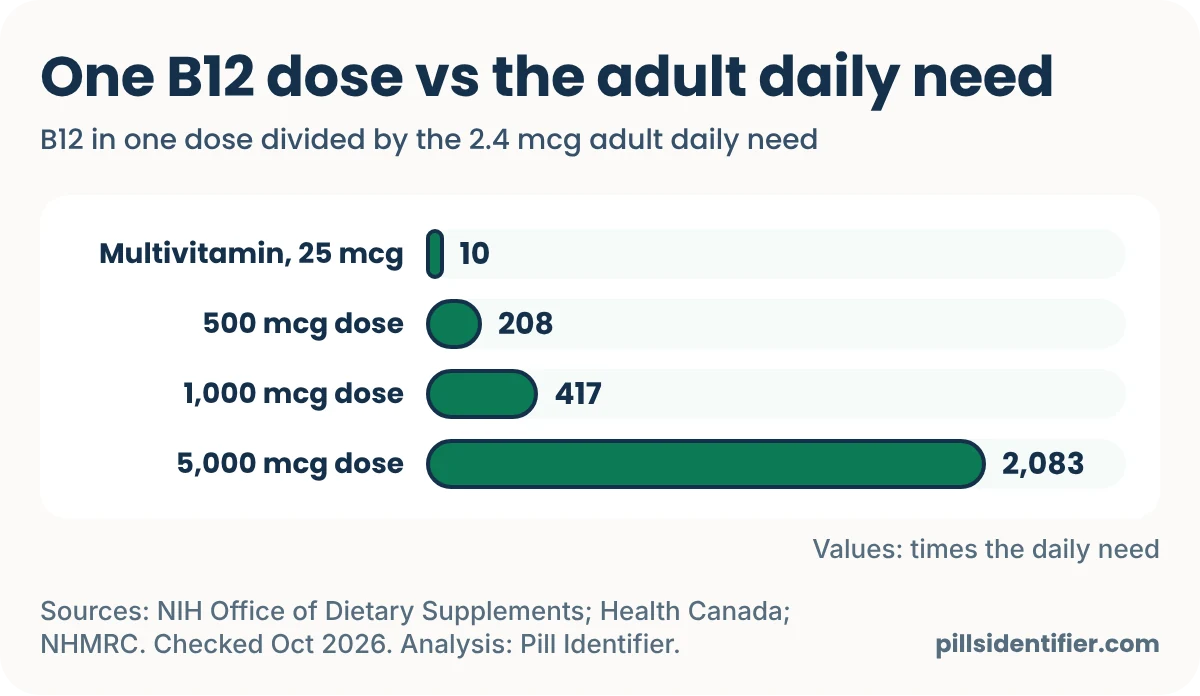
- A 1,000 mcg tablet holds about 417 times the adult daily need, but the NIH says only about 1.3% of a dose that size is absorbed, roughly 13 mcg.
- Case reports link high-dose B12 to acne-like breakouts that usually clear 2 to 3 weeks after stopping, according to a 2020 review in Dermatology Online Journal.
- A high B12 blood level in someone who doesn’t take supplements can be a sign of liver disease or certain blood disorders, according to MedlinePlus.
What are the symptoms of too much B12?
There is no recognized set of B12 overdose symptoms, and the US injection label says no overdose has been reported. The problems on record are side effects, described in case reports and drug labels.
Acne-like breakouts and rosacea flares
A 2020 review in Dermatology Online Journal describes breakouts after B12 injections or high-dose B6 and B12 pills, usually many small, similar red bumps and pus spots on the face. Most cleared within 2 to 3 weeks of stopping. A separate case report linked a sudden, severe form of rosacea (rosacea fulminans) to high-dose vitamins B6 and B12.
Side effects of B12 injections
The US cyanocobalamin injection label lists mild diarrhea that passes, itching, a short-lived rash and a feeling that the whole body is swollen. It also warns that “anaphylactic shock and death have been reported” after injected B12, though this is rare. MedlinePlus says to call a doctor right away for hives, rash, itching or trouble breathing or swallowing.
The label also lists fluid in the lungs and heart failure early in treatment, and low potassium when severe megaloblastic anemia is treated intensively. People sensitive to cobalt or B12 shouldn’t use it, and people with early Leber’s disease, an inherited eye condition, had fast, severe optic nerve damage after cyanocobalamin.
Why is there no upper limit for B12?
The NIH says B12 “is generally considered to be safe, even at high doses” because the body does not store the excess. Australia’s NHMRC says no adverse effects have been linked to excess B12 from food or supplements in healthy people. Extra B12 is usually removed in the urine.
“No limit” means experts found too little evidence of harm to set a number, not that more is better. B-complex and multivitamin products also contain nutrients that do have limits, such as vitamin B6 and vitamin D (see can you overdose on vitamins and vitamin D overdose).
Our analysis: B12 doses vs what you need and absorb
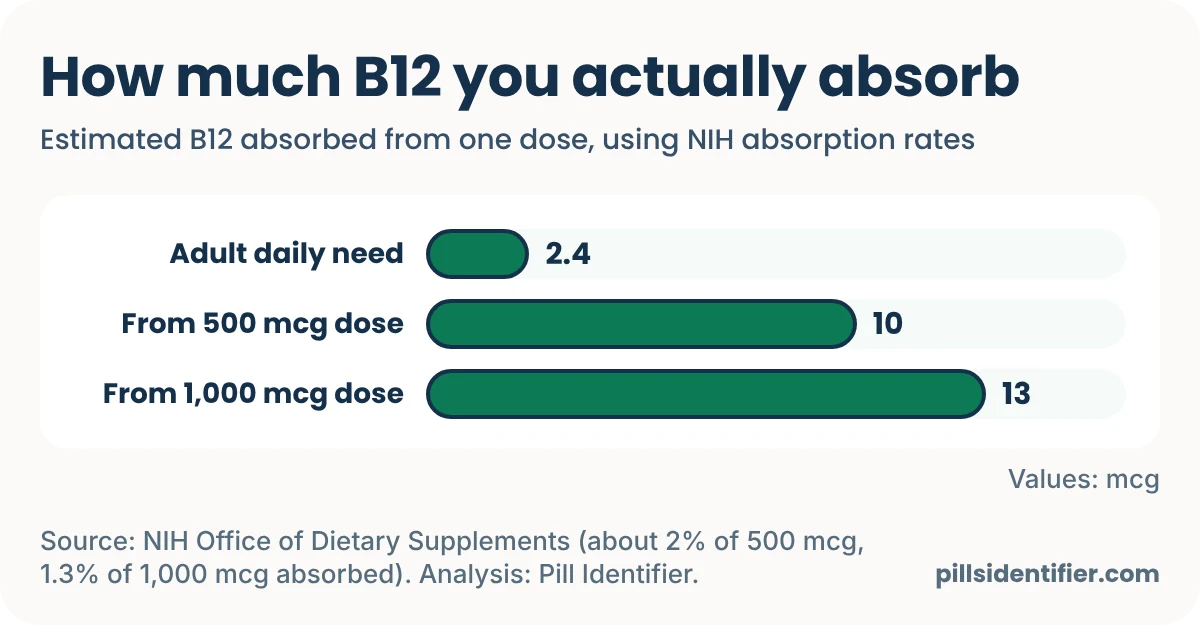
Method: We compared the typical B12 amounts in supplements, as listed by the NIH Office of Dietary Supplements, with the adult daily need of 2.4 mcg, and applied the NIH’s published absorption rates (checked October 2026; multiples rounded).
| Product type | B12 per dose | Times the daily need | About how much is absorbed |
|---|---|---|---|
| Multivitamin | 5 to 25 mcg | About 2 to 10 times | No NIH figure |
| B-complex | 50 to 500 mcg | 21 to 208 times | No NIH figure |
| B12-only, 500 mcg | 500 mcg | 208 times | About 2% (roughly 10 mcg) |
| B12-only, 1,000 mcg | 1,000 mcg | 417 times | About 1.3% (roughly 13 mcg) |
| High-strength, 5,000 mcg | 5,000 mcg | 2,083 times | No NIH figure |
What we found
- Absorption drops sharply above 1 to 2 mcg, once intrinsic factor, the protein that carries B12 to be absorbed, is full.
- Doubling a tablet from 500 to 1,000 mcg raises the absorbed amount only from about 10 to 13 mcg, which is still about 5 times the daily need.
Does any country set an upper limit for B12?
No. We checked each health body’s official reference values in October 2026.
| Region | Adult daily need | Upper limit | Set by |
|---|---|---|---|
| US and Puerto Rico | 2.4 mcg | None set | NIH (Food and Nutrition Board) |
| Canada | 2.4 mcg | None set | Health Canada |
| Australia and NZ | 2.4 mcg | None set | NHMRC |
| India | 2.2 mcg (2020) | None listed | ICMR-NIN |
| EU | 4 mcg | None set | EFSA |
The need rises to 2.6 mcg in pregnancy and 2.8 mcg while breastfeeding in the US, Canada and Australia.
Are B12 injections or methylcobalamin better?
Not necessarily. The NIH says there is no evidence that absorption differs by form, and that injections, which skip the gut, are mainly for people who can’t absorb B12, such as those with pernicious anemia.
In India, methylcobalamin is sold as injections, tablets and under-the-tongue forms, alone or with other B vitamins, and its tablets are easier to find than cyanocobalamin tablets, according to a 2017 article in the Journal of Pharmacology and Pharmacotherapeutics. The authors called the controlled trial evidence for it “scanty.” A 2021 review in the Indian Journal of Medical Research found vitamins make up about 24 to 25% of prescribed drugs in parts of India.
In Ontario, Canada, a 2019 JAMA Internal Medicine study found that 63.7% of 146,850 people aged 65 and older given B12 injections from 2011 to 2015 had a normal B12 level or no recent test. The authors note that B12 pills raise levels as well as injections, if not better.
What does a high B12 blood level mean?
MedlinePlus gives a normal range of 299 to 1,054 pg/mL (219 to 773 pmol/L) and says a high level is uncommon. Supplements and injections raise it. If you don’t take B12, a high result can be linked to liver disease, such as cirrhosis or hepatitis, or to bone marrow disorders such as polycythemia vera and chronic myelogenous leukemia. Tell your doctor what you take, and ask whether you need more tests.
What should you do if you took too much B12?
- Call emergency services if the person has collapsed, had a seizure, has trouble breathing or can’t be woken.
- Treat hives or trouble breathing or swallowing after an injection as an emergency.
- Otherwise, call poison control with the label in hand. Many B12 products also contain other ingredients, such as iron or vitamin B6.
- If someone took a lot of pills on purpose, get help right away, even if they say it was only vitamins. Other medicines may be involved.
- Don’t make anyone vomit unless poison control or a health professional tells you to.
If you get acne or a rash while taking a high dose every day, talk to your doctor or pharmacist. If you take B12 on your own, you can pause it; if it was prescribed for a deficiency, don’t stop without advice. For warning signs that apply to any substance, see signs of an overdose.
What happens in the hospital?
Hospital care focuses on any allergic reaction and on anything else that was swallowed. A multivitamin with iron is far more urgent for a young child: see iron overdose.
Who should be careful with B12?
- People allergic to cobalt or B12, or with Leber’s disease, before any injection.
- People taking B-complex products, which may also contain vitamin B6 or folic acid, nutrients that do have limits.
- People who may be low in B12, such as older adults, vegans, people who had weight-loss surgery and people taking metformin or acid-reducing medicines. Ask a doctor about testing rather than guessing a dose.
Is that tablet B12 or a medicine?
If a tablet has letters or numbers, check it with our pill imprint search. If it has no markings, read our guide to pills with no imprint. Metformin can lower B12 levels, and you can see pictures of metformin pills to confirm what you take. If a child may have swallowed something, call poison control first and identify it later.
Common questions
Can you overdose on B12 injections?
No overdose has been reported, according to the US cyanocobalamin injection label. Injections can still cause side effects, including diarrhea, itching and rash. Rarely, they cause a severe allergic reaction, which is an emergency.
Is 5,000 mcg of B12 a day too much?
No official upper limit exists, but that doesn’t make high doses necessary. A 5,000 mcg dose holds about 2,083 times the adult daily need, and the NIH says absorption falls sharply above 1 to 2 mcg. Ask your doctor whether you need that much, and tell them if you get acne or a rash.
Can too much B12 cause acne?
Yes, in some people. Case reports describe acne-like breakouts after B12 injections or high-dose pills. Most cleared within 2 to 3 weeks of stopping.
Can high B12 be a sign of cancer?
Sometimes. MedlinePlus says a high level can be linked to bone marrow disorders such as polycythemia vera and chronic myelogenous leukemia, or to liver disease. B12 supplements and injections also raise blood levels, so tell your doctor what you take and ask what your result means.