Can You Overdose On Vitamins? Safe upper limits by country
Which vitamins and minerals can build up to harmful levels, the warning signs, what to do, and how official daily upper limits differ across five regions.
Yes, you can overdose on vitamins, usually from supplements rather than food. Minerals like iron pose the most serious risk, especially for young children. Vitamins A and D, which the body stores, can build up to harmful levels, and very high doses of vitamin B6, niacin or vitamin C can also cause harm. If someone took too much, call poison control now, even if they seem fine.
At a glance
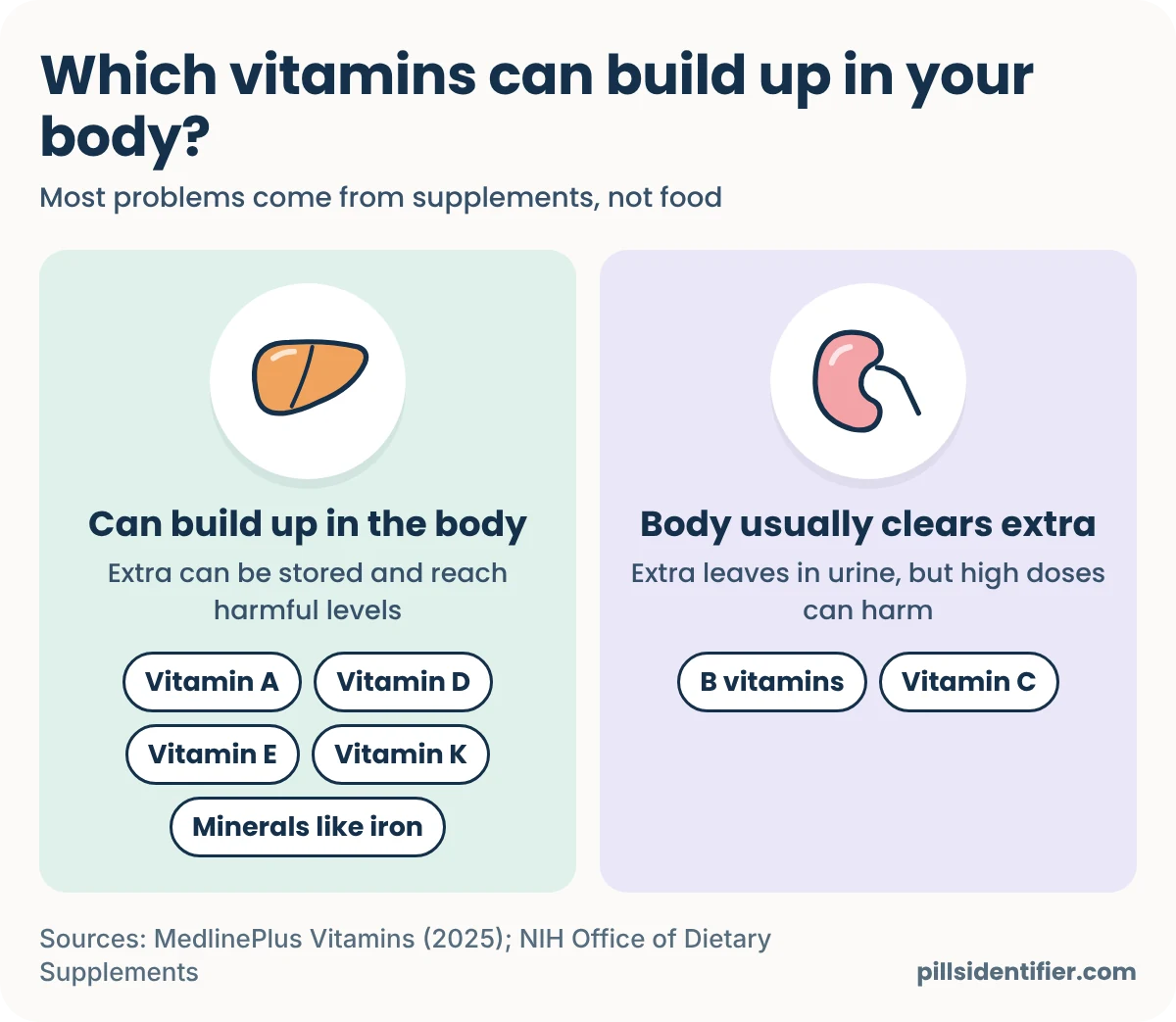
- Vitamins A, D, E and K are stored in the liver, fatty tissue and muscles, while extra B vitamins and vitamin C mostly leave the body in urine, according to MedlinePlus (reviewed January 2025).
- Under an FDA rule, US iron supplement labels must warn that accidental overdose of iron-containing products “is a leading cause of fatal poisoning in children under 6.”
- US poison centers recorded 40,343 vitamin exposures in children aged 5 and younger in 2024, the 7th most common type of substance in that age group, according to the National Capital Poison Center.
- The upper limit for vitamin D for adults is 4,000 IU (100 mcg) a day in the US, Canada and India, but 3,200 IU (80 mcg) in Australia.
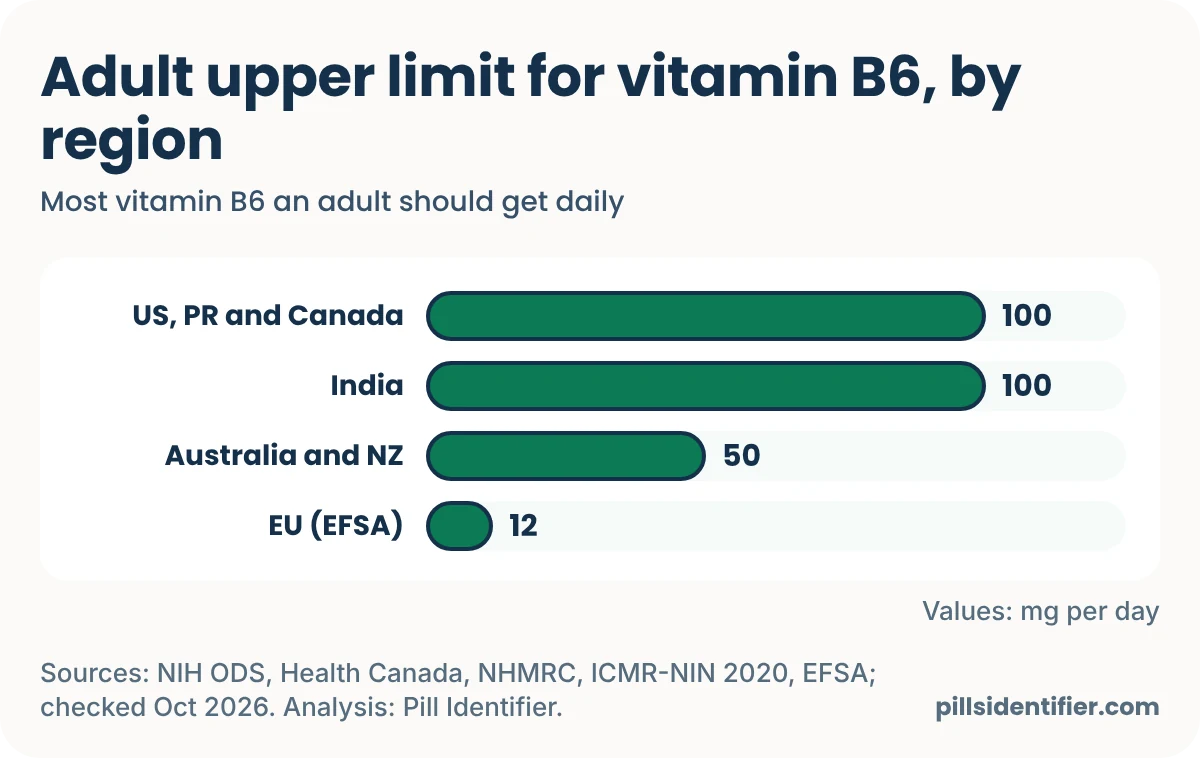
- For vitamin B6, the EU’s adult upper limit of 12 mg a day is about one-eighth of the 100 mg limit used in the US, Canada and India (checked October 2026).
- Australia’s medicines regulator, the TGA, had 250 reports of nerve damage (peripheral neuropathy) involving vitamin B6 products as of October 31, 2025, and will tighten sales of higher-dose products from June 1, 2027.
Which vitamins can you overdose on?
It depends on how your body handles each one. In most cases, the problems come from supplements, not from ordinary food.
Fat-soluble vitamins (A, D, E and K) can build up
Your body keeps fat-soluble vitamins in the liver, fatty tissue and muscles. MedlinePlus warns: “Be very careful about taking large amounts of fat-soluble vitamin supplements. These can build up in your body and may cause harmful effects.” Vitamins A and D cause the most trouble. Vitamin K has not been shown to cause harm, but it matters a lot if you take the blood thinner warfarin (see our warfarin overdose guide).
Water-soluble vitamins (B and C) usually leave in urine
Vitamin C and the eight B vitamins are not stored, so leftovers leave the body through the urine. Vitamin B12 is the exception, stored in the liver for years, but it has such a low potential for harm that no region we checked sets an upper limit (see vitamin B12 overdose). Still, very high doses of vitamin B6 can damage nerves, high-dose niacin can harm the liver, and too much vitamin C can upset your stomach (see can you overdose on vitamin C).
Minerals: iron is the biggest danger
MedlinePlus says iron and calcium pose the most serious risk in a multivitamin overdose, with vitamins D and A also a concern. Iron is especially dangerous for children. Too much zinc can also cause sickness and, over time, low copper levels.
What are the symptoms of too many vitamins?
A multivitamin overdose often causes nausea, vomiting and diarrhea. MedlinePlus also lists confusion, seizures, fainting, heart rhythm problems, bone or joint pain, rash and sun sensitivity. Here are the main signs for each nutrient.
| Nutrient | Signs of too much | Longer-term or severe harm |
|---|---|---|
| Vitamin A | Severe headache, blurred vision, nausea, dizziness, muscle aches, poor coordination | Bone pain, skin peeling; birth defects if taken in pregnancy |
| Vitamin D | Nausea, vomiting, muscle weakness, loss of appetite, extreme thirst, passing a lot of urine | Kidney stones, kidney failure, heart rhythm problems |
| Vitamin E | Bleeding problems | Higher risk of stroke caused by bleeding |
| Vitamin B6 | Tingling, burning or numbness, usually in the hands or feet | Nerve damage with loss of balance; skin sores, sun sensitivity |
| Niacin | Flushing (red, burning, itchy skin), headache, rash, dizziness | Low blood pressure, high blood sugar, liver damage |
| Vitamin C | Diarrhea, nausea, stomach cramps | Kidney stones in some people; worse iron overload |
| Iron | Stomach pain, vomiting, diarrhea | Symptoms can fade, then return a day or more later; liver damage |
| Zinc | Nausea, vomiting, dizziness, headache, loss of appetite | Low copper, weaker immunity, lower “good” cholesterol |
For warning signs that apply to any substance, see signs of an overdose.
What is a safe upper limit for vitamins?
An upper limit (UL) is the most of a nutrient you can take every day for a long time without a likely risk of harm for almost everyone. Australia’s NHMRC defines it as the highest average daily intake “likely to pose no adverse health effects to almost all individuals.” It is a ceiling, not a goal. Most people need far less.
- Most limits count every source. The NIH Office of Dietary Supplements says vitamin A limits include food, drinks and supplements together.
- Some count only the added kind. For niacin, folic acid and (in Canada) vitamin E, the limit covers supplements and fortified foods.
- A doctor may prescribe more for a while, for example iron for low iron levels, but only under medical care.
Our analysis: upper limits compared in 5 regions
Official upper limits are not the same everywhere, so we compared them for nine common vitamins and minerals.
Method: We compared adult (age 19 and over) upper limits from the NIH Office of Dietary Supplements, Health Canada’s reference tables, Australia’s NHMRC Nutrient Reference Values, ICMR-NIN’s 2020 Nutrient Requirements for Indians and EFSA’s overview of upper limits, all checked in October 2026.
| Nutrient | US, Puerto Rico and Canada | Australia and NZ | India | EU (EFSA) |
|---|---|---|---|---|
| Vitamin A (retinol) | 3,000 mcg | 3,000 mcg | 3,000 mcg | 3,000 mcg |
| Vitamin D | 100 mcg (4,000 IU) | 80 mcg (3,200 IU) | 4,000 IU (100 mcg) | 100 mcg (4,000 IU) |
| Vitamin E | 1,000 mg (added forms) | 300 mg | None listed | 300 mg (under review) |
| Vitamin B6 | 100 mg | 50 mg (cut proposed) | 100 mg | 12 mg |
| Niacin (added nicotinic acid) | 35 mg | 35 mg | 35 mg | 10 mg |
| Folic acid | 1,000 mcg | 1,000 mcg | 1,000 mcg | 1,000 mcg |
| Vitamin C | 2,000 mg | Not set | 2,000 mg | Not set |
| Iron | 45 mg | 45 mg | 45 mg | Not set (safe level 40 mg) |
| Zinc | 40 mg | 40 mg | 40 mg | 25 mg |
| Vitamins K and B12 | Not set | Not set | None listed | Not set |
“Not set” means the body found too little evidence to set a limit. It does not mean any amount is safe. 1 mcg of vitamin D equals 40 IU. Puerto Rico follows the US values, and the US and Canadian limits match for every nutrient in this table.
What we found
- The regions agree on only 2 of 9 nutrients: vitamin A (3,000 mcg) and folic acid (1,000 mcg).
- Vitamin B6 shows the biggest gap. The EU’s 12 mg limit is about one-eighth of the 100 mg limit in North America and India. Australia’s 50 mg limit is half the US limit, and the NHMRC has consulted on lower B6 limits for all ages, to be finalized in 2027. Its draft report suggests adopting the EU’s 12 mg.
- Vitamin E limits differ more than threefold. Australia and the EU set 300 mg, less than a third of the US and Canadian 1,000 mg.
- Australia’s vitamin D limit is 20% lower than in the US, Canada, India and the EU.
- India set upper limits for the first time in 2020, partly because more foods are now fortified, according to ICMR-NIN.
A supplement made for one country can be over another country’s limit, so check labels against the limit where you live. For one vitamin in depth, see vitamin D overdose.
Why is iron so dangerous for children?
According to the NIH Office of Dietary Supplements, accidental swallowing of iron supplements caused about a third of reported child poisoning deaths in the US between 1983 and 1991. After the FDA required warning labels in 1997, only one child death from an iron tablet was reported from 1998 to 2002.
Prenatal vitamins carry the most iron of any multivitamin, while children’s gummy or chewable multivitamins usually contain little or none. The danger is that an iron overdose can seem to get better. MedlinePlus says symptoms “may go away in a few hours, then return again after 1 day or later,” and liver damage can follow days later. Get help right away, even if the child seems fine. Read more in our iron overdose guide.
Why do gummy vitamins worry poison centers?
The CDC warns that “many medicines and supplements, including those in gummy form, look like candy.” Every day in the US, about 100 young children go to emergency rooms after getting into medicines. Store vitamins up high and out of sight, relock the safety cap every time, and never call vitamins or medicine “candy.”
Can you take too much vitamin A while pregnant?
Yes. The NIH Office of Dietary Supplements says that taking too much preformed vitamin A while pregnant “can cause birth defects in your baby, including abnormal eyes, skull, lungs, and heart.” Australia’s NHMRC and the EU’s EFSA keep the same 3,000 mcg daily upper limit for preformed vitamin A in pregnancy as for other adults.
The limit covers preformed vitamin A (retinol). Beta-carotene does not cause the same problems. If you’re pregnant or planning to be, ask your doctor or pharmacist before adding any vitamin to a prenatal vitamin, and keep prenatal vitamins away from children because of their iron.
How do supplements and fortified foods add up?
It’s easy to get more than you think by stacking a multivitamin, a separate vitamin D or B6 supplement, fortified foods and medicines with the same nutrient. Australia’s TGA tells people to add up their B6 from all of these. Add up the amounts on each label, and talk to a pharmacist if the total is over your country’s limit.
What should you do if someone took too many vitamins?
- Call emergency services if the person has collapsed, had a seizure, has trouble breathing or can’t be woken.
- Otherwise, call poison control now, even if they seem fine. This matters most for iron, prenatal vitamins and slow-release products, where harm can be delayed.
- Have the bottle ready. MedlinePlus says to share the person’s age and weight, the product name and its ingredients and strength, when it was swallowed and how much.
- Don’t make them vomit unless poison control or a health professional tells you to.
- Stay with them. If they are drowsy but breathing, turn them on their side (the recovery position). Start CPR if they stop breathing and you are trained.
If you’ve been taking too much of a vitamin for weeks, stop the extra supplement and call your doctor or pharmacist.
What happens at the hospital?
Staff check breathing, heart rate, blood pressure and temperature, and may run blood and urine tests, an ECG or x-rays. Depending on what was taken, treatment can include activated charcoal, fluids through a drip, oxygen and, in severe cases, a breathing machine. For iron, doctors can give a medicine that removes iron from the blood. MedlinePlus says most iron and calcium overdoses do well with prompt care.
Who is most at risk?
- Young children, who can mistake gummies or iron tablets for candy.
- People who are pregnant, because of vitamin A and the iron in prenatal vitamins.
- People taking several supplements with the same nutrient.
- People with hemochromatosis (inherited iron overload), which high-dose vitamin C could make worse.
- People who take warfarin, who should keep their vitamin K intake about the same every day.
- People who smoke or used to smoke, who had a higher lung cancer risk in studies of high-dose beta-carotene.
How do vitamin rules differ by country?
| Place | Rule | Source |
|---|---|---|
| US and Puerto Rico | Iron products must warn that accidental overdose is a leading cause of fatal poisoning in children under 6 | FDA (via NIH ODS) |
| Australia | Products with more than 10 mg of B6 a day must warn about tingling, burning or numbness (since March 1, 2022). From June 1, 2027, products with over 50 mg per daily dose will need a pharmacist’s advice to buy. | TGA |
| India | Health supplements must keep nutrients within levels FSSAI sets. Where none is set, a “high” nutrient claim can’t exceed one day’s recommended amount (RDA). | FSSAI health supplement regulations, 2022 |
Found a tablet and not sure if it’s a vitamin?
A loose tablet could be a vitamin, an iron pill or a prescription medicine. Check markings with our pill imprint search, or try identify a pill by color and shape. If it has no markings, read our guide to pills with no imprint. You can also see pictures of ferrous sulfate iron tablets. If a child may have swallowed one, call poison control first and identify it later.
Common questions
Can you overdose on gummy vitamins?
Yes. The CDC warns that gummy supplements look like candy, so children may eat many at once. Children’s gummies usually contain little or no iron, but adult and prenatal gummies can be more dangerous. If a child ate vitamins that weren’t meant for them, call poison control right away.
What happens if you take too many vitamins in one day?
Often you get nausea, vomiting, diarrhea or stomach cramps. Products with iron are the main exception, because an iron overdose can be serious and the symptoms can fade and then return. Call poison control and have the bottle ready.
Which vitamins are the most dangerous in large amounts?
MedlinePlus names iron and calcium as the most serious risks in a multivitamin overdose, with vitamins A and D also a concern. Vitamins A and D are stored in the body, so too much can build up over time. High-dose vitamin B6 can damage nerves.
Is it safe to take a multivitamin every day?
MedlinePlus advises not taking more than 100% of the recommended daily amount (RDA) from supplements unless a health professional supervises you. Taking several products with the same nutrients makes it easier to go over the limit. A pharmacist can check your total.
Can too many vitamins damage your liver or kidneys?
Yes, some can. High-dose niacin, especially extended-release forms, can cause liver problems, and too much vitamin A can affect the liver. Too much vitamin D can cause kidney stones and kidney failure, and very high vitamin C intake is linked to kidney stones in some people.
How long does it take to recover from too many vitamins?
It depends on the vitamin and how much was taken. MedlinePlus says most people with vitamin A toxicity fully recover, and nerve symptoms from vitamin B6 usually stop if the supplement is stopped as soon as they appear. Iron poisoning needs urgent medical care, and MedlinePlus says recovery is likely if symptoms are gone 48 hours later.