Drawing based on the label description. No photo yet.
CRIXIVAN 400 mg pill
Pill with imprint CRIXIVAN 400 mg is white, capsule, 22 mm and has been identified as Indinavir Sulfate 400 mg. It is used for HIV. It is supplied by State of Florida Doh Central Pharmacy.
Indinavir Sulfate 400 mg
- Imprint
- CRIXIVAN 400 mg
- Strength
- 400 mg
- Used for
- HIV
- Color
- White
- Shape
- Capsule / oblong
- Size
- 22 mm
- Score
- No score line
- Form
- Capsule
- Manufacturer
- State of Florida Doh Central Pharmacy
- Drug class
- Antiviral (protease inhibitor)
- NDC
- 53808-0661, 0006-0573, 53808-0661-1, 21695-366, 21695-366-18, 16590-064, 16590-064-90
Source: the official drug label on DailyMed (US National Library of Medicine). Last checked .
Report a mistake
What is Indinavir Sulfate used for?
Indinavir Sulfate is used for HIV.
- Medicine type
- Antiviral (protease inhibitor)
Official uses from the US prescribing label
CRIXIVAN in combination with antiretroviral agents is indicated for the treatment of HIV infection.
This indication is based on two clinical trials of approximately 1 year duration that demonstrated: 1) a reduction in the risk of AIDS-defining illnesses or death; 2) a prolonged suppression of HIV RNA.
Description of Studies
In all clinical studies, with the exception of ACTG 320, the AMPLICOR HIV MONITOR assay was used to determine the level of circulating HIV RNA in serum. This is an experimental use of the assay. HIV RNA results should not be directly compared to results from other trials using different HIV RNA assays or using other sample sources.
Study ACTG 320 was a multicenter, randomized, double-blind clinical endpoint trial to compare the effect of CRIXIVAN in combination with zidovudine and lamivudine with that of zidovudine plus lamivudine on the progression to an AIDS-defining illness (ADI) or death. Patients were protease inhibitor and lamivudine naive and zidovudine experienced, with CD4 cell counts of ≤200 cells/mm3. The study enrolled 1156 HIV-infected patients (17% female, 28% Black, 18% Hispanic, mean age 39 years). The mean baseline CD4 cell count was 87 cells/mm3. The mean baseline HIV RNA was 4.95 log10 copies/mL (89,035 copies/mL). The study was terminated after a planned interim analysis, resulting in a median follow-up of 38 weeks and a maximum follow-up of 52 weeks. Results are shown in Table 4 and Figures 1 & 2.
Study 028, a double-blind, multicenter, randomized, clinical endpoint trial conducted in Brazil, compared the effects of CRIXIVAN plus zidovudine with those of CRIXIVAN alone or zidovudine alone on the progression to an ADI or death, and on surrogate marker responses. All patients were antiretroviral naive with CD4 cell counts of 50 to 250 cells/mm3. The study enrolled 996 HIV-1 seropositive patients [28% female, 11% Black, 1% Asian/Other, median age 33 years, mean baseline CD4 cell count of 152 cells/mm3, mean serum viral RNA of 4.44 log10 copies/mL (27,824 copies/mL)]. Treatment regimens containing zidovudine were modified in a blinded manner with the optional addition of lamivudine (median time: week 40). The median length of follow-up was 56 weeks with a maximum of 97 weeks. The study was terminated after a planned interim analysis, resulting in a median follow-up of 56 weeks and a maximum follow-up of 97 weeks. Results are shown in Table 5 and Figures 3 and 4.
Study 035 was a multicenter, randomized trial in 97 HIV-1 seropositive patients who were zidovudine-experienced (median exposure 30 months), protease-inhibitor- and lamivudine-naive, with mean baseline CD4 count 175 cells/mm3 and mean baseline serum viral RNA 4.62 log10 copies/mL (41,230 copies/mL). Comparisons included CRIXIVAN plus zidovudine plus lamivudine vs. CRIXIVAN alone vs. zidovudine plus lamivudine. After at least 24 weeks of randomized, double-blind therapy, patients were switched to open-label CRIXIVAN plus lamivudine plus zidovudine. Mean changes in log10 viral RNA in serum, the proportions of patients with viral RNA below 500 copies/mL in serum, and mean changes in CD4 cell counts, during 24 weeks of randomized, double-blinded therapy are summarized in Figures 5, 6, and 7, respectively. A limited number of patients remained on randomized, double-blind treatment for longer periods; based on this extended treatment experience, it appears that a greater number of subjects randomized to CRIXIVAN plus zidovudine plus lamivudine demonstrated HIV RNA levels below 500 copies/mL during one year of therapy as compared to those in other treatment groups.
Genotypic Resistance in Clinical Studies
Study 006 (10/15/93-10/12/94) was a dose-ranging study in which patients were initially treated with CRIXIVAN at a dose of <2.4 g/day followed by 2.4 g/day. Study 019 (6/23/94-4/10/95) was a randomized comparison of CRIXIVAN 600 mg every 6 hours, CRIXIVAN plus zidovudine, and zidovudine alone. Table 6 shows the incidence of genotypic resistance at 24 weeks in these studies.
From the FDA-approved label on DailyMed (published Jun 18, 2012).
Doctors sometimes prescribe a medicine for other reasons too. If you are not sure what yours is for, ask your pharmacist.
Is this your pill? Check every detail
- Your pill shows CRIXIVAN 400 mg. The parts can be split between the two sides, so turn the pill over and check both.
- It is white, capsule, 22 mm.
- Its score line and coating match the details on this page.
- It came from a pharmacy package that names the same drug.
Sold under the brand name Crixivan.
Ingredients
Active: Indinavir Sulfate
Inactive: Anhydrous Lactose, Magnesium Stearate, Gelatin, Titanium Dioxide, Silicon Dioxide, Sodium Lauryl Sulfate
Also distributed by
Rebel Distributors Corp, Stat Rx USA LLC
Pills that look similar but are different drugs
Same color and shape, different medicine. This is why the imprint matters.
-
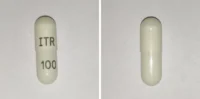 ITR 100
Itraconazole 100 mg
White, capsule, 23 mm
Used for vaginal yeast infections and nail fungus
-
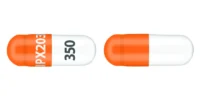 IPX203 350
Carbidopa and Levodopa 87.5 mg / 350 mg
Orange & white, capsule, 23 mm
Used for Parkinson's disease
-
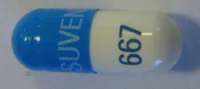 Suven 667
Calcium Acetate 667 mg
Blue & white, capsule, 22 mm
Used for osteoporosis (weak bones) and low calcium
-
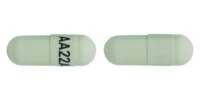 AA22A
Lenalidomide 25 mg
White, capsule, 22 mm
Used for multiple myeloma and mantle-cell lymphoma
-
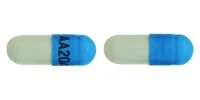 AA20A
Lenalidomide 15 mg
Blue & white, capsule, 22 mm
Used for multiple myeloma and mantle-cell lymphoma
-
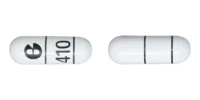 410 G
Propafenone Hydrochloride 425 mg
White, capsule, 23 mm
Used for atrial fibrillation (irregular heartbeat) and fast heartbeat (SVT)